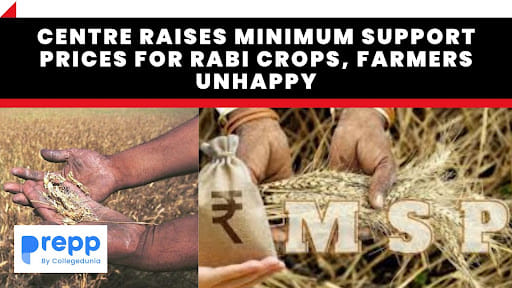
Centre Raises Minimum Support Prices For Rabi Crops, Farmers Unhappy
Relevance: GS3 - Issues related to direct and indirect farm subsidies and minimum support prices; Major crops-cropping patterns in various parts of the country
(Source: The Hindu, 10/19/2023)
Click here for Daily Current Affairs
Why in the news?
- Recently, the Cabinet Committee on Economic Affairs raised the Minimum Support Price (MSP) for Rabi crops for FY 2024-25.
- Farmers’ organizations have criticized the increase, claiming it did not match the increase in input costs.
Table of Contents
What is the hiked MSP for rabi crops announced by the Union Government?
The Cabinet Committee on Economic Affairs raised the Minimum Support Price of rabi crops like wheat and lentils for the 2024-25 FY as follows:
| Crop | Hike Announced (₹ per quintal) | New MSP (₹ per quintal) |
|---|---|---|
| Wheat | 150 | 2,275 |
| Lentils (Masur) | 425 | 6,425 |
| Rapeseed | 200 | 5,650 |
| Mustard | 200 | 5,650 |
| Safflower | 150 | 5,800 |
| Barley | 115 | 1,850 |
| Gram | 105 | 5,440 |
Other announcements by the Centre
The Union government also announced the final estimated production of major crops during 2022-23.
| Crop | Production estimate |
|---|---|
| Rice | 1,357.55 lakh tonnes |
| Wheat | 1,105.54 lakh tonnes |
| Nutri and coarse cereals | 573.19 lakh tonnes |
| Maize | 380.85 lakh tonnes |
| Pulses | 60.58 lakh tonnes |
| Oilseeds | 413.55 lakh tonnes |
| Sugarcane | 4,905.33 lakh tonnes |
| Cotton | 336.60 lakh bales of 170 kg each |
| Jute | 93.92 lakh bales of 180 kg each |
How have agricultural groups responded?
- Farmers’ organizations have criticized the hike and claimed that it did not match the increase in input costs.
- The lack of significant increase in MSP and the increasing prices of fertilizers and diesel have led to a drop in agricultural production.
- Recommendation: Agricultural organizations suggested that the Government should have implemented the recommendations of the Swaminathan Committee report.
- Capital assets, rentals, and forgone interest on owned land should be included in the comprehensive cost calculation
- Critics have also claimed that the hike in MSP is meaningless when procurement is mostly left to private traders.
What is the Minimum Support Price?
- The Minimum Support Price (MSP) is a type of government intervention that is designed to protect farmers against sharp drops in commodity prices during good years.
- The concept of Minimum Support Price (MSPs) was first proposed in the 1960s.
- A report published by NABARD in 2019 found that the financial debt burden faced by farmer’s households in India exceeds ₹1 lakh.
- It refers to the price at which the government is obligated to purchase produce from farmers when the market price falls below the specified threshold.
- Objective:
- Baseline for market prices: Ensure that farmers obtain a specific minimum compensation to cover their cultivation expenses and generate profit.
- Maintenance of supply of essentials: Incentivize crop development and guarantee that India does not run short of staple food grains.
- Announcement: The Government of India sets the MSP for 23 commodities twice a year.
- It relies on the recommendations of the Commission for Agricultural Costs and Prices (CACP)
How is it calculated?
- The minimum support price (MSP) is determined at one-and-a-half times the expenses or production costs.
- This includes explicit costs such as expenses for seeds, fertilizers, pesticides, fuel, irrigation, labor, and leased-in land, and the estimated value of unpaid labor provided by family members.
- In 2015, the Shanta Kumar Committee report revealed that only 6% of agricultural households engaged in the practice of selling wheat and rice to the government at MSP.
Criticism
- Not comprehensive: Government procurement of agricultural produce at minimum support prices (MSPs) is not comprehensive and varies based on the specific crop and geographical location.
- No legal backing: MSPs lack legal underpinning, so farmers do not possess the legal entitlement to claim MSPs as a matter of right
- Distorted production patterns: Recent NSSO data reveals a shift in food consumption patterns from cereals to protein-rich foods, but production patterns have not changed correspondingly.
- Despite being the world's largest producer and consumer of pulses, India still imports 25% of its pulses.
- Open-ended procurement: The MSP scheme has led to government stockpiles doubling the buffer stock, PDS, and other schemes' requirements.
- Inflation: Since market prices are dictated by MSP, it leads to inflation in food commodities.
- Middlemen: A major concern with the MSP-based system is its dependence on middlemen, commission agents, and APMC (Agriculture Produce Marketing Committee) bureaucracy.
- Impact on system and environment: The MSP promotes intensive farming, and soil degradation, and discourages private investment.
- It also harms the environment, depletes water resources, and causes long-term crop production issues.
- Non-implementation of MSP and below-MSP-procurement of a large number of crops, has adversely affected crop diversification.
Significance of MSP hike
- An elevated MSP could lead to a rise in the remuneration of agricultural workers.
- It could augment the purchasing power and consequently enhance the economic conditions in rural areas.
- Increasing the MSP can inject financial resources into the rural sector to immunize the sector against slowing agricultural and rural growth.
Alternatives
- Providing farmers with remunerative prices for their produce.
- Allowing market forces to determine prices.
- Establish mechanisms to protect farmers from price fluctuations.
To learn more about the MSP, click the link.
Commission for Agricultural Costs and Prices (CACP)
|
(*Click this link to read prelims specific weekly current affairs articles)
FAQs
Question: What is an APMC?
Answer:
The Agricultural Produce Market Committee or APMC is the marketing board established by the state governments to eliminate the exploitation of farmers by middlemen. APMCs aim to develop an efficient marketing system, promote agri-processing and agricultural exports, and specify procedures to establish an effective agri-produce marketing infrastructure.
Question: What is the Cabinet Committee on Economic Affairs?
Answer:
It is a Cabinet committee headed by the Prime Minister of India and mandated to review economic conditions periodically. It takes decisions on matters such as economic activities of the government, price control, FDI, disinvestment, etc.
UPSC Mains Practice Question:
|
MCQs
Question: Consider the following statements:
- The Government of India provides a Minimum Support Price for niger (Guizotia abyssinica) seeds.
- Niger is cultivated as a Kharif crop.
- Some tribal people in India use niger seed oil for cooking.
How many of the above statements are correct? (UPSC CSE 2023)
(a) Only one
(b) Only two
(c) All three
(d) None of the above
Answer: (c) See the Explanation
- The Government of India provides a Minimum Support Price (MSP) for niger seeds. Hence statement 1 is correct.
- Niger, also known as Guizotia abyssinica, is primarily cultivated as a Kharif crop in India. Hence statement 2 is correct.
- Some Tribal communities use niger seed oil in their cooking practices, utilize the press cake remaining after oil extraction as livestock feed, and even consume the seeds themselves as a condiment. Hence statement 3 is correct.
- Niger seed oil possesses medicinal properties, leading to its high demand in commercial sectors such as cosmetics, perfumeries, and related industries.
Therefore, option (c) is the correct answer.
Question: Consider the following statements (UPSC CSE 2020)
- In the case of all cereals, pulses and oil seeds, the procurement at Minimum Support Price (MSP) is unlimited in any State/UT of India.
- In the case of cereals and pulses, the MSP is fixed in any State/UT at a level to which the market price will never rise.
Which of the statements given above is/are correct?
(a) 1 only
(b) 2 only
(c) Both 1 and 2
(d) Neither 1 nor 2
Answer: (d) See the Explanation
- The procurement of commodities at MSP is not unlimited in any State/UT of India. The government of India sets MSP for various crops every year, and the procurement is done up to a certain limit based on the production in that particular year. This limit is set by the government and varies from year to year. Moreover, the procurement is done only for the crops that are covered under the MSP regime. Not all crops are covered under the MSP regime. Hence statement 1 is incorrect.
- The MSP is not fixed at a level to which the market price will never rise.
- It is revised every year based on the prevailing market conditions and the market price of the crops can go higher than the MSP if the demand is high, and the supply is low. Hence statement 2 is incorrect.
Therefore, option (d) is the correct answer.
Question: The economic cost of food grains to the Food Corporation Of India is the Minimum Support Price and bonus (if any) paid to the farmers plus [2019-I]
(a) Transportation cost only
(b) Interest cost only
(c) Procurement incidentals and distribution costs
(d) Procurement incidentals and charges for godowns
Answer: (c) See the Explanation
The economic cost of food grains to the Food Corporation of India is the Minimum Support Price and bonus (if any) paid to the farmers plus procurement incidentals and distribution costs.
Therefore, option (c) is the correct answer.
Question: Consider the following: (UPSC CSE 2018)
- Areca nut
- Barley
- Coffee
- Finger millet
- Groundnut
- Sesamum
- Turmeric
The Cabinet Committee on Economic Affairs, has announced the Minimum Support Price for which of the above?
(a) 1, 2, 3 and 7 only
(b) 2, 4, 5 and 6 only
(c) 1, 3, 4, 5 and 6 only
(d) 1, 2, 3, 4, 5, 6 and 7
Answer: (b) See the Explanation
The commodities covered under the MSP are
- CACP currently recommends MSPs for 23 commodities, including seven cereals (paddy, wheat, maize, sorghum, pearl millet, barley, and ragi), five pulses (gramme, tur, moong, urad, lentil), seven oilseeds (groundnut, rapeseed-mustard, soyabean, sesamum, sunflower, safflower, and niger seed), and four commercial crops (copra, sugarcane, cotton and raw jute).
Therefore, option (b) is the correct answer.
Download the PREPP App and attempt FREE IAS Exam Mock Tests and get complete study material!

Full Test - 04: UPSC CSE Prelims CSAT (Paper-II)
Full Test - 03: UPSC CSE Prelims CSAT (Paper-II)
UPSC CSE Prelims 2026 GS Paper 1 Question Paper (24-May-2026)
UPSC CSE Prelims 2026 CSAT Paper 2 Question Paper (24-May-2026)

17 February 2025 | The Hindu Must Read Articles | Current Affairs

16 February 2026 | The Hindu Must Read Articles | Current Affairs

13 February 2026 | The Hindu Must Read Articles | Current Affairs









Comments