Third Belt And Road Forum For International Cooperation
Relevance: GS2 - Groupings & Agreements Involving India and/or Affecting India's, Interests; GS3 - Infrastructure
(Source: The Hindu, 10/19/2023)
Click here for Daily Current Affairs
Why in the news?
Recently, the third Belt and Road Forum for International Cooperation was in Beijing, China, which marked the 10th anniversary of the Belt and Road Initiative (BRI).
Table of Contents
Brief Background of BRI
- The Belt and Road Initiative (BRI) is a global infrastructure and investment project announced by Chinese leader Xi Jinping in 2013.
- The Belt and Road Forum for International Cooperation was previously held in 2017 and 2019.
What is the Belt and Road Initiative (BRI)?
- The Belt and Road Initiative (BRI) is a comprehensive development strategy introduced in 2013 with the goal of bolstering worldwide connectivity and collaboration.
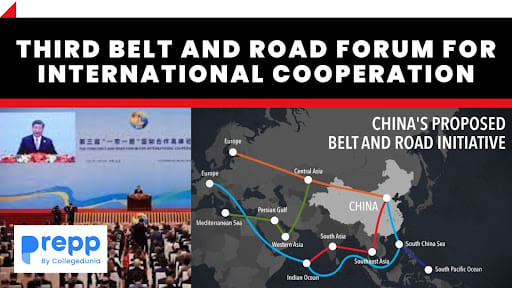
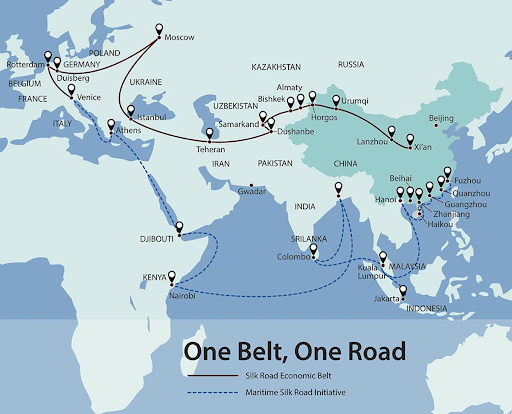
- This initiative seeks to establish extensive networks of land and sea routes connecting Southeast Asia, Central Asia, the Gulf region, Africa, and Europe.
- Originally named "One Belt, One Road," it was later rebranded as the Belt and Road Initiative to emphasize its open and inclusive nature, steering away from any perception of being dominated solely by China.
- The BRI consists of two key routes: the Silk Road Economic Belt and the Maritime Silk Road.
- Silk Road Economic Belt: This segment of the BRI is dedicated to improving connectivity, infrastructure, and trade links across Eurasia through a network of overland transportation routes.
- Maritime Silk Road: This component emphasizes maritime connections and cooperation in the form of ports, shipping routes, and maritime infrastructure projects. It begins via the South China Sea going towards Indo-China, South-East Asia and then around the Indian Ocean thus reaching Africa and Europe.
What are the objectives of BRI?
- The central objective of the BRI is to strengthen global connectivity through the improvement of infrastructure, facilitation of trade, and fostering economic collaboration.
- This initiative involves an extensive array of endeavors, spanning railways, ports, highways, and energy infrastructure, among others.
- The BRI is also linked to China's efforts to create new transport and trade routes to reduce dependency on the Strait of Malacca.
Challenges and Issues associated with BRI
- Ecological Damage: BRI projects have been criticized for causing environmental harm, such as deforestation, habitat destruction, and pollution. Ensuring that BRI projects are environmentally sustainable and consider the well-being of local communities is a challenge.
- Displacement of People: Some BRI projects have led to the displacement of local populations, raising concerns about their rights and well-being.
- Disputes over Payouts: Disagreements and disputes have arisen over payments and compensation related to BRI projects, leading to tensions and conflicts.The China-Pakistan Economic Corridor (CPEC) has experienced challenges, with reports suggesting that China benefits disproportionately from this initiative.
- For instance: A legislative report revealed that China claimed the majority of revenue (91%) from the Gwadar port, while Pakistan received a smaller share, which has raised concerns about equity in BRI projects.
- Labor Unrest: Instances of labor disputes, including disagreements over wages and working conditions, have been reported in connection with BRI ventures.
- In Indonesia, anxiety has emerged regarding the influx of Chinese laborers taking jobs meant for locals.
- Infrastructure and Debt Burden: Laos is facing challenges amidst its ambitious infrastructure projects, such as fast trains and dams on the Mekong River. These projects have left some residents without proper compensation and have caused droughts, negatively affecting local communities.
- Laos is also burdened by a substantial debt to China, accounting for approximately 65% of its GDP, with an estimated owed amount of $12.2 billion.
Global Alternatives to counter BRI
- United States-Japan Infrastructure Investment: During the Trump administration, US and Japan initiated discussions on creating alternatives to the BRI. They have been exploring opportunities for infrastructure investment in the Indo-Pacific region.
- Build Back Better World (B3W): The Biden administration introduced the Build Back Better World initiative, which aims to mobilize private capital for infrastructure projects in developing countries. While initially proposed as B3W, it appears to have been reorganized as the Partnership for Global Infrastructure and Investment, focusing on climate change, energy security, healthcare, digital technology, and gender equity.
- India-Middle East-Europe Corridor (IMEC): The G-20 Delhi summit introduced the concept of the India-Middle East-Europe Corridor, which seeks to connect India, West Asia, and Europe through railways, shipping lines, and other forms of infrastructure. This initiative also envisions trade connectivity, electricity, digital infrastructure, and a clean hydrogen export pipeline.
- Multilateral Development Banks: Existing international financial institutions, such as the World Bank and the Asian Development Bank, are expanding their efforts to support infrastructure development in the regions covered by the BRI.
What is India’s Stance on BRI?
- Sovereignty and Transparency Concerns: India firmly opposes the BRI due to concerns related to sovereignty and transparency.
- Boycott of BRI Summits: India notably boycotted the BRI summits in 2017 and 2019 hosted by China and refrained from endorsing the BRI joint statements within the Shanghai Cooperation Organisation (SCO).
- CPEC and Territorial Dispute: A major point of contention is the inclusion of the China-Pakistan Economic Corridor (CPEC) within the BRI, which passes through Pakistan-occupied Kashmir (PoK) – an area India claims as its own.
- Call for International Norms: India advocates that BRI projects must adhere to international norms, the rule of law, and ensure financial sustainability. It opposes the creation of debt traps and environmental or social risks for host countries.
- Promotion of Alternative Initiatives: India has instead been promoting alternative connectivity initiatives, such as the Partnership for Global Infrastructure and Investment (PGII), a G7 initiative aimed at funding infrastructure projects in developing nations.
(*Click this link to read prelims specific weekly current affairs articles)
FAQs
Question: What is BRI?
Answer:
The Belt and Road Initiative (BRI) is a comprehensive development strategy introduced in 2013 by China with the goal of bolstering worldwide connectivity and collaboration.
Question: What is the China-Pakistan Economic Corridor (CPEC)?
Answer:
CPEC is a 3,000-km infrastructure route linking China's Xinjiang region to Pakistan's Gwadar Port. It's a bilateral project between Pakistan and China focused on enhancing connectivity through highways, railways, pipelines, and infrastructure developments in Pakistan.
Question: What is India-Middle East-Europe Corridor (IMEC)?
Answer:
The India-Middle East-Europe Economic Corridor is a planned economic corridor that aims to bolster economic development by fostering connectivity and economic integration between Asia, the Persian Gulf and Europe.
UPSC Mains Practice Question:
|
MCQs
Question: Belt and Road Initiative’ is sometimes mentioned in the news in the context of the affairs of (UPSC 2016)
(a) African Union
(b) Brazil
(c) European Union
(d) China
Answer: (d) See the Explanation
The "Belt and Road Initiative" is primarily associated with China. This ambitious infrastructure and economic development project aims to enhance connectivity across Asia, Europe, and Africa through a network of railways, roads, ports, and other infrastructure.
Therefore, option (d) is the correct answer.
Download the PREPP App and attempt FREE IAS Exam Mock Tests and get complete study material!

Full Test - 04: UPSC CSE Prelims CSAT (Paper-II)
Full Test - 03: UPSC CSE Prelims CSAT (Paper-II)
UPSC CSE Prelims 2026 GS Paper 1 Question Paper (24-May-2026)
UPSC CSE Prelims 2026 CSAT Paper 2 Question Paper (24-May-2026)

17 February 2025 | The Hindu Must Read Articles | Current Affairs

16 February 2026 | The Hindu Must Read Articles | Current Affairs

13 February 2026 | The Hindu Must Read Articles | Current Affairs









Comments