What To Do With Spent Nuclear Fuel?
(Source: The Hindu, 08/30/2023)
Click here for Daily Current Affairs
Why in the news?
- Recently, the Fukushima Daiichi nuclear plant, damaged by an earthquake and tsunami in 2011, began to release treated radioactive water into the Pacific Ocean.
- This article discusses the various ways to dispose of the used nuclear fuel in a safe and controlled manner.
Table of Contents
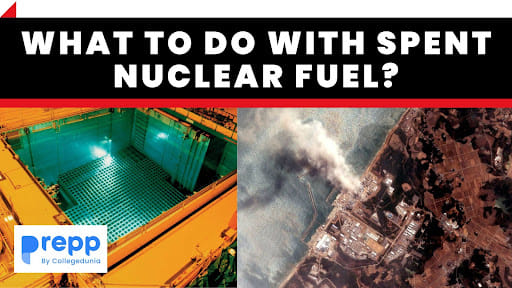
Nuclear fuel
- Nuclear energy is a viable alternative to carbon-based energy sources such as fossil fuels.
- It can contribute towards climate change mitigation.
- Presently only 10% of global energy production is from nuclear energy sources but countries are planning to increase the share of nuclear energy in power generation.
- This is because it is an efficient path in the transition to clean energy sources.
- The U.S.A., Switzerland, Spain, Sweden, and Finland are all planning to build new or update existing nuclear reactors, while India, China, and Russia are working on expanding their nuclear power projects.
To learn more about nuclear fuel, click the link.
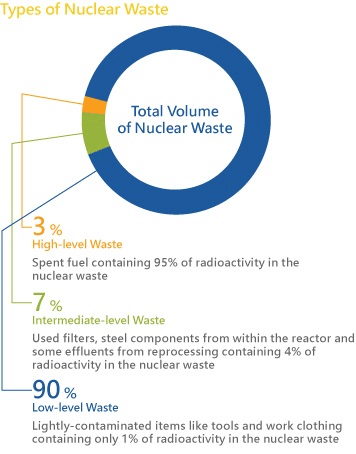
How can spent nuclear fuel be disposed of?
- Used nuclear fuel is kept in either wet or dry storage facilities, before being recycled or disposed of.
- When used fuel is taken out of a reactor, it is both hot and radioactive and requires storage in water to allow the fuel to cool.
- The fuel can be kept in wet storage, or transferred into a dry facility after a period of initial cooling.
- Keeping the used fuel in temporary storage to allow both the heat and radioactivity to diminish makes recycling and disposal easier.
For low-level waste
- The spent fuel can be stored in pools until they cool and in dry casks which can be buried in near-surface disposal facilities at ground level or below.
- Such facilities are generally equipped with a protective covering that is a few meters thick.
- The waste is then placed in vaults and backfilled with soil and clay.
- The volume is then covered with an impermeable material followed by topsoil.
- Such facilities are usually used for waste with low-level and intermediate-level radioactivity, i.e. those from an operating plant.
For high-level waste
- Deep geological disposal is considered to be the most feasible method to dispose of high-level waste.
- The Onkalo repository, Finland scheduled to open in 2025 will become the first facility to implement this method.
- It will use the Swedish KBS-3 concept in which there are three layers of protection.
- The waste is placed in copper canisters which are wrapped in bentonite clay and buried more than 400 metres below ancient bedrock.
- The repository also has safety measures called release barriers which are to keep the waste isolated from its surroundings.
- The facility will take 100-120 years to become full according to manufacturers, Posiva.
- Finland plans to leave the waste undisturbed for 100 millennia, while also studying how the site might change and how the safety measures evolve.
- E.g.: The tunnels where the waste is stored have already been checked to assess if they will be able to weather geological changes like an ice age or earthquakes.
Other methods
- Recycling: Although some countries like the U.S.A. treat used nuclear fuel as waste, approximately 97% of it could be used as fuel in certain types of reactors.
- However, recycling has largely focused on the extraction of plutonium and uranium which can be reused in conventional reactors after mixing with fresh uranium to make new fuel rods.
- Plutonium recycling is used for electricity generation in France, Japan, Germany, Belgium, and Russia.
- This also reduces the radiological footprint of their waste although some by-products must be disposed of via a repository for which they are immobilized by mixing with glass, i.e. vitrification
- Another method is the storage of nuclear waste under the ocean, which is a kind of geologic disposal.
- However, this method has a higher risk of the material leaking and spreading in the ocean.
- It will also be more difficult to monitor, making the control and management of nuclear waste challenging.
Why is the safe disposal of nuclear fuel necessary?
- Nuclear power produces a large amount of energy from a very small amount of fuel.
- It also produces a very limited amount of waste during this process.
- However, this waste is mostly radioactive and must be carefully managed as it is extremely hazardous.
- Toxic waste needs to be dealt with safely because of its radioactivity and toxicity.
- Safe disposal of nuclear fuel is necessary to protect people and the environment.
To know more, click the link.
(*Click this link to read prelims specific weekly current affairs articles)
FAQs
Question: What is spent nuclear fuel?
Answer:
Spent nuclear fuel or used nuclear fuel, is nuclear fuel that has been irradiated in a nuclear reactor. It is no longer useful in sustaining a nuclear reaction in an ordinary thermal reactor and depending on its point along the nuclear fuel cycle, it may have considerably different isotopic constituents.
Question: What is vitrification?
Answer:
Vitrification refers to the transformation of a substance into glass. It is performed by heating the material until it liquidizes and then cooling the material rapidly.
UPSC Mains Practice Question:
|
MCQs
Question: To meet its rapidly growing energy demand, some opine that India should pursue research and development on thorium as the future fuel of nuclear energy. In this context, what advantage, does thorium hold over uranium? (UPSC CSE 2012)
- Thorium is far more abundant in nature than uranium.
- On the basis of per unit mass of mined mineral, thorium can generate more energy compared to natural uranium.
- Thorium produces less harmful waste compared to uranium.
Which of the statements given above is/are correct?
(a) 1 only
(b) 2 and 3 only
(c) 1 and 3 only
(d) 1, 2 and 3
Answer: (d) See the Explanation
- Thorium makes up 0.0006% of the earth’s crust while uranium makes up 0.00018% of the earth’s crust. Hence statement 1 is correct.
- In a liquid fluoride thorium reactor, one tonne of thorium can produce as much energy as 35 tonnes of uranium. Hence statement 2 is correct.
- Thorium reactors produce up to two orders of magnitude less waste than uranium. Hence statement 3 is correct.
Therefore, option (d) is the correct answer.
Question: In India, why are some nuclear reactors kept under “IAEA Safeguards” while others are not?
(a) Some use uranium and others use thorium
(b) Some use imported uranium and others use domestic supplies
(c) Some are operated by foreign enterprises and others are operated by domestic enterprises
(d) Some are State-owned and others are privately owned
Answer: (b) See the Explanation
- The IAEA safeguards are a set of technical safeguards applied by the IAEA to independently verify if nuclear facilities or commodities are being misused.
- In India, some facilities are checked because they use imported uranium.
Therefore, option (b) is the correct answer.
Download the PREPP App and attempt FREE IAS Exam Mock Tests and get complete study material!

Full Test - 04: UPSC CSE Prelims CSAT (Paper-II)
Full Test - 03: UPSC CSE Prelims CSAT (Paper-II)
UPSC CSE Prelims 2026 GS Paper 1 Question Paper (24-May-2026)
UPSC CSE Prelims 2026 CSAT Paper 2 Question Paper (24-May-2026)

17 February 2025 | The Hindu Must Read Articles | Current Affairs

16 February 2026 | The Hindu Must Read Articles | Current Affairs

13 February 2026 | The Hindu Must Read Articles | Current Affairs









Comments