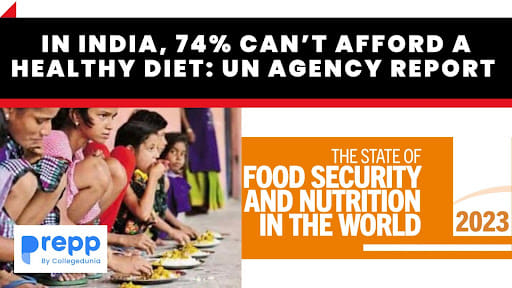
In India, 74% Can’t Afford A Healthy Diet: UN Agency Report
Relevance: GS2 - Issues relating to health; Issues relating to poverty and hunger; GS3 - Food Security
(Source: The Hindu, 08/31/2023)
Click here for Daily Current Affairs
Why in the news?
- In the recently released 'State of Food Security and Nutrition in the World' (SOFI) 2023 report, it was revealed that the expense associated with maintaining a nutritious diet has risen in India over the past few years.
- In a comparison with other BRICS nations (along with the six newly incorporated countries) and India's neighboring countries, India's cost for a healthy diet remains the most economical.
- However, the percentage of individuals capable of affording this nutritious diet remains low. This is primarily due to India's placement at the lower end of the list, attributed to either stagnating or declining income levels.
Table of Contents
India’s Data Points
- It was revealed that over a span of five years, meal expenses in Mumbai surged by 65% while salaries/wages rose by just 28%-37%.
- Mumbai was chosen as an illustrative model due to its consistent and reliable data availability.
- This striking discrepancy underscores the challenge faced by individuals in maintaining their purchasing power amid escalating food costs.
How is the cost of a nutritious diet determined?
- In the context of the SOFI report, determining the cost of a nutritious diet involves analyzing the least expensive local food items that align with dietary recommendations.
- This cost, as well as the accessibility of these food items, is computed from nationwide data averages. The affordability of this diet is gauged by comparing its cost to the mean income in each country.
- A key criterion is that if the cost of the diet surpasses 52% of a nation's average income, it is deemed excessively costly.
- This percentage stems from data indicating that individuals in lower-income nations typically allocate around 52% of their earnings towards food expenses.
- The subsequent step involves calculating the proportion of individuals unable to afford this diet, which is accomplished by considering income distributions within the country.
Highlights of the SOFI Report 2023
- Global Hunger: Over 122 million more people are facing hunger in the world since 2019 due to the pandemic and repeated weather shocks and conflicts, including the war in Ukraine.
- Nutritional Access: Approximately 2.4 billion individuals, largely women and residents of rural areas, did not have consistent access to nutritious, safe, and sufficient food in 2022.
- Child Malnutrition: Child malnutrition is still alarmingly high. In 2021, 22.3% (148.1 million) children were stunted, 6.8% (45 million) were wasted, and 5.6% (37 million) were overweight.
- Impact of Urbanization on Diet: As urbanization accelerates, there is a noticeable increase in the consumption of processed and convenience foods, leading to a spike in overweight and obesity rates across urban, peri-urban, and rural areas.
- Rural Dependence on Global Markets: Previously self-sustaining rural regions, especially in Africa and Asia, are now found to be increasingly dependent on national and global food markets.
- Future Outlook: By 2050, it’s projected that 70% of the global population will reside in cities. This significant demographic shift necessitates a reorientation of food systems to cater to these new urban populations and eradicate hunger, food insecurity, and malnutrition.
About the State of Food Security and Nutrition in the World Report (SOFI)
- It is an annual flagship report jointly prepared by the:
- Food and Agriculture Organisation of the United Nations (FAO),
- International Fund for Agricultural Development (IFAD),
- United Nations Children’s Fund (UNICEF),
- World Food Programme (WFP) and
- World Health Organisation (WHO)
- It aims to inform on progress towards ending hunger, achieving food security and improving nutrition and to provide an in-depth analysis of key challenges for achieving this goal in the context of the SDG.
- The report targets a wide audience, including policy-makers, international organisations, academic institutions and the general public.
- The 2023 edition of The State of Food Security and Nutrition in the World (SOFI) report presents updates on the food security and nutrition situation around the world including the latest estimates of the cost and affordability of a healthy diet
Other Global Indicators
- Global Food Security Index (GFSI): It is an annual report by The Economist Intelligence Unit, which measures the food security of 113 countries. India is ranked at 68th position, according to GFSI 2022.
- Food Insecurity Experience Scale (FIES): It is developed by FAO and measures the level of food insecurity experienced by households over the past 12 months.
- Global Hunger Report: The Global Hunger Report 2022 released by Concern Worldwide and Welt Hunger Hilfe, Non-Government Organisations from Ireland and Germany respectively, has ranked India at 107 among 121 countries.
Various government initiatives to tackle hunger in India
- National Nutrition Mission (NNM), Poshan Abhiyan
- National Food Security Act, 2013
- Eat Right India Movement
- Zero Hunger Program
- Pradhan Mantri Matru Vandana Yojana (PMMVY)
- Pradhan Mantri Poshan Shakti Nirman scheme (PM Poshan Scheme)
(*Click this link to read prelims specific weekly current affairs articles)
FAQs
Question: What is the objective of the State of Food Security and Nutrition in the World (SOFI) report?
Answer:
SOFI aims to inform on progress towards ending hunger, achieving food security and improving nutrition and to provide an in-depth analysis of key challenges for achieving this goal in the context of the SDG.
Question: What is hunger?
Answer:
The Food and Agriculture Organization (FAO) defines hunger as the habitual (or chronic) consumption of too few calories to provide the minimum dietary energy an individual requires to live a healthy and productive life.
Question: What is Food Insecurity?
Answer:
Food insecurity is defined as a household-level economic and social condition of limited or uncertain access to adequate food.
MCQ
Question: 'State of Food Security and Nutrition in the World Report (SOFI),' is an annual flagship report jointly prepared by which of the following?
- Food and Agriculture Organisation (FAO)
- International Fund for Agricultural Development (IFAD)
- United Nations Children’s Fund (UNICEF)
- World Food Programme (WFP)
How many of the above are correct?
(a) Only one
(b) Only two
(c) Only three
(d) All four
Answer: (d) See the Explanation
State of Food Security and Nutrition in the World Report (SOFI) is an annual flagship report jointly prepared by the
- Food and Agriculture Organisation of the United Nations (FAO),
- International Fund for Agricultural Development (IFAD),
- United Nations Children’s Fund (UNICEF),
- World Food Programme (WFP) and
- World Health Organisation (WHO)
Therefore, option (d) is the correct answer.
Download the PREPP App and attempt FREE IAS Exam Mock Tests and get complete study material!

Full Test - 04: UPSC CSE Prelims CSAT (Paper-II)
Full Test - 03: UPSC CSE Prelims CSAT (Paper-II)
UPSC CSE Prelims 2026 GS Paper 1 Question Paper (24-May-2026)
UPSC CSE Prelims 2026 CSAT Paper 2 Question Paper (24-May-2026)

17 February 2025 | The Hindu Must Read Articles | Current Affairs

16 February 2026 | The Hindu Must Read Articles | Current Affairs

13 February 2026 | The Hindu Must Read Articles | Current Affairs









Comments