WCS-India Report Flags Illegal Trade Of Red Sand Boa
Relevance: GS3 - Biodiversity and Conservation; Prelims
(Source: The Hindu, 08/31/2023)
Click here for Daily Current Affairs
Why in the news?
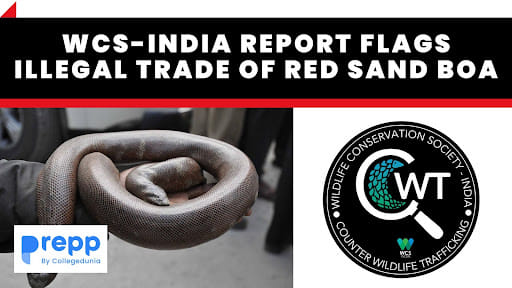
- The Counter Wildlife Trafficking unit of WCS-India has compiled a report titled 'Illegal Trade of Red Sand Boa in India 2016-2021'.
- According to the report, there have been 172 recorded incidents of red sand boa (Eryx johnii) seizures during the mentioned time frame.
Table of Contents
Highlights of the Report
- The incidents of illegal sand boa trade were documented in 18 States and one Union Territory, covering 87 districts across India.
- The highest number was recorded in Maharashtra (59), often from urban areas such as the districts of Pune (11), Thane (9), Raigad (7), and Mumbai Suburban (5).
- The second highest number was recorded from Uttar Pradesh (33), often from regions in proximity to the international border with Nepal, such as the districts of Bahraich (eight) and Lakhimpur-Kheri (seven).
- The red sand boa is now acknowledged as one of the most traded reptile species in the illegal trade market, due to its demand in the pet trade, as well as for use in black magic.
About Red Sand Boa
- Red Sand Boa (Eryx johnii), commonly called the Indian Sand Boa, is a non-venomous species found throughout the dry parts of the Indian subcontinent.
- Appearance: It is a primarily reddish-brown and thick-set snake that grows to an average length of 75 cm.
- The tail is almost as thick as the body and gives the reptile the appearance of being double-headed.
- They are the largest of the sand boas in the world.
- They are ovoviviparous and nocturnal and spend the majority of their time under the ground.
- Ecological importance: It plays a significant role in the ecosystem by maintaining a healthy population between prey and predator.
- It feeds on rodents, lizards, and even other snakes.
- Protection Status:
- Wildlife (Protection) Act, 1972 – Schedule IV;
- CITES – Appendix II;
- IUCN Status – Near Threatened.
What are the recommendations?
- The report proposed that local and global conservation groups collaborate on formative research, aiming to gain a deeper understanding of the illegal reptile trade and its demand, especially in Maharashtra and Uttar Pradesh.
- Additionally, civil society, educational institutions, and conservation organizations should create training initiatives designed to enhance the skills of journalism students and investigative reporters.
- These efforts will enable them to create well-researched and influential media narratives about the illegal wildlife trade, thereby countering misinformation surrounding wildlife consumption and raising awareness about this critical issue.
(*Click this link to read prelims specific weekly current affairs articles)
FAQs
Question: What is Red Sand Boa
Answer:
Red Sand Boa (Eryx johnii), commonly called the Indian Sand Boa, is a non-venomous species found throughout the dry parts of the Indian subcontinent. It is a primarily reddish-brown and thick-set snake that grows to an average length of 75 cm.
Question: What is the protection status of Red Sand Boa?
Answer:
- Wildlife (Protection) Act, 1972 – Schedule IV;
- CITES – Appendix II;
- IUCN Status – Near Threatened.
Question: Which state of India has the highest incidents of illegal trade of Red Sand Boa?
Answer:
The highest number was recorded in Maharashtra (59), often from urban areas such as the districts of Pune (11), Thane (9), Raigad (7), and Mumbai Suburban (5). The second highest number was recorded from Uttar Pradesh (33).
MCQ
Question: With reference to Red Sand Boa, consider the following statements:
- It is acknowledged as one of the most traded reptile species in the illegal trade market.
- It is listed as 'vulnerable' under the IUCN Red List.
Which of the statements given above is/are correct?
(a) 1 only
(b) 2 only
(c) Both 1 and 2
(d) Neither 1 nor 2
Answer: (a) See the Explanation
- The red sand boa is acknowledged as one of the most traded reptile species in the illegal trade market, due to its demand in the pet trade, as well as for use in black magic.
- Protection Status:
- Wildlife (Protection) Act, 1972 – Schedule IV;
- CITES – Appendix II; IUCN Status – Near Threatened.
Therefore, option (a) is the correct answer
Download the PREPP App and attempt FREE IAS Exam Mock Tests and get complete study material!

Full Test - 04: UPSC CSE Prelims CSAT (Paper-II)
Full Test - 03: UPSC CSE Prelims CSAT (Paper-II)
UPSC CSE Prelims 2026 GS Paper 1 Question Paper (24-May-2026)
UPSC CSE Prelims 2026 CSAT Paper 2 Question Paper (24-May-2026)

17 February 2025 | The Hindu Must Read Articles | Current Affairs

16 February 2026 | The Hindu Must Read Articles | Current Affairs

13 February 2026 | The Hindu Must Read Articles | Current Affairs









Comments