What Are The Findings Of The Parliament Panel On The New Education Policy?
Relevance: GS2 - Government policies and interventions for development in various sectors and issues arising out of their design and implementation, Issues relating to development and management of Social Sector/Services relating to Education and Human Resources, Parliament and State legislatures—structure, functioning, conduct of business, powers & privileges and issues arising out of these.
(Source: The Hindu, 09/26/2023)
Click here for Daily Current Affairs
Why in the news?
- Recently, the Parliament Standing Committee on Education tabled a report during the special session of Parliament on the “Implementation of the National Education Policy (NEP), 2020 in Higher Education.”
- The Report made recommendations such as ensuring gender balance in admissions, improving financial assistance, making curricula inclusive, and improving employability.
Table of Contents
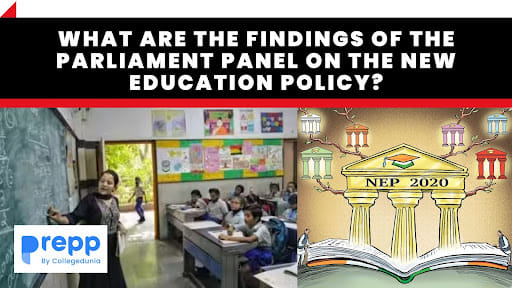
What did the Parliament Panel report on the NEP say?
- The Report examined the implementation of the National Education Policy in the Higher Education sector.
- The committee engaged with representatives from State governments, Union Ministries, higher education institutions, and stakeholders.
Significant findings
- 70% of the country's 1,043 universities operate under State Acts.
- Only 6% of students attend Central higher educational institutions while the remaining 94% are enrolled in State or private institutions.
- It emphasized the critical role played by the states in delivering higher education.
What were the issues discussed?
- Disciplinary separation: It examined the rigid separation of disciplines in the higher education sector.
- Access to education: It discussed the limitations to access to higher education in socio-economically disadvantaged areas.
- Medium of instruction: The need to address the shortage of higher educational institutions with local languages as the medium of instruction.
- Faculty shortage: The committee acknowledged the scarcity of faculty in higher educational institutions.
- Institutional autonomy: The members raised concerns about the institutional autonomy of HEIs.
- Research emphasis: The committee deliberated on the need to encourage research among students of higher educational institutions.
- Regulatory system: The panel also identified the ineffectiveness of the present regulatory system.
- Undergraduate education: The panel also raised concerns about the low standards of undergraduate education.
What were the recommendations?
- Enrolment: Gross Enrolment Ratio (GER) in higher education, including vocational education, should be increased from 26.3% in 2018 to 50% by 2035.
- Multidisciplinary HEIs: There should be at least one multidisciplinary HEI in each district by 2030.
- Assistance for SEDGs: It set out clear targets to increase the GER for Socially and Economically Disadvantaged Groups and allocated funds for financial assistance and scholarships to the SEDGs in public and private HEIs.
- Gender equality: It recommended that the government take necessary steps to improve gender balance in admissions to HEIs.
- Inclusiveness: The committee highlighted the need to reform the admission process and curricula to make it more inclusive.
- Institutional reforms: Implement infrastructural reforms to ensure physically challenged students can attend and participate.
- Reform of programs to enhance the employability potential of students.
- Increase the number of degree courses taught in regional languages and bilingually.
- Rigorous enforcement of non-discrimination and anti-harassment rules in institutions.
- Funding: It recommended the diversification of funding beyond government sources to improve the effectiveness of the Higher Education Financing Agency (HEFA).
- Partnerships could be explored with private sector organizations, philanthropic foundations, and international financial institutions.
- It also recommended making HEFA loans more competitive and affordable through a review and adjustment of interest rates.
NEP Implementation in Jammu and Kashmir
- The committee lauded the successful implementation of NEP in Jammu and Kashmir.
- The NEP was adopted in all higher educational institutions in Jammu and Kashmir from the 2022 academic session onwards.
- The committee noted that the NEP had significantly improved teaching methods in HEI’s in the Union Territory.
- The implementation of the NEP also provided lifelong learning opportunities to students.
- The committee acknowledged the “Design Your Degree” programme which was adopted in Jammu University and recommended its adoption in Higher Education Institutions across the country as it enabled personalized and interdisciplinary learning.
What are the challenges highlighted by the panel about the Multiple Entry Multiple Exit Programme?
- The committee has raised concerns about the implementation of the MEME system in India despite its flexible nature and effective implementation in the West.
- Uncertainty in number of students: The high student population in India makes it difficult for institutions to predict how many students will exit or join midway, which leads to uncertainty in managing resources and maintaining pupil-teacher ratios.
- Geographical challenges and opposition by states: It would be difficult to implement the MEME scheme in India due to the uneven distribution of higher educational institutions across the country, especially in rural areas.
- States like Kerala have not implemented the MEME system due to a lack of uniform acceptance across regions.
- Lack of clear framework: To implement the MEME effectively, comprehensive guidelines and well-defined framework such as specific eligibility criteria and credit transfer mechanisms must be developed.
- Devalued degrees: Critics have alleged that the MEME system could lead to a devaluation of degrees under the perception of producing cheap labor for the job market.
- This is also likely to increase drop-out rates and lead to more lower-qualified individuals.
- However, the panel also noted that the scheme has certain advantages such as
- Greater flexibility of students to tailor their academics with their individual needs and circumstances as they can obtain certificates or diplomas at different stages rather than completing a full degree program.
- It enables diverse educational pathways and enhances access to higher education.
(*Click this link to read prelims specific weekly current affairs articles)
FAQs
Question: What is the Gross Enrolment Ratio?
Answer:
Gross enrollment ratio is the ratio of total enrollment, regardless of age, to the population of the age group that officially corresponds to the level of education shown.
Question: What are the foundational pillars of the National Education Policy 2020?
Answer:
The 5 foundational pillars of the National Educational Policy 2020 are Access, Equity, Quality, Affordability, and Accountability.
UPSC Mains Practice Question:
|
MCQs
Question: Consider the following statements.
- As per the Right to Education (RTE) Act, to be eligible for appointment as a teacher in a State, a person would be required to possess the minimum qualification laid down by the concerned State Council of Teacher Education.
- As per the RTE Act, for teaching primary classes, a candidate is required to pass a Teacher Eligibility Test conducted in accordance with the National Council of Teacher Education guidelines.
- In India, more than 90% of teacher's education institutions are directly under the State Governments.
Which of the statements given above is/are correct?
(a) 1 and 2
(b) 2 only
(c) 1 and 3
(d) 3 only
Answer: (b) See the Explanation
- In accordance with the provisions of sub-section (1) of section 23 of the Right of Children to Free and Compulsory Education (RTE) Act, 2009, the National Council for Teacher Education (NCTE) has laid down the minimum qualifications for a person to be eligible for appointment as a teacher in class I to VIII, vide its Notification dated August 23, 2010. Hence, statement 1 is incorrect
- One of the essential qualifications for a person to be eligible for appointment as a teacher in any of the primary schools is that he/she should pass the Teacher Eligibility Test (TET) which will be conducted by the appropriate Government. Hence, statement 2 is correct.
- From the mid-1960s to 1993, the number of Teacher Education Institutions(TEIs) in India went up from about 1,200 to about 1,500. After the NCTE was set up, the number of TEIs exploded to about 16,000 by 2011, of which over 90% are private. So in India, more than 90% of teacher education institutions are private institutes. Hence, statement 3 is incorrect.
Therefore, option (b) is the correct answer.
Question: Consider the following statements:
- Free and compulsory education to the children of 6-14 years age-group by the State by the seventy-sixth Amendment to the Constitution of India.
- Sarva Shiksha Abhiyan seeks to provide computer education even in rural areas.
- Education was included in the Concurrent List by the Forty-second Amendment, 1976 to the Constitution of India’.
Which of the statements given above are correct? (UPSC CSE 2006)
(a) 1, 2 and 3
(b) 1 and 2
(c) 2 and 3
(d) 1 and 3
Answer: (c) See the Explanation
- The 86th Constitutional Amendment of 2002 included Article 21A in the Indian constitution making Education a fundamental Right. Hence statement 1 is incorrect.
- The Sarva Shiksha Abhiyan (SSA) is flagship programme of the Government of India that aims to achieve Universalization of Elementary Education (UEE) in a time bound manner.
- Under the SSA scheme, new schools will be opened in habitations which do not have schooling facilities, existing school infrastructure will be strengthened, teching capacity and teacher strength will be increased, and computer educatio provided to students. Hence statement 2 is correct.
- The 42nd amendment of 1976 transferred state list subjects like education, forest, protection of wild animals and birds, administration of justice, and weights and measurements to the Concurrent List. Hence statement 3 is correct.
Therefore, option (c) is the correct answer.
Download the PREPP App and attempt FREE IAS Exam Mock Tests and get complete study material!

Full Test - 04: UPSC CSE Prelims CSAT (Paper-II)
Full Test - 03: UPSC CSE Prelims CSAT (Paper-II)
UPSC CSE Prelims 2026 GS Paper 1 Question Paper (24-May-2026)
UPSC CSE Prelims 2026 CSAT Paper 2 Question Paper (24-May-2026)

17 February 2025 | The Hindu Must Read Articles | Current Affairs

16 February 2026 | The Hindu Must Read Articles | Current Affairs

13 February 2026 | The Hindu Must Read Articles | Current Affairs









Comments