More Women Odhuvars In T.N Temples
Relevance: GS1 - Salient features of Indian Society, Diversity of India; Social Empowerment; Role of women
(Source: The Hindu, 09/26/2023)
Click here for Daily Current Affairs
Why in the news?
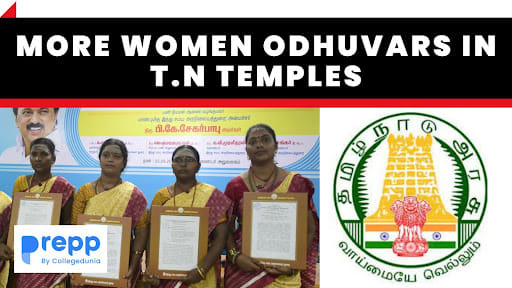
- Recently, Tamil Nadu’s Hindu Religious & Charitable Endowments Department (HR & CE), handed appointment orders to 15 Odhuvars, among them were five women who were assigned to temples in the Chennai region.
- These women come from diverse backgrounds but share a common goal of serving deities through their singing.
- In the last 28 months, 10 women Odhuvars have been appointed in various temples.
Table of Contents
Who are Odhuvars?
- Odhuvar refers to individuals who perform devotional music and sing hymns in temples, particularly during religious ceremonies and rituals.
- Odhuvars sing devotional hymns at Hindu temples in Tamil Nadu, but they are not priests.
- Odhuvars play an essential role in Saivite temples, as they are responsible for singing from the Thirumurai not only during regular pujas but also during special functions and festivals, ensuring the sacred verses are honored and cherished.
Significance of Women Redefining Roles as Odhuvars in Temples
- Gender equality: Historically, this role had been dominated by men, but now more women are taking up this important and spiritually significant role.
- The inclusion of more women as Odhuvars reflects a positive shift towards gender equality and inclusivity in religious practices and temple activities.
- Participation in religious traditions: It not only provides women with opportunities for active participation in religious traditions but also helps diversify and enrich the cultural and musical aspects of temple worship.
- Social changes: This development may be attributed to changing social attitudes, increased awareness of gender equality, and efforts to promote women's participation in various aspects of society.
- It's a positive step towards recognizing and celebrating the talents and contributions of women in religious and cultural contexts.
- It is another milestone in Tamil's journey towards equality.
Efforts of the Tamil Nadu Government for the Appointment of Temple Priests
- Role of caste: In July 2023, the Madras High Court ruled out that caste will have no role to play in the appointment of temple priests, and that the only criteria for such appointments would be how well-versed a person is in religious texts and rituals.
- Women as temple priests: Recently, Tamil Nadu’s Chief Minister MK Stalin stated that women are all set to enter temples in Tamil Nadu as priests under the Dravidian model of governance. In Tamil Nadu, the Dravidian model government has removed the thorn by appointing people of all castes as priests. Women are also now stepping into the sanctums, bringing a new era of inclusivity and equality.
- Hindu Religious and Charitable Endowments Minister P K Sekar Babu had said in 2021 that women could be appointed as priests in temples following their training.
- Hence, for the first time, the Tamil Nadu government has recently trained three women as temple priests at an Archakar Payirchi Palli – an institution for the training of priests.
Contributions of Madras in Abolition of Untouchability
- Historic temple entry: The temple entry at Madurai Meenakshi Sundareshwarar temple in 1939 is usually held up as the defining moment in the history of the temple entry movement in Tamil Nadu. This was led by Gandhian leaders belonging to the Madras Harijan Sevak Sangh, and it was supported by the Congress government.
- It was July 8, 1939, when the Dalits and Nadars, the most suppressed communities in Madras Presidency of British India, successfully entered the famous Meenakshi Sundareshwarar Temple in Madurai and created a history in the struggle against untouchability in the country.
- Madras Temple Entry Authorization Act, 1947: It is an act to authorize entry into Hindu temples in the Province of Madras and the offer of worship therein by certain classes of Hindus who by custom or usage are excluded from such entry and worship.
(*Click this link to read prelims specific weekly current affairs articles)
FAQs
Question: Who are Odhuvars?
Answer:
Odhuvar refers to individuals who perform devotional music and sing hymns in temples, particularly during religious ceremonies and rituals. Odhuvars sing devotional hymns at Hindu temples in Tamil Nadu, but they are not priests.
Question: What is the historic entry into Madurai Meenakshi Temple?
Answer:
On July 8, 1939, the Dalits and Nadars, the most suppressed communities in Madras Presidency of British India, successfully entered the famous Meenakshi Sundareshwarar Temple in Madurai and created a history in the struggle against untouchability in the country.
Question: What is Agama Shastra?
Answer:
Agama Shastra is a manual for worship, rituals and construction of temples in Hinduism. In Sanskrit, agama means “handed down by tradition” and shastra refers to a commentary or treatise.
MCQ
Question: Which of the following are envisaged by right against exploitation in the constitution of india (UPSC 2017)
- Prohibition of traffic in human beings and forced labour.
- Abolition of untouchability
- Protection of the interests of minorities
- Prohibition of employment of children in factories and mines
Select the correct answer using the code given below;
(a) 1, 2 and 4 only
(b) 2,3 and 4 only
(c) 1 and 4 only
(d) 1, 2, 3 and 4
Answer: (c) See the Explanation
Right against exploitation is under Articles 23–24. These are crucial Fundamental Rights that ensure that no citizen is subjected to any form of forced labour. Article 23 - Prohibition of traffic in human beings and forced labour. Article 24 - Prohibition of employment of children in factories, etc.
Therefore, option (c) is the correct answer.
Download the PREPP App and attempt FREE IAS Exam Mock Tests and get complete study material!

Full Test - 04: UPSC CSE Prelims CSAT (Paper-II)
Full Test - 03: UPSC CSE Prelims CSAT (Paper-II)
UPSC CSE Prelims 2026 GS Paper 1 Question Paper (24-May-2026)
UPSC CSE Prelims 2026 CSAT Paper 2 Question Paper (24-May-2026)

17 February 2025 | The Hindu Must Read Articles | Current Affairs

16 February 2026 | The Hindu Must Read Articles | Current Affairs

13 February 2026 | The Hindu Must Read Articles | Current Affairs









Comments