Recent Issues in South China Sea
(Source: The Hindu, 09/26/2023)
Click here for Daily Current Affairs
Why in the News?
- Recently, the Philippines has declared that it will remove a floating barrier placed by China's coast guard to prevent Filipino fishing boats from entering a disputed lagoon in the South China Sea.
- The 300 metre-long barrier at the entrance to the lagoon at Scarborough Shoal is stated“illegal and illegitimate” by the Philippines.
Table of Contents
More About the News
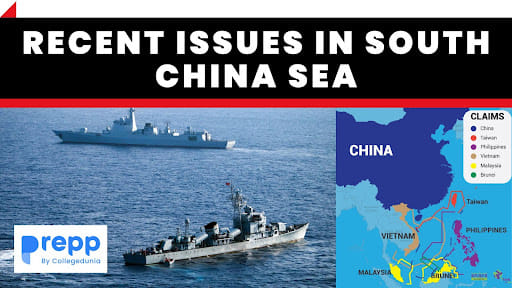
- The 300 metre-long barrier has been built by China at the entrance to the lagoon at Scarborough Shoal, located in south china sea.
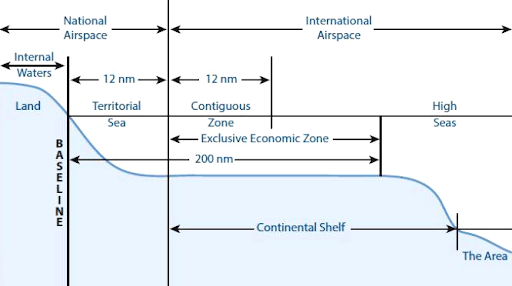
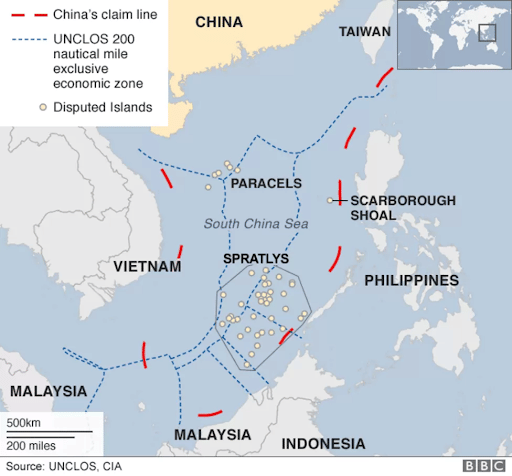
- The Philippines condemn the installation of floating barriers by the Chinese coast guard as the region is claimed by the Philippines itself and says Scarborough Shoal lies within its exclusive economic zone, a 200-nautical mile stretch of water where coastal states have exclusive rights to fish and other resources.
- The Chinese barrier denies Filipinos access to the rich fishing lagoon surrounded by underwater coral outcrops, as China is also claiming the rights over the region.
- Those rights of the Philippines were upheld by a 2016 arbitration decision set up under the 1982 U.N. Convention on the Law of the Sea.
What is the UN Convention on the Law of the Sea (UNCLOS)?
|
Issue of the South China Sea
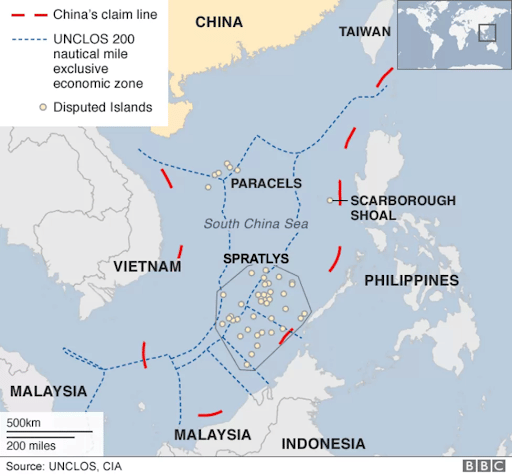
- China claims the largest portion of territory in the South China Sea demarcated by its so-called "nine-dash line." (Marked in Red in Map)
- Originally an “eleven-dashed-line”, this line was first indicated by the Kuomintang government of the Republic of China in 1947.
- In 1947, China issued a revised map detailing its claims, and insists history backs up its claims and says its right to the area goes back centuries to when the Paracel and Spratly island chains were regarded as integral parts of the Chinese nation.
- These claims are mirrored by Taiwan.
- Vietnam says it has actively ruled over both the Paracels and the Spratlys islands since the 17th Century.
- The Philippines claims some part of the Spratlys island and the Scarborough Shoal (known as Huangyan Island in China).
- Malaysia and Brunei also lay claim to territory in the South China Sea that they say falls within their economic exclusion zones, as defined by the United Nations Convention on the Law of the Sea, or UNCLOS.
- Brunei does not claim any of the disputed islands, but Malaysia claims a small number of islands in the Spratlys.
About South China Sea
|
Importance of South China Sea
- The South China Sea is a major shipping route.
- The United Nations Conference on Trade and Development estimates that over 21% of global trade, amounting to $3.37 trillion, transited through these waters in 2016.
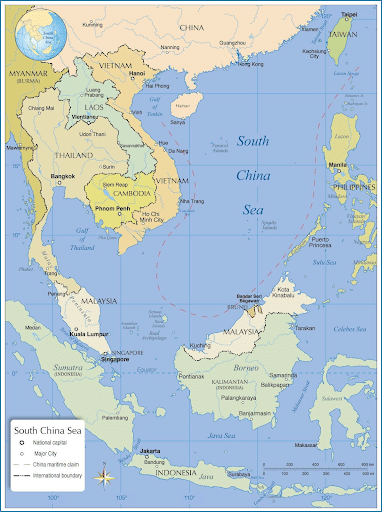
- This sea holds tremendous strategic importance for its location as it is the connecting link between the Indian Ocean and the Pacific Ocean (Strait of Malacca).
- It is also home to rich fishing grounds that provide for the livelihoods of millions of people across the region.
- More than half of the world's fishing vessels operate in this area.
- the Paracels and the Spratlys may have reserves of natural resources around them.
- There has been little detailed exploration of the area, so estimates are largely extrapolated from the mineral wealth of neighbouring areas.
Steps taken so far to solve the dispute
- The Philippines filed an arbitration case with the Permanent Court of Arbitration (PCA) in order to settle disputes with China.
- Despite China’s withdrawal from the arbitration process in 2013, the proceedings continued according to the guidelines set by the United Nations Convention on the Law of the Sea (UNCLOS).
- UNCLOS' Annex VII states that the absence or failure of a party to present its case does not hinder the proceedings.
- On July 12, 2016, the PCA issued its Award in favor of the Philippines, after considering aspects such as maritime rights, the status of specific marine features, historical rights, and the legality of China's actions in the South China Sea.
- The tribunal’s decision is “final and binding” in accordance with UNCLOS Article 296 and Article 11 of Annex VII.
- The Permanent Court of Arbitration (PCA) is an Intergovernmental organisation established in 1899. It settles issues involving territorial and maritime conflicts, sovereignty, human rights, foreign investments, and regional trade, among other things, between member nations, international organisations, and private parties.
Tribunal’s decision
- China has no legal basis: It found that China’s claim to ‘historic rights’ or ‘maritime rights and interests’ in the South China Sea was inconsistent with UNCLOS and declared that any prior claims to resources within the "nine-dash line" were without legal basis.
- ‘Nine-dash line’ is a dotted line that was adopted from Chinese maps in the 1940s, and represents Beijing’s claim over the sea and all the land features that are contained within the line.
- Harmed Environment: The tribunal concluded that China's development and land reclamation activities had significantly altered the reefs, breaching UNCLOS commitments and causing irreparable harm to the maritime environment by destroying evidence of the natural condition of features in the South China Sea.
- Violated Sovereignty: The Tribunal also found that “China has violated the sovereign rights of the Philippines in its Exclusive Economic Zone (EEZ) by
- interfering with the Philippines’ fishing and petroleum exploration,
- constructing artificial islands, and
- failing to stop Chinese fishermen from fishing in the zone”.
- Impacted traditional fishing rights: It said that China had reduced the traditional fishing rights of Filipino fishermen by physically obstructing Philippine vessels.
- Finally, it determined that China had no legal basis for asserting historic rights to resources located within the sea areas under the Tribunal’s jurisdiction.
- An “exclusive economic zone,” or “EEZ” is an area of the ocean, generally extending 200 nautical miles (230 miles) beyond a nation's territorial sea, within which a coastal nation has jurisdiction over both living and nonliving things.
(*Click this link to read prelims specific weekly current affairs articles)
FAQs
Question: What is Nine Dash Lines?
Answer:
‘Nine-dash line’ is a dotted line that was adopted from Chinese maps in the 1940s, and represents Beijing’s claim over the sea and all the land features that are contained within the line.
Question: What is UNCLOS?
Answer:
The United Nations Convention on the Law of the Sea, also called the Law of the Sea Convention or the Law of the Sea Treaty, is an international agreement that establishes a legal framework for all marine and maritime activities. As of June 2016, 167 countries and the European Union are parties.
UPSC Mains Practice Question:
|
MCQs
Question: Which of the following countries open out to the South China Sea?
- Singapore
- Laos
- Brunei
- Cambodia
Select the correct answer using the codes given below
(a) 1 and 3 only
(b) 1, 2 and 3 only
(c) 1, 3 and 4 only
(d) 1, 2, 3 and 4
Answer: (c) See the Explanation
- Laos is landlocked.
- Ten countries are open in the South china sea.
- The South China Sea is bordered by Brunei, Cambodia, China, Indonesia, Malaysia, the Philippines, Singapore, Taiwan, Thailand and Vietnam.
Arrange the following islands in the South China Sea from North to South.
- The Paracels islands
- The Spratlys islands
- Scarborough Shoal
- Natuna Island
(a) 3-4-2-1
(b) 4-3-1-2
(c) 3-4-1-2
(d) 4-1-2-3
Answer: (c) See the Explanation
Download the PREPP App and attempt FREE IAS Exam Mock Tests and get complete study material!

Full Test - 04: UPSC CSE Prelims CSAT (Paper-II)
Full Test - 03: UPSC CSE Prelims CSAT (Paper-II)
UPSC CSE Prelims 2026 GS Paper 1 Question Paper (24-May-2026)
UPSC CSE Prelims 2026 CSAT Paper 2 Question Paper (24-May-2026)

17 February 2025 | The Hindu Must Read Articles | Current Affairs

16 February 2026 | The Hindu Must Read Articles | Current Affairs

13 February 2026 | The Hindu Must Read Articles | Current Affairs









Comments