Monsoon Begins Its Withdrawal
Relevance: GS1 - Salient features of world’s physical geography, Important Geophysical phenomena such as earthquakes, Tsunami, Volcanic activity, cyclone etc.,
(Source: The Hindu, 09/26/2023)
Click here for Daily Current Affairs
Why in the news?
- Recently, the Indian Meteorological Department announced that the southwest moon has begun to withdraw from India.
- The withdrawal began 8 days after the normal date of 17th September, making it the 13th consecutive late withdrawal of the Southwest monsoon.
Table of Contents
What has the IMD said about the withdrawal of the monsoon?
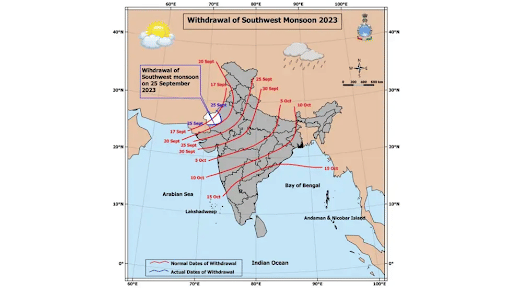
- According to the IMD, the Southwest monsoon began its withdrawal from Rajasthan on 25th September 2023.
- The withdrawal of the monsoon from Northwest India marks the beginning of its retreat from the Indian subcontinent.
- The monsoon withdrawal is late by 8 days.
Performance of the 2023 monsoon season
- India has received 780.3 mm of rain during this monsoon season so far, compared to a normal of 832.4 mm.
- Normally, the country receives an average of 870 mm of precipitation between June and September.
- This means that rainfall received this year was 5% below the normal.
- The IMD had predicted a normal monsoon for India but had cautioned that the El Nino effect could result in weaker monsoon winds and drier conditions in India during the second half of the monsoon season.
- Although India experienced deficit rainfall in June, it experienced excessive precipitation in July due to consecutive western disturbances over northwest India and a favorable phase of the Madden-Julian Oscillation (MJO).
- In August, the El Nino effect caused the month to be the driest since 1901 and the hottest ever recorded while September experienced excess rain due to multiple low-pressure systems and the positive phase of MJO.
What are the criteria for declaring the withdrawal of the Monsoon from a region?
- According to the IMD, the following conditions have to be fulfilled for declaring the withdrawal of the monsoon:
- Rainfall activity over the area ceases for 5 continuous days.
- An anticyclone forms in the lower troposphere around 1.5 km from sea level
- There is a significant drop in moisture content
- In order to declare the withdrawal of the monsoon from the country as a whole, similar criteria are adopted, and a change in the southwest regime of the wind circulation.
What are the impacts of late withdrawal of the monsoon?
- Agriculture: Late withdrawal means a longer rainy season, which can affect agricultural production.
- This is particularly concerning for northwest India where monsoon rainfall is crucial in Rabi crop production.
- While it may benefit Kharif crops, it could be harmful for standing crops like urad.
- Effect on other countries: The late withdrawal of the southwest monsoon from India will lead to a delay in the monsoon over Australia.
Southwest monsoon
|
(*Click this link to read prelims specific weekly current affairs articles)
FAQs
Question: What is the El Nino?
Answer:
El Nino is a condition in which the waters of the eastern tropical Pacific Ocean warm unusually. It is the warm phase of the El Nino Southern Oscillation (ENSO). Its effects include increased rainfall in South America, reduced hurricanes in North America, and droughts in Australia and Indonesia.
Question: What is the Madden Julien Oscillation?
Answer:
The Madden-Julian Oscillation (MJO) is an eastward moving 'pulse' of clouds, rainfall, winds, and pressure near the equator that typically recurs every 30 to 60 days.
It’s a traversing phenomenon and is most prominent over the Indian and Pacific Oceans. When it is over the Indian Ocean during the Monsoon season, it brings good rainfall over the Indian subcontinent but when it witnesses a longer cycle and stays over the Pacific Ocean, it is harmful for the Indian Monsoon.
UPSC Mains Practice Question:
|
MCQs
Question: Consider the following statements.
- The duration of the monsoon decreases from southern India to northern India.
- The amount of annual rainfall in the northern plains of India decreases from east to west.
Which of the statements given above is/are correct? (UPSC CSE 2012)
(a) 1 only
(b) 2 only
(c) Both 1 and 2
(d) Neither 1 nor 2
Answer: (c) See the Explanation
- The amount of rainfall decreases from east to west owing to the progressive decrease in humidity of the winds. Hence statement 1 is correct.
- The Southern part of India gets rainfall early and for a longer duration than the northern part as it is closer to the sea. Hence statement 2 is correct.
Therefore, option (c) is the correct answer.
Question: With reference to the 'Indian Ocean Dipole (IOD)' sometimes mentioned in the news while forecasting the Indian monsoon, which of the following statements is/are correct?
- The IOD phenomenon is characterized by a difference in sea surface temperature between the tropical Western Indian Ocean and the tropical Eastern Pacific Ocean.
- An IOD phenomenon can influence an El Nino's impact on the monsoon.
Which of the above statements is/are correct? (UPSC CSE 2017)
(a) 1 only
(b) 2 only
(c) Both 1 and 2
(d) Neither 1 nor 2
Answer: (b) See the Explanation
- The Indian Ocean Dipole (IOD) is an event in which the western Indian Ocean becomes alternately warmer and then colder than the eastern part of the Indian Ocean. Hence statement 1 is incorrect.
- A positive IOD leads to greater monsoon rainfall and more monsoon days above normal while a negative IOD leads to less rainfall and more monsoon break days. Hence statement 2 is correct.
Therefore, option (b) is the correct answer.
Download the PREPP App and attempt FREE IAS Exam Mock Tests and get complete study material!

Full Test - 04: UPSC CSE Prelims CSAT (Paper-II)
Full Test - 03: UPSC CSE Prelims CSAT (Paper-II)
UPSC CSE Prelims 2026 GS Paper 1 Question Paper (24-May-2026)
UPSC CSE Prelims 2026 CSAT Paper 2 Question Paper (24-May-2026)

17 February 2025 | The Hindu Must Read Articles | Current Affairs

16 February 2026 | The Hindu Must Read Articles | Current Affairs

13 February 2026 | The Hindu Must Read Articles | Current Affairs









Comments