Types of Plate Boundaries - Geography notes
The edges where two plates meet are known as plate boundaries. There are three types of plate boundaries: Divergent, convergent, and transform plate boundaries. The majority of geologic events, such as volcanoes, earthquakes, and mountain formation, occur at plate boundaries. The topic “Types of Plate Boundaries” is an important part of the UPSC/IAS Exam Geography syllabus which is discussed in this article in detail.
|
Table of Contents |
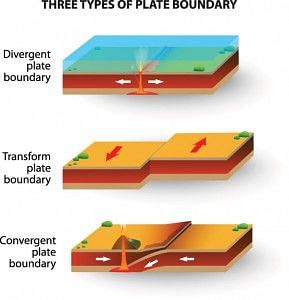
Concept of Plate Boundaries
- A plate boundary is a three-dimensional surface or zone where the velocity (speed or direction) of one lithospheric plate relative to the neighboring lithospheric plate changes significantly.
- As high-temperature deformation mechanisms become more prominent than the near-surface brittle mechanisms of fracturing, faulting, and cataclastic flow, the breadth of these plate boundaries may expand with depth.
- Earth's lithosphere is broken into several tectonic plates that float atop the semi-fluid asthenosphere beneath them.
- The boundaries between these plates are regions of dynamic interaction, and they play a crucial role in shaping Earth's geologic and geomorphic features.
- These interactions are primarily dictated by the relative motion of the plates involved.
- In addition to the primary interactions, there are also plate boundary zones where the interactions are complex and don't fit into the aforementioned categories. These zones involve multiple interactions over broader areas.

Tectonic Plates
- A tectonic plate (also known as a lithospheric plate) is a massive, irregularly shaped slab of solid rock made up of both continental and oceanic lithosphere.
- The science of lithosphere plate motions is called plate tectonics.
- The term tectonics comes from the Greek word tektonikos, which means "building or construction," and refers to the deformation of the earth's crust caused by internal forces.
- Plates range in size from a few hundred to thousands of kilometres across; the Pacific and Antarctic Plates are among the largest.
- Plate thickness varies greatly as well, ranging from less than 15 km for young oceanic lithosphere to 200 km or more for ancient continental lithosphere (for example, the interior parts of North and South America).
- The continental crust is made up of granitic rocks, which are composed of relatively lightweight minerals like quartz and feldspar.
- The oceanic crust, on the other hand, is made up of basaltic rocks, which are much denser and heavier.
- The theory of plate tectonics identifies 7 major and 20 minor types of lithospheric plates.
- These plates are continuously in motion with respect to each other.
- A tectonic plate is classified as either a continental or an oceanic plate, depending on which occupies the greater section of the plate.
- The Pacific plate is mostly oceanic, whereas the Eurasian plate is continental.
Types of Plate Boundaries
Three types of tectonic borders are formed by the movement of tectonic plates:
Convergent Boundaries
- When two tectonic plates collide, a convergent plate boundary is formed. Convergent Boundaries are also called destructive boundaries.
- The impact of colliding plates can cause one or both plates' edges to bow up into mountain ranges, or one plate to bend down into a deep undersea trench.
- Along convergent plate borders, a chain of volcanoes frequently occurs, and severe earthquakes are prevalent.
- A convergent plate boundary is an example of the Pacific Ring of Fire.
- Oceanic crust is frequently pulled down into the mantle near convergent plate borders, where it begins to melt.
- Magma rises through and into the opposite plate, hardening into granite, the rock that forms the continents.
- As a result of convergent borders, continental crust is formed while oceanic crust is destroyed.
- The common examples of convergent boundaries are the subduction zones that are formed when the heavier plate slides beneath the lighter plate, creating a deep trench.
- The dense mantle material is transformed into buoyant magma, which rises through the crust to the Earth's surface.
- The rising magma has created a chain of active volcanoes known as volcanic arc over millions of years.
- Convergent plate boundaries cause mountain formation and the formation of island arcs in addition to Subduction Zones.
- If both convergent plates are oceanic, the volcanoes form a curved line of islands parallel to the trench, known as an island arc.
- Convergence can happen in three different ways:
- between an oceanic and continental plate
- between two oceanic plate
- between two continental plates
- When continental and oceanic plates clash, the oceanic plate, which is thinner and denser, is pushed aside by the continental plate, which is thicker and less dense.
- The Washington-Oregon (United States) coastline is an example of an oceanic-continental convergent plate boundary
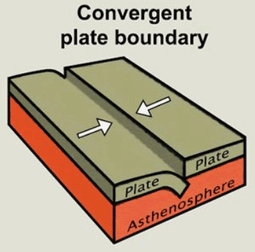
Convergent Boundary
Divergent Boundaries
- Divergent Boundaries are formed when the tectonic plates pull apart from each other. Divergent Boundaries are also called constructive boundaries.
- Seafloor spreading and rift valleys occur along divergent borders.
- Magma from deep under the Earth's mantle rises to the surface at divergent oceanic borders, pushing two or more plates apart. Along the seam, mountains and volcanoes rise.
- The ocean floor is renewed, and large basins are widened as a result of the process.
- Examples of divergent boundaries include the Mid-Atlantic Ridge, where the American Plates are split from the Eurasian and African Plates.
- The world's oceans are connected by a single mid-ocean ridge system, making it the world's largest mountain range (10,000 miles).
- Giant troughs form on land, such as the Great Rift Valley in Africa, where plates are pulled apart.
- If the plates continue to diverge, eastern Africa will split from the continent millions of years from now, becoming a new landmass.
- The border between the plates would then be marked by a mid-ocean ridge.
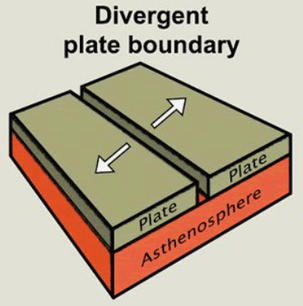
Divergent Boundary
Transform Boundaries
- Transform Boundaries are formed when tectonic plates travel horizontally past each other but parts of the plates become stuck where they touch.
- Two plates slide past each other in this type of interaction, and no new landforms are created or destroyed; only the present landform is deformed.
- Plate interaction happens without generating or destroying crust, therefore these limitations are conservative.
- As a result, they don't build beautiful landforms like mountains or oceans, but the slowing motion frequently causes big earthquakes, such as the devastating 1906 earthquake in San Francisco.
- Stress builds up in these places of contact, forcing the rocks to crack or slip, lurching the plates forward, and creating earthquakes.
- Faults are the places where things break or slip.
- In the Ring of Fire, the majority of Earth's faults can be found along transform borders.
- The San Andreas fault zone, which stretches underwater, has one of the most famous transform plate borders.
- It occurs as the Pacific Plate advances northward past the North American Plate.
- It's one of the Rings of Fire’s most active faults.
- Structures that cross a transform boundary are offset — divided into parts and conveyed in opposite directions.
- As the plates grind along, the rocks at the boundary are pulverized, forming a linear fault valley or undersea canyon.
- Along these faults, earthquakes are common.
- In contrast to convergent and divergent boundaries, crust at transform margins is cracked and broken but not generated or destroyed.

Transform Boundary
Difference Between Convergent, Divergent and Transform Boundaries
| Types of Margin | Divergent | Convergent | Transform |
|---|---|---|---|
| Motion | Spreading | Subduction | Lateral Sliding |
| Effect | Constructive (oceanic lithosphere created) | Destructive (oceanic lithosphere destroyed) | Conservative (lithosphere neither created or destroyed) |
| Topography | Ridge/Rift | Trench | No major effect |
| Volcanic Activity | Yes | Yes | No |
Significance of Plate Boundaries
- Many of the world's major mountain ranges, like the Himalayas and the Andes, have formed as a result of convergent plate boundaries where plates collide.
- Deep-sea trenches, such as the Mariana Trench, are formed at convergent boundaries where one plate is subducting beneath another.
- Divergent boundaries, especially on continents, can lead to the formation of rift valleys, like the East African Rift.
- Plate borders are significant because earthquakes and volcanoes are frequently associated with them.
- When the Earth's tectonic plates collide, massive amounts of energy are released in the form of earthquakes.
- Different geological features are linked with each of these types of plate borders.
Conclusion
With the other plates that surround it, a single tectonic plate can have numerous types of plate boundaries. Besides, as the molten rock from deep below the Earth (known as magma) can move upward at these plate intersections, volcanoes are frequently found near plate boundaries. As a result of the movement of Earth's tectonic plates, the planet's surface is shaped.
|
|
|
|---|---|
| Geography Notes | Physical Geography |
| Geomorphology | Different Layers of the Earth |
| Distribution of Oceans and Continents Basins | Minerals and Rocks |
FAQs
Question: What are the main types of plate boundaries?
Answer: The three main types of plate boundaries are divergent, convergent, and transform boundaries. Divergent boundaries occur when two plates move away from each other, convergent boundaries when two plates collide, and transform boundaries when plates slide past each other horizontally.
Question: How do divergent plate boundaries form?
Answer: Divergent plate boundaries form when two tectonic plates move apart, typically resulting in the creation of new crust as magma rises from below the Earth's surface. These boundaries are often found along mid-ocean ridges.
Question: What happens at convergent plate boundaries?
Answer: At convergent plate boundaries, two plates move towards each other, leading to subduction (where one plate is forced beneath another) or mountain building (if the plates are of equal density). Earthquakes and volcanic activity are common here.
Question: What is a transform boundary?
Answer: A transform boundary is where two tectonic plates slide horizontally past each other. This lateral movement often leads to earthquakes. A well-known example is the San Andreas Fault in California.
Question: How do plate boundaries affect Earth's topography?
Answer: Plate boundaries shape the Earth's topography by creating features such as mountains, rift valleys, and oceanic trenches. They are responsible for volcanic activity, earthquakes, and the formation of new crust.
MCQs
1. Which type of plate boundary is responsible for the creation of mid-ocean ridges?
A. Divergent
B. Convergent
C. Transform
D. Subduction
Answer: (A) See the Explanation
Divergent plate boundaries are responsible for the creation of mid-ocean ridges. At these boundaries, plates move apart, and magma rises to form new oceanic crust, leading to the formation of ridges.
2. What is the most common geological feature associated with convergent boundaries?
A. Earthquakes
B. Rift Valleys
C. Mid-Ocean Ridges
D. Ocean Trenches
Answer: (D) See the Explanation
Ocean trenches are common features at convergent boundaries, especially where subduction occurs, with one plate being forced beneath another, leading to deep oceanic depressions.
3. Which of the following is an example of a transform plate boundary?
A. San Andreas Fault
B. Himalayas
C. Mid-Atlantic Ridge
D. Mariana Trench
Answer: (A) See the Explanation
The San Andreas Fault in California is a well-known example of a transform plate boundary, where the Pacific Plate and the North American Plate slide past each other, causing frequent earthquakes.
4. What type of plate movement is responsible for the formation of the Himalayas?
A. Divergent
B. Transform
C. Convergent
D. Subduction
Answer: (C) See the Explanation
The Himalayas were formed by the collision of the Indian Plate and the Eurasian Plate, a classic example of a convergent boundary. This convergence caused the Earth's crust to buckle and create the mountain range.
5. Which boundary type is most associated with earthquake activity?
A. Divergent
B. Convergent
C. Transform
D. Subduction
Answer: (C) See the Explanation
Transform boundaries are often associated with intense earthquake activity as the plates slide past one another horizontally, creating friction that leads to seismic activity. The San Andreas Fault is a prime example.
GS Mains Questions and Model Answers
1. Explain the role of plate tectonics in shaping the Earth's landscape, with a focus on the different types of plate boundaries.
Answer: Plate tectonics plays a critical role in shaping the Earth's landscape by creating various geological features at different types of plate boundaries. Divergent boundaries lead to the formation of mid-ocean ridges and rift valleys, while convergent boundaries are responsible for mountain building, ocean trenches, and volcanic activity. Transform boundaries, characterized by plates sliding past each other, are often the sites of significant earthquakes. Collectively, these processes continuously reshape the Earth's surface over millions of years.
2. Analyze the impact of plate tectonics on natural disasters, focusing on earthquakes and volcanic eruptions.
Answer: Plate tectonics directly contribute to natural disasters such as earthquakes and volcanic eruptions. Earthquakes occur primarily at transform and convergent boundaries due to the movement of plates, while volcanic eruptions are common at convergent boundaries where subduction leads to magma formation. Divergent boundaries, particularly under oceans, can also trigger volcanic activity. Understanding plate tectonics is essential for predicting and mitigating the impacts of these disasters.
3. Discuss the significance of transform plate boundaries in relation to seismic hazards, using the San Andreas Fault as an example.
Answer: Transform plate boundaries, where plates slide past each other, are significant sources of seismic hazards. The San Andreas Fault is a prime example, where the Pacific and North American Plates' movement has led to numerous high-magnitude earthquakes. These boundaries are prone to sudden, intense seismic events, making regions near transform boundaries particularly vulnerable to earthquake-related destruction.
Previous Year Questions on Plate Tectonics
1. UPSC CSE Prelims 2020
Question: Which type of plate boundary is associated with the formation of the Himalayas?
A. Divergent
B. Convergent
C. Transform
D. Subduction
Answer: B
Explanation: The Himalayas were formed as a result of the convergent boundary between the Indian Plate and the Eurasian Plate, leading to mountain building due to the collision of the two continental plates.
2. UPSC CSE Mains 2021
Question: "Plate tectonics plays a key role in understanding the distribution of earthquakes and volcanoes across the globe." Discuss with examples.
Answer: Plate tectonics is essential in understanding the distribution of earthquakes and volcanoes. Earthquakes primarily occur at convergent and transform boundaries, such as the Pacific Ring of Fire, where subduction zones lead to frequent seismic activity. Volcanic eruptions also occur at divergent and convergent boundaries, with notable examples like the Mid-Atlantic Ridge and the Andes Mountains in South America. These plate interactions explain the global pattern of these natural phenomena.
Download the PREPP App and attempt FREE IAS Exam Mock Tests and get complete study material!

Full Test - 04: UPSC CSE Prelims CSAT (Paper-II)
Full Test - 03: UPSC CSE Prelims CSAT (Paper-II)
UPSC CSE Prelims 2026 GS Paper 1 Question Paper (24-May-2026)
UPSC CSE Prelims 2026 CSAT Paper 2 Question Paper (24-May-2026)

17 February 2025 | The Hindu Must Read Articles | Current Affairs

16 February 2026 | The Hindu Must Read Articles | Current Affairs

13 February 2026 | The Hindu Must Read Articles | Current Affairs









Comments