Two Indian Military Aircraft Visit Australia’s Strategic Cocos Islands
(Source: The Hindu, 07/31/2023)
Click here for Daily Current Affairs
Why in the news?
- Recently, an Indian Navy Dornier maritime patrol aircraft and an IAF C-130 transport aircraft visited the Cocos (Keeling) Islands in the Southern Indian Ocean.
- The visit was part of India’s efforts to improve military interoperability with Australia and enhance the country’s strategic influence in the region.
Table of Contents

What is the importance of the Cocos Islands in the India-Australia partnership?
Strategic
- It can be a refueling and operational turnaround base for the Indian defense forces.
- The Australian Defense Forces plan to expand the Cocos Islands runway to accommodate larger crafts like the P-81 used by the Indian Navy for threat detection and neutralization by 2026.
- It is a suitable site for India and Australia to conduct air surveillance of the Indian Ocean and Southeast Asia.
Location
- The Cocos Islands are located in close proximity to Indonesia and other strategic maritime chokepoints.
- Turnaround from either Cocos Islands or neighboring Christmas Island would enhance the on-station time of the Indian P-81’s monitoring maritime activity in the region.
- This could help monitor and counter increased Chinese aggression in the region.
Space
- India has established a temporary ground station at Cocos Islands for the Gaganyaan mission.
- The Indian Space Research Organization (ISRO) and the Australian Space Agency (ASA) had discussed bilateral cooperation in space sector activities such as earth observation, satellite navigation, space situational awareness, and satellite data-based weather and climate studies.
India-Australia Defense Relationship
- The India-Australia Defense partnership has been growing significantly through exchanges, bilateral visits, and bilateral and multilateral exercises.
- Anti-submarine exercises: The fourth iteration of P-8 cross-deployment (navy personnel flying P-8 aircraft from the other country) for anti-submarine warfare was held in July 2023 with an Australian P-8A deployed to the I.N.S. Rajali Naval Air Station, Tamil Nadu.
- In February, an Indian Navy Kilo-class conventional submarine, I.N.S. Sindhukesari (on operational deployment) traveled through the Sunda Strait and docked in Jakarta, Indonesia for operational turnaround.
- Ex. Malabar: It is a multilateral naval exercise among the QUAD nations - India, U.S.A., Japan, and Australia.
- Chinese expansionism in the region has led to a focus on maritime domain awareness, subsurface domain awareness, and anti-submarine warfare among QUAD nations.
- The 2023 edition will be hosted by Australia in Sydney.
- Talisman Sabre: It is a biennial joint forces exercise that is hosted either by Australia or the U.S.A.
- India will participate in the 2023 edition, for the first time.
- Canada, Japan, New Zealand, South Korea, and the U.K. are the other participating countries.
Agreements
- In 2020, the relationship was elevated to a Comprehensive Strategic Partnership.
- The Mutual Logistics Support Agreement which permits access to military bases for logistics support was signed in 2020 as part of the 2+2 Ministerial Dialogue.
- Joint Guidance for the India – Australia Navy to Navy Relationship: Signed in 2021, it aims to ensure a shared approach to regional and global security challenges through mutual understanding, regional security cooperation, and mutually beneficial activities.
Import aspects of India-Australia ties
- Historical: Diplomatic relations between India and Australia began with the opening of the Consulate General of India as a Trade Office in Sydney in 1941.
- Similarities: Pluralistic, Westminster-style democracies with strong, vibrant, secular, and multicultural democracies, a free press, and an independent judicial system.
- Multilateral partnerships: India and Australia are both members of the UN, Commonwealth, QUAD, IORA, ASEAN Regional Forum, and the Asia Pacific Partnership on Climate and Clean Development.
- They are also part of the Five Interested Parties at the WTO.
- Supply Chain Resilience Initiative: It is a trilateral partnership between India, Australia, and Japan for resilient supply chains in the Indo-Pacific Region.
- India and Australia are also part of the International Solar Alliance and the Critical Minerals Alliance.
- Economic:
- Australia became the first developed country to sign a free trade agreement with India with a developed country in a decade following the Economic Cooperation Trade Agreement (ECTA) 2022.
- Bilateral trade: India is Australia’s 9th largest trading partner and Australia is India‘s 17th largest trading partner with bilateral trade worth $ 27.5 billion in 2021.
What are the challenges faced in the relationship?
- Coal mine controversy: The proposed Adani coal mine in Australia has been opposed by environmentalists and activists in Australia.
- Visa issues: Indian students and professionals seeking work in Australia have expressed concerns over restrictions in terms of visas issued.
- Ukraine crisis: Australia has criticized the Russian invasion of Ukraine and sided with the U.S. and Western countries while India has not joined either side and meanwhile condemned the violence.
- No Free Trade Agreement: Despite decade-long negotiations, no consensus regarding the Free trade agreement has been achieved.
- Violence against Diaspora: Xenophobia against Indianas and Khalistan-organized attacks on Indians based in Australia is another challenge to the healthy people-people ties between the two countries.
Cocos Islands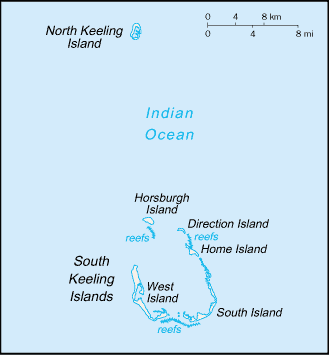
|
FAQs
Question: What are the Five Interested Parties?
Answer:
The Five Interested Parties or FIPs are also known as the Five or the Quint. It includes Australia, Brazil, the EU, India, and the US, who have been meeting since 2004 to try to break the deadlock in agriculture.
Question: What is the turnaround time?
Answer:
In maritime travel, the duration between the arrival of a vessel and its departure is referred to as the turnaround time. It is a metric that measures the fighting preparedness of a navy.
MCQs
Question: Consider the following statements about the QUAD.
- All member nations are Westminster-style democracies.
- Its central theme is a free and open Indo-Pacific region.
- All 4 nations participate in the Malabar exercise biannually.
How many of the above statements are correct?
(a) Only 1
(b) Only 2
(c) All 3
(d) None
Answer: (a) See the Explanation
- The QUAD nations include India, Australia, the U.S.A., and Japan. While India and Australia are Westminister-style democracies, the U.S.A. is not. Although the Japanese Constitution prescribes a Westminister-style democracy, the actual implementation is different. Hence statement 1 is incorrect.
- The central theme of the QUAD is an open and fair Indo-Pacific. Hence statement 2 is correct.
- The Malabar exercise is an annual exercise between the navies of the four QUAD nations. Hence statement 3 is incorrect.
Therefore, option (a) is the correct answer.
Download the PREPP App and attempt FREE IAS Exam Mock Tests and get complete study material!

Full Test - 04: UPSC CSE Prelims CSAT (Paper-II)
Full Test - 03: UPSC CSE Prelims CSAT (Paper-II)
UPSC CSE Prelims 2026 GS Paper 1 Question Paper (24-May-2026)
UPSC CSE Prelims 2026 CSAT Paper 2 Question Paper (24-May-2026)

17 February 2025 | The Hindu Must Read Articles | Current Affairs

16 February 2026 | The Hindu Must Read Articles | Current Affairs

13 February 2026 | The Hindu Must Read Articles | Current Affairs









Comments