Isro’s PSLV-C56 Puts 7 Satellites In Orbit; Four More Missions This Year
(Source: The Hindu, 07/31/2023)
Click here for Daily Current Affairs
Why in the news?
- Recently, ISRO successfully completed the launch of the PSLV-C56 whose payload consisted of seven satellites including the DS-SAR from Singapore.
- ISRO is scheduled to launch four more missions in 2023 including the Gaganyaam test vehicle and INSAT 3DS.
Table of Contents
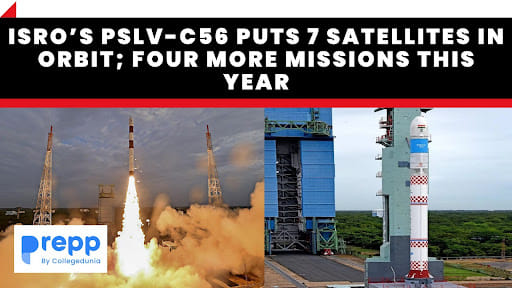
PSLV Mission status
- The PSLV C-56 launch vehicle with its payload of seven satellites was launched from the Satish Dhawan Space Center, Sriharikota on 30th July at 6:31 in the morning.
- The mission was conducted for New Space India Limited (NSIL), the commercial arm of the Indian Space Research Organisation (ISRO).
- NSIL had been contracted to launch the seven satellites aboard the PSLV C-56 by agencies sponsored by the Government of Singapore.
Deorbiting Experiment
- ISRO stated that the PSLV-C56 has been successfully placed in the right orbit - a 535 km circular orbit.
- After the orbital placement, the PS4 stage was brought back to a lower orbit of 295 km x 300 km orbit.
- This reduces the time spent in space by the craft before reentering Earth’s atmosphere from more than two decades to less than two months.
- This technique is part of ISRO and India’s commitment to reduce space debris and ensure the sustainable use of space in a way that benefits everyone.
Payload
- DS-SAR: It is a 360 kg satellite that will be used to support the satellite imagery requirements of agencies under the Government of Singapore.
- It was developed through a partnership between DSTA (representing the Government of Singapore) and ST Engineering.
- Capabilities: All-weather day and night coverage and imaging at a 1-meter resolution with full polarimetry.
- It will be placed into a Near-equatorial Orbit (NEO) of 535 Km altitude at 5° inclination.
- VELOX-AM: It is a 23 kg technology demonstration microsatellite that will operate in a Low-orbit airport.
- ARCADE: The Atmospheric Coupling and Dynamics Explorer (ARCADE) is an experimental satellite developed by Singapore Space Research Agency.
- SCOOB-II: It is a 3U nanosatellite with a technology demonstrator payload.
- NuLIoN: It is an advanced 3U nanosatellite built by NuSpace to enable seamless IoT connectivity in urban and remote locations.
- Galassia-2: It is a 3U nanosatellite that will orbit Earth in a low earth orbit.
- ORB-12 STRIDER: It is a satellite developed under an International collaboration with multiple payloads for in-orbit testing and demonstration.
Future Missions of ISRO
- A PSLV mission in August or September
- Gaganyaan test vehicle
- Third development mission of a Small Satellite Launch Vehicle
- Geosynchronous Satellite Launch Vehicle mission for launching INSAT-3DS.
PSLV
- The Polar Satellite Launch Vehicle (PSLV) is India’s third-generation launch vehicle.
- It was the first Indian launch vehicle equipped with liquid stages and was first launched in October 1994.
- It was used in the launch of the Chandrayaan-1 in 2008 and the Mars Orbiter Spacecraft in 2013 and to place satellites from the IRNSS Constellation into orbit.
- Stages:
- First (PS1): Consists of S139 solid rocket motor augmented by 6 solid strap-on boosters.
- Second (PS2): The Vikas engine, an Earth-storable liquid rocket engine developed by the Liquid Propulsion Systems Centre.
- Third (PS3): A solid rocket motor that provides high thrust in the upper stages after the atmospheric phase of the launch.
- Fourth (PS4): The uppermost stage of PSLV comprises two Earth-storable liquid engines.
(*Click this link to read prelims specific weekly current affairs articles)
FAQs
Question: What is a near-equatorial orbit?
Answer:
A near-equatorial orbit is an orbit that lies close to the equatorial plane of the orbited object. It has a near 0° inclination. On Earth, such orbits lie on the celestial equator which is an imaginary celestial sphere on the same plane as Earth’s equator.
Question: What is a geostationary orbit?
Answer:
It is a low-inclination orbit which is also called a Geosynchronous Equatorial Orbit. Satellites placed in it appear ‘Stationary’ because their orbital period is the same as the earth’s rotation period. It generally houses communication satellites as it is easier for Earth antennas to track them without rotation
Question: What is INSAT-3DS?
Answer:
It is an operational meteorology mission operated by IMD and ISRO that will be launched into a geostationary orbit. It is the seventh unit of the INSAT-3 series which will weigh 2060 Kg at launch.
MCQs
Question: Consider the following statements about the NSIL:
- It is a Central Public Sector Enterprise under the Department of Space.
- It is the commercial and marketing arm of ISRO.
Which of the above statements is/are correct?
(a) Only 1
(b) Only 2
(c) 1 and 2
(d) None
Answer: (a) See the Explanation
- The New Space India Limited is a completely Government owned Central Public Sector Enterprise under the administrative control of the Department of Space (DOS). Hence statement 1 is correct.
- It is the commercial arm of the ISRO and builds satellites and launch vehicles and provides launch services as per the requirements of the customer.
- Antrix Corporation Limited is the commercial and marketing arm of ISRO. Hence statement 2 is incorrect.
Therefore, option (a) is the correct answer.
Download the PREPP App and attempt FREE IAS Exam Mock Tests and get complete study material!

Full Test - 04: UPSC CSE Prelims CSAT (Paper-II)
Full Test - 03: UPSC CSE Prelims CSAT (Paper-II)
UPSC CSE Prelims 2026 GS Paper 1 Question Paper (24-May-2026)
UPSC CSE Prelims 2026 CSAT Paper 2 Question Paper (24-May-2026)

17 February 2025 | The Hindu Must Read Articles | Current Affairs

16 February 2026 | The Hindu Must Read Articles | Current Affairs

13 February 2026 | The Hindu Must Read Articles | Current Affairs









Comments