The State Of Climate In Asia, 2022
Relevance: GS3 - Environment and Conservation
(Source: Down to Earth, 07/31/2023)
Click here for Daily Current Affairs
Why in the news?
- Recently, the State of Climate in Asia 2022 report was released by the World Meteorological Organisation (WMO).
- It was stated that Asia is the world’s most disaster-prone region.
- The report, one of a series of WMO regional State of the Climate reports, was released during a meeting of the UN Economic and Social Commission for Asia and the Pacific’s (ESCAP) Committee on Disaster Risk Reduction.
Table of Contents
Highlights of Asia's Increasing Disaster Trends in 2022
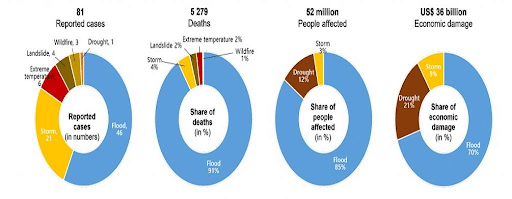
- Impact of Weather, Climate, and Water-Related Disasters: In 2022, there were 81 natural hazards that directly affected more than 50 million people in the continent. While this number is lower than 2021, the impacts were more severe in terms of fatalities, affected populations, and economic damage.
- Rising Human Deaths and Affected Population: In 2022, approximately 5,879 Asians lost their lives due to natural disasters, a significant 55% increase compared to 2021. The number of people affected by disasters also rose to 52 million, up from 48.3 million in the previous year.
- Economic Cost of Disasters: The economic cost of the damage caused by these events exceeded $36 billion in 2022. Pakistan alone accounted for 42% of this figure, with economic losses of at least $15 billion.
- Floods and Droughts: Flood-related economic losses in 2022 surpassed the 20-year average from 2002 to 2021. Pakistan, China, and India were particularly affected, with Pakistan experiencing losses of over $15 billion. Drought-related economic losses in 2022 (mainly in China) were nearly 200% higher than the 20-year average.
- Agriculture sector: More than 25% of all loss and damage from climate-related disasters in Asia are associated with the agriculture sector.
Challenges Faced
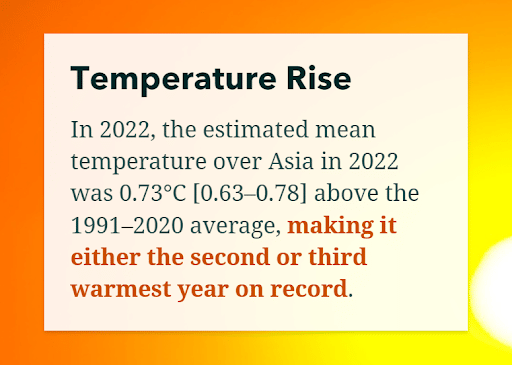
- The warming trend in Asia between 1991 and 2022 was almost double that of the period between 1961 and 1990. In 2022, the estimated mean temperature over Asia was 0.73°C, above the 1991-2020 average, which makes it either the second or third warmest year on record.
- Certain areas in Asia, such as the northwestern Arabian Sea, the Philippine Sea, and the seas east of Japan, have been warming at alarming rates of over 0.5°C per decade, about three times faster than the global average.
- Melting Glaciers and Rising Sea Levels: Glaciers in the High Mountain Asia region experienced mass loss, with accelerating trends. From 2013 to 2022, the global average sea level rose at a rate of 4.6 mm per year, with the rates across most of Asia higher than the global mean rate.
- La Nina Influence: The continuing La Nina from 2020 through 2022 had a significant impact on precipitation in parts of Asia, leading to devastating floods and disruptions.
- Warming of sea surface: Asia's surrounding seas are warming over three times faster than the global average, with the Barents Sea experiencing regional warming rates five-seven times higher than the global average, making it a climate change hotspot.
World Meteorological Organization (WMO)
|
Way Ahead
- Strengthening early warning systems and climate adaptation planning is crucial to mitigate adverse impacts.
- Implementing climate change adaptation strategies is crucial for building resilience in vulnerable communities and ecosystems.
- This includes measures like improved agricultural practices, water management, and infrastructure development.
- Governments should allocate resources and invest in disaster risk reduction programs to minimize the impact of disasters.
- Continued research and innovation in climate science and disaster management can lead to better understanding and more effective strategies for mitigation and adaptation.
(*Click this link to read prelims specific weekly current affairs articles)
FAQs
Question: What is World Meteorological Organization (WMO)?
Answer:
It is a specialized agency of the United Nations responsible for promoting international cooperation in the field of meteorology (weather and climate), operational hydrology, and related geophysical sciences.
Question: Where is the Barent Sea?
Answer:
The Barents Sea is a marginal sea of the Arctic Ocean, located off the northern coasts of Norway and Russia and divided between Norwegian and Russian territorial waters.
Question: What is Climate Change?
Answer:
Climate change encompasses long-term changes in temperatures and weather patterns, which can be both natural and human-induced. However, since the 1800s, human activities, particularly the burning of fossil fuels such as coal, oil, and gas, have been the primary driver of climate change by releasing heat-trapping gases into the atmosphere.
UPSC Mains Practice Question:
|
MCQ
Question: ‘State of climate in Asia, 2022,’ recently seen in news, is released by:
(a) United Nations
(b) World Bank
(c) IPCC
(d) WMO
Answer: (d) See the Explanation
State of Climate in Asia 2022 report was released by the World Meteorological Organisation (WMO). It was stated that Asia is the world’s most disaster-prone region.
Download the PREPP App and attempt FREE IAS Exam Mock Tests and get complete study material!

Full Test - 04: UPSC CSE Prelims CSAT (Paper-II)
Full Test - 03: UPSC CSE Prelims CSAT (Paper-II)
UPSC CSE Prelims 2026 GS Paper 1 Question Paper (24-May-2026)
UPSC CSE Prelims 2026 CSAT Paper 2 Question Paper (24-May-2026)

17 February 2025 | The Hindu Must Read Articles | Current Affairs

16 February 2026 | The Hindu Must Read Articles | Current Affairs

13 February 2026 | The Hindu Must Read Articles | Current Affairs









Comments