India, Japan Will Work To Strengthen ‘Peacetime Cooperation’: Jaishankar
(Source: The Hindu, 07/29/2023)
Click here for Daily Current Affairs
Why in the news?
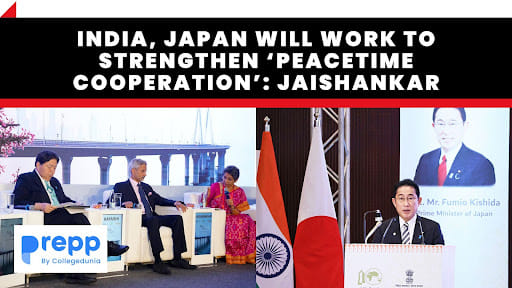
- Recently, the External Affairs Minister of India stated that India and Japan were natural partners and that they would strengthen peacetime cooperation.
- The event was also attended by the Japanese Foreign Minister who also discussed the Indo-Japanese partnership.
- Japan’s new Indo-Pacific policy also focussed on India’s indispensable role in maintaining a free and open Indo-Pacific and a rule of law-based international order.
Table of Contents
What did the External Affairs Ministers of India and Japan say on India-Japan cooperation during peacetime?
Indian
- Partners: India and Japan are natural partners in facing the emerging challenges of the future world order.
- Cooperation:
- India and Japan would work together to enhance cooperation in economics, supply chains, the digital sector and critical technologies, and maritime security.
- Ensuring strengthened peace, stability, and security in the Indo-Pacific region would help avoid some of the worst fears of both countries.
- However, the minister did not directly reply to queries on India’s wartime cooperation if a war broke out over Chinese aggression in the Taiwan strait, which is one of Japan’s worst-case scenarios.
- Modernizer: Japan is the epitome of modernization and has played a crucial role in several industrial revolutions in India.
- These include the Maruti-Suzuki passenger car project, Metro rail projects, and high-speed rail projects like the Mumbai-Ahmedabad Shinkansen project.
- Therefore, Japan is a suitable example for India to follow in its pursuit of modernization.
Japanese
- India-China conflict:
- India and Japan were cooperating through military and maritime exercises which could help India in case the Sino-India border conflict worsened or if security concerns arose in the Indo-Pacific.
- The first-ever India-Japan joint fighter exercise was conducted in 2023 as part of the two countries’ efforts for military preparedness and enhanced interoperability.
- Regional stability:
- Strong bilateral ties with countries of the region and improved people-people ties would boost regional stability.
- Additionally, defense cooperation would contribute towards mitigating any potentially adverse scenarios.
Other initiatives discussed during the Meeting
- At the 15th annual India-Japan Foreign Ministers’ Strategic Dialogue, the two countries recommitted to Japanese investment worth five trillion yen in India during 2022-2027.
- Japan’s new Indo-Pacific policy, which was unveiled during the Japanese Prime Minister’s visit to India in April 2023 focuses on investments in India, Bangladesh, and Sri Lanka.
- Japan, which is the President of the G-7, has expressed its desire to align its presidential goals with India’s G-20 presidency goals such as prioritizing the involvement of the Global South.
- It was necessary to listen to the voices of the Global South and cooperate on their issues such as a free and open international order based on the Rule of law.
Japan’s New Indo-Pacific Policy
- Japan’s new policy for the Indo-Pacific emphasizes the necessity to maintain a rules-based order and respect the geographical authority of countries in the region.
- The Indo-Pacific which is a combination of two regions — Asia and Africa; and two oceans - Pacific and Indian, can be a key driver towards ensuring international security and building wealth.
- Terrorism, Proliferation of WMD, Natural disasters, and efforts to alter the status quo were identified as major threats.
Four Pillars of Cooperation
- Quality Infrastructure Investment: Participate in economic development programs such as the G-20 Principles for "Quality Infrastructure Investment."
- Implement and establish guidelines for Official Development Assistance (ODAs) through the mobilization of private capital, including $75 billion in public and private capital for infrastructure development in the Indo-Pacific by 2030.
- Addressing challenges in an Indo-Pacific manner: Realistic initiatives in fields such as climate change, agricultural security, global health, and cybersecurity.
- Multi-layered Connectivity: Additional initiatives with Southeast Asia, South Asia, and Pacific Island countries.
- Eg: Collaborate with India and Bangladesh to promote the Bay of Bengal-Northeast India industrial value chain
- Efforts for security: Assist nations in improving their maritime law enforcement capacities.
India-Japan ties
- Historic: India-Japan ties date back to the visit of Bodhisena, an Indian monk, in 752 AD.
- India and Japan established diplomatic relations on 28 April 1952.
- India agreed on a separate peace treaty with Japan in 1952 after its sovereignty was fully restored following the Second World War.
- Economic: India was the 18th largest trading partner for Japan, and Japan was the 13th largest trading partner for India in 2021.
- Japan was the 5th largest investor for India in FY2021.
- India has been the largest recipient of Japanese ODA Loan for the past decade
- Defense: Military exercises between India and Japan include
- JIMEX- Bilateral naval exercise
- SHINYU Maitri- Bilateral air force exercise
- Dharma Guardian- Bilateral army exercise
- Ex. Malabar- Naval exercise of QUAD nations
Challenges
- Trade: Indian exports have struggled to penetrate the Japanese market due to high quality and service standards, and language barriers.
- Defense Exports: India’s push towards promoting defense exports could lead to potential competition with Japan's defense exports.
- China: India and Japan relations have developed over concerns about China.
- Experts have recommended increased cooperation in mutual interests such as Trade, Science and Technology Cooperation, etc.
- Delayed projects: Many Indo-Japan projects have been delayed and economically impacted such as the Asia-Africa Growth Corridor and the Mumbai-Ahmedabad Bullet train project.
- Divergences: There is a divergence in interests between India and Japan.
- These include India’s decision to exit from the trade pillar of IPEF, and RCEP due to domestic compulsions while Japan has aimed to engage proactively with countries in the Indo-Pacific region.
(*Click this link to read prelims specific weekly current affairs articles)
FAQs
Question: What is the Indo-Pacific region?
Answer:
The Indo-Pacific region refers to the Indian Ocean, the western and central Pacific Oceans, and the seas between them. It is a geopolitical term that was developed to replace the term "Asia-Pacific”.It extends from Africa's east shore to America's west coast.
Question: What is the RCEP?
Answer:
RCEP is a trade agreement involving 15 countries in the Asia-Pacific region including the 10 member states of the Association of Southeast Asian Nations (ASEAN). It aims to create a regional free trade area, covering a significant portion of the global economy, and is one of the largest trade agreements in the world.
MCQs
Question: Furoshiki, which was recently in the news, is a sustainable alternative to plastic from which of the following countries?
(a) South Korea
(b) China
(c) Thailand
(d) Japan
Answer: (d) See the Explanation
- Furoshiki, a Japanese traditional wrapping cloth, is eco-friendly and used for wrapping gifts, carrying goods, or decorating.
- The reusable Furoshiki can be an example of a sustainable alternative to traditional plastic wrapping paper.
Therefore, option (d) is the correct answer.
Download the PREPP App and attempt FREE IAS Exam Mock Tests and get complete study material!

Full Test - 04: UPSC CSE Prelims CSAT (Paper-II)
Full Test - 03: UPSC CSE Prelims CSAT (Paper-II)
UPSC CSE Prelims 2026 GS Paper 1 Question Paper (24-May-2026)
UPSC CSE Prelims 2026 CSAT Paper 2 Question Paper (24-May-2026)

17 February 2025 | The Hindu Must Read Articles | Current Affairs

16 February 2026 | The Hindu Must Read Articles | Current Affairs

13 February 2026 | The Hindu Must Read Articles | Current Affairs









Comments