States’ Lax Response To Lynching
Relevance: GS3 - Challenges to internal security through communication networks, the role of media and social networking sites in internal security challenges GS2- Governance
(Source: The Hindu, 07/31/23)
Click here for Daily Current Affairs
Why in the news?
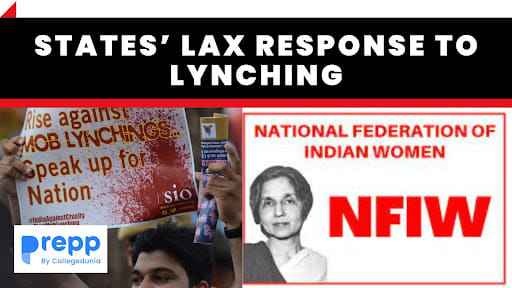
- Recently, the Supreme Court issued a notice to the Ministry of Home Affairs and the Governments of Maharashtra, Odisha, Rajasthan, Bihar, Madhya Pradesh, and Haryana based on a petition filed by the National Federation of Indian Women (NFIW).
- The petition seeks an explanation for the failure to address lynching and mob violence against Muslims by cow vigilantes despite a landmark judgment in Tehseen Poonawala versus Union of India in 2018.
Table of Contents
What is Mob Lynching?
- Mob lynching is when common people take the law into their own hands, violating human rights by killing others without due process.
- It is caused by intolerance, biases, vigilantism, and a lack of speedy justice.
- In India, it can be related to communal violence, cow-related issues, suspicion of child lifting, theft cases, etc.
- It constitutes a grand failure on part of the State which must prevent the violation thereof and must further protect the fundamental rights (Article 14, 15 and 21) guaranteed to its citizens under the Constitution.
- Articles 14 (equality before the law),
- Article 15 (religious non-discrimination) and
- Article 21 (right to life)
About Tehseen Poonawala Judgment
- The Supreme Court, under Justice Dipak Misra, emphasized that it is the state's duty to protect its citizens.
- The judgment condemned incidents of lynchings and their glorification on social media, questioning whether tolerance and diversity values were eroding.
- The court warned against vigilantism, stating that states must prevent any form of it, including cow vigilantism, as it leads to anarchy and a violent society. Vigilantism should not be tolerated under any circumstances.
Example of Cases Highlighted in NFIW Petition
- In early 2023, several incidents of violence against Muslims were reported in different parts of India.
- These alleged attacks included a Muslim man being lynched in Haryana for transporting a cow, two men being lynched and set on fire in Rajasthan, and a 56-year-old man being lynched in Bihar over suspicions of carrying beef.
- In April, Asif Qureshi was allegedly assaulted in Latur, Maharashtra, in the presence of two constables and three home guards, an attack on a bus carrying Hajj pilgrims in Rajasthan, and the brutal assault of two Muslim men in Odisha.
- The violence culminated in June with the fatal assault on two men suspected of smuggling beef, leaving one dead and the other undergoing treatment in Mumbai.
- These incidents sparked outrage and raised concerns about communal tensions in the country.
Remedial directions given by the SC
- Appointment of Nodal Officer: The designated nodal officer, not below the rank of Superintendent of Police (SP), will be appointed to address measures against prejudice-motivated crimes like mob violence and lynching.
- Immediate Lodging of FIR: Local police must immediately lodge a First Information Report (FIR) upon noticing an incident of lynching or mob violence.
- Duties of the Nodal Officer and Station House Officer: The appointed nodal officer in the district must be informed by the Station House Officer (SHO) after registering the FIR. The nodal officer is responsible for ensuring the victims' families are protected from further harassment.
- Personal Monitoring of Investigation: The nodal officer must personally monitor the investigation of the crime to ensure its proper handling. The investigation and chargesheet filing should be completed within the stipulated period as per the law.
- Compensation Scheme for Victims: A compensation scheme should be established to provide support to the victims of prejudice-motivated crimes.
- Non-compliance Consequences: Failure by police or district administration officers to comply with court directions will be considered deliberate negligence and misconduct.
- Disciplinary Actions: States should take appropriate disciplinary action against officials who fail to prevent mob lynching incidents despite prior knowledge.
What are the steps taken by the government and the judiciary to prevent this?
- In 2018, the Supreme Court of India issued a comprehensive set of guidelines aimed at addressing the alarming issue of mob lynching and cow vigilantism in the country.
- These guidelines encompass preventive, remedial, and punitive measures to effectively combat this menace.
- The preventive measures recommended by the Supreme Court include the identification of vulnerable areas, the deployment of police patrols in such regions, and the prompt registration of FIRs whenever incidents of mob violence occur.
- The Ministry of Home Affairs issued an advisory in 2019 to all the states and union territories to implement the Supreme Court's guidelines and take effective action against mob lynching.
- In response to the gravity of the situation, some states like Rajasthan, Manipur, West Bengal, and Madhya Pradesh have introduced or proposed specific anti-lynching laws.
- These laws define mob lynching as a distinct criminal offense and prescribe stringent penalties for those involved in such acts.
International Laws to Deal with Mob Lynching
- Universal Declaration of Human Rights
- International Covenant on Civil and Political Rights
- Convention against Torture and Other Cruel, Inhuman or Degrading Treatment or Punishment
- International Convention on the Elimination of All Forms of Racial Discrimination
- Rome Statute of the International Criminal Court
(*Click this link to read prelims specific weekly current affairs articles)
FAQs
Question: What is Mob Lynching?
Answer:
Mob lynching is when common people take the law into their own hands, violating human rights by killing others without due process. It is caused by intolerance, biases, vigilantism, and a lack of speedy justice.
Question: What is the National Federation of Indian Women (NFIW)?
Answer:
The National Federation of Indian Women is a women's organisation in India, the women's wing of the Communist Party of India. It was established in 1954 June 4 by several leaders from Mahila Atma Raksha Samiti including Aruna Asaf Ali.
Question: What is the Tehseen Poonawala Judgment?
Answer:
The Supreme Court, under Justice Dipak Misra, emphasized that it is the state's duty to protect its citizens. The judgment condemned incidents of lynchings and their glorification on social media, questioning whether tolerance and diversity values were eroding.
MCQ
Question: Right to Privacy is protected as an intrinsic part of Right to Life and Personal Liberty. Which of the following in the Constitution of India correctly and appropriately implies the above statement? (UPSC 2018)
(a) Article 14 and the provisions under the 42nd Amendment to the Constitution.
(b) Article 17 and the Directive Principles of State Policy in Part IV.
(c) Article 21 and the freedoms guaranteed in Part III.
(d) Article 24 and the provisions under the 44th Amendment to the Constitution.
Answer: (c) See the Explanation
Article 21: The right to privacy is protected as an inherent part of the right to life and personal liberty under Article 21 and as part of the freedoms guaranteed by Part III of the Constitution.
Therefore, option (c) is the correct answer.
Download the PREPP App and attempt FREE IAS Exam Mock Tests and get complete study material!

Full Test - 04: UPSC CSE Prelims CSAT (Paper-II)
Full Test - 03: UPSC CSE Prelims CSAT (Paper-II)
UPSC CSE Prelims 2026 GS Paper 1 Question Paper (24-May-2026)
UPSC CSE Prelims 2026 CSAT Paper 2 Question Paper (24-May-2026)

17 February 2025 | The Hindu Must Read Articles | Current Affairs

16 February 2026 | The Hindu Must Read Articles | Current Affairs

13 February 2026 | The Hindu Must Read Articles | Current Affairs









Comments