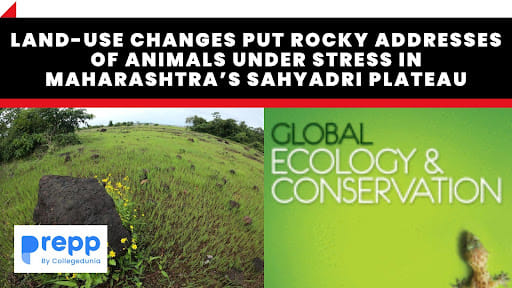
Land-Use Changes Put Rocky Addresses Of Animals Under Stress In Maharashtra’s Sahyadri Plateau
Relevance: GS 3 - Conservation, environmental pollution and degradation, environment Biodiversity
(Source: The Hindu, 07/31/23)
Click here for Daily Current Affairs
Why in the news?
- A recent research study conducted by the Nature Conservation Foundation-India (NCF), Bombay Environmental Action Group (BEAG), and the Reliance Foundation in Ahmedabad has been published in the peer-reviewed international journal Global Ecology and Conservation.
- The study examines the effects of monoculture plantations of mango and cashew on elusive amphibians, insects, and reptiles that inhabit the areas under loose rocks in the Sahyadri plateaus of Maharashtra.
- The research focused on white-striped viper gecko, Seshachari’s caecilian, saw-scaled viper, ants, spiders, and scorpions.
Table of Contents
How have land-use changes impacted animals in Maharashtra’s Sahyadri Plateau?
- Threat to habitat: The animals seek refuge under loose rocks on the rocky plateaus of Maharashtra, protecting them from the scorching heat of summer and the heavy monsoon rains.
- Many of these animals are unique, and sensitive to the changes on the plateaus, even removing a rock can have cascading impacts on biodiversity.
- Adaptability: The changing land-use patterns like abandoning traditional local grain cultivation, and establishing monoculture plantations of mango and cashew pose a challenge to their adaptability.
- The rapid expansion of mango orchards has resulted in the conversion of more than 25,000 hectares of lateritic plateaus.
- The increasing number of orchards poses a threat to the rare and vulnerable animals living under the rocks.
Way forward
- Given their rarity and vulnerability to change due to ever-increasing orchards, representative plateau habitats need to be preserved in partnership with local communities and could help conserve the plateaus as biodiversity heritage sites
Maharashtra Plateau
|
(*Click this link to read prelims specific weekly current affairs articles)
FAQs
Question: What is Monoculture?
Answer:
Monoculture is the agricultural practice of growing a single crop, plant, or livestock species, variety, or breed in a field or farming system at a time. Monocropping is the practice of growing the same crop on the same land year after year.
Question: What is meant by rock outcrops?
Answer:
Rock outcrops are defined as visible exposures of bedrock or other geologic formations at the surface of the Earth.
Question: What are western ghats?
Answer:
The Western Ghats are a chain of mountains running parallel to India’s western coast, approximately 30-50 km inland, the Ghats traverse the States of Kerala, Tamil Nadu, Karnataka, Goa, Maharashtra and Gujarat. These mountains cover an area of around 140,000 km² in a 1,600 km long stretch that is interrupted only by the 30 km Palghat Gap at around 11°N. Older than the great Himalayan mountain chain, the Western Ghats of India are a geomorphic feature of immense global importance.
MCQ
Question: Consider the following statements:
- The Western Ghats traverse the States of Kerala, Tamil Nadu, Karnataka, Goa, Maharashtra and Gujarat.
- Western Ghats are younger than the great Himalayan mountain chain.
Which of the above statements is/are correct?
(a) 1 only
(b) 2 only
(c) Both 1 and 2
(d) Neither 1 nor 2
Answer: (a) See the Explanation
- The Western Ghats are a chain of mountains running parallel to India’s western coast, approximately 30-50 km inland, the Ghats traverse the States of Kerala, Tamil Nadu, Karnataka, Goa, Maharashtra and Gujarat. Hence, statement 1 is correct.
- These mountains cover an area of around 140,000 km² in a 1,600 km long stretch that is interrupted only by the 30 km Palghat Gap at around 11°N. Older than the great Himalayan mountain chain, the Western Ghats of India are a geomorphic feature of immense global importance. Hence, statement 2 is correct.
- Therefore, option (a) is the correct answer.
Download the PREPP App and attempt FREE IAS Exam Mock Tests and get complete study material!

Full Test - 04: UPSC CSE Prelims CSAT (Paper-II)
Full Test - 03: UPSC CSE Prelims CSAT (Paper-II)
UPSC CSE Prelims 2026 GS Paper 1 Question Paper (24-May-2026)
UPSC CSE Prelims 2026 CSAT Paper 2 Question Paper (24-May-2026)

17 February 2025 | The Hindu Must Read Articles | Current Affairs

16 February 2026 | The Hindu Must Read Articles | Current Affairs

13 February 2026 | The Hindu Must Read Articles | Current Affairs









Comments