Troposphere - Layers of Atmosphere - Geography Notes
The atmosphere consists of different layers with varying densities and temperatures. The troposphere is the lowest layer of the Earth’s atmosphere. The height of this layer is about 18 km on the equator and 8 km on the poles. The troposphere contains the majority (about 75–80%) of the atmosphere's mass. The troposphere is where most clouds are found, and it is also where most weather is produced. By far, the wettest part of the atmosphere is the troposphere (all of the other layers contain very little moisture). In this article, you will read about the troposphere in detail for the IAS exam.
|
Table of Contents |
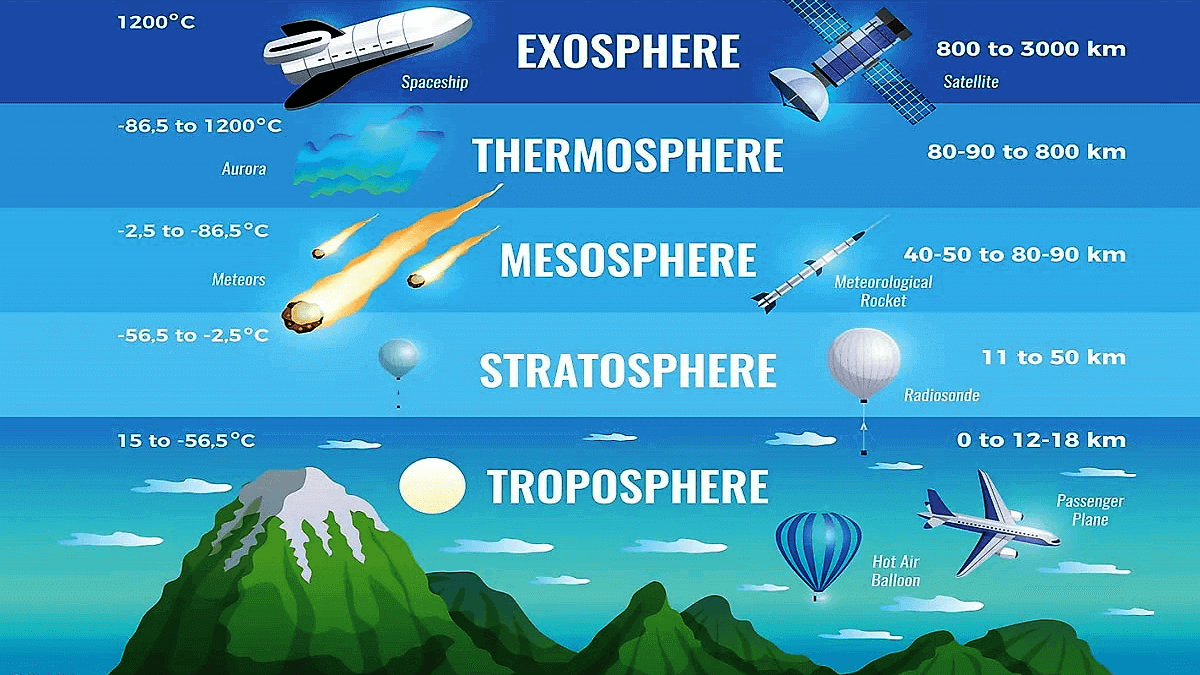
Location of Troposphere
Troposphere
- It extends about 8-16 km above the earth. The troposphere is the lowest layer of the Earth's atmosphere, containing around 80% of its mass and 99 % of its water vapour and aerosols.
- In addition to nitrogen and oxygen, the troposphere contains carbon dioxide, water vapour (almost all of the water vapour in the atmosphere is concentrated in the troposphere), and a variety of other particles.
- The troposphere is where the majority of our weather occurs: clouds, rain, and snow.
- The troposphere is home to nearly all of the air in the atmosphere, as well as nearly all of the water vapour (which forms clouds and rain).
- Its thickness, which tends to vary seasonally, is least at the poles and greatest at the equator.
- The water vapour and particulates of the atmosphere are concentrated in this one layer; they are rarely found in the atmosphere above the troposphere.
Tropospheres Thickness
- The thickness of the troposphere varies across different latitudes of the earth.
- It is thickest in the equator, up to 20 km deep in the tropics, and shallower near the poles, at 7 km.
Reasons:
-
Temperature Differences:
- The equator receives more direct sunlight throughout the year, leading to higher temperatures. Warm air expands and rises, resulting in a thicker troposphere.
- The poles receive less sunlight, leading to cooler temperatures. Cold air is denser and contracts, resulting in a thinner troposphere.
-
Earth's Rotation (Coriolis Effect):
- The rotation of the Earth affects the distribution of atmospheric pressure and temperature. The centrifugal force is greatest at the equator, causing the atmosphere to bulge outward.
- This effect is less pronounced at the poles, where the centrifugal force is minimal.
-
Convection Currents:
- At the equator, strong convection currents (rising warm air) contribute to a thicker troposphere as the warm air rises higher before cooling and descending.
- At the poles, weaker convection currents result in a thinner troposphere because the cold air does not rise as high.
Chemical Composition of Troposphere
- With the significant exception of water vapour, the chemical composition of the troposphere is generally uniform.
- With increasing altitude, the volume of water vapour drops dramatically. As a result, the quantity of water vapour is generally highest at the surface and gradually drops as one rises in altitude.
Temperature of Troposphere
- The temperature in this area of the atmosphere drops by around 6.5°C per kilometre as the distance above the earth increases. The temperature normally decreases with increased altitude.
- The average rate at which temperature within the troposphere decreases with altitude is called the normal lapse rate (or environmental lapse rate).
- The lapse rate of the environment (ELR) is roughly 0.6°C per 100 metres. With increasing altitude, the temperature drops at a nearly uniform rate.
- The reason for the lapse is that the world's general thermal balance is maintained by maximum absorption of the sun's energy at the bottom, which heats the lower levels of the atmosphere, and maximum radiation of heat occurs at the top of the atmosphere, cooling the earth.
Significance of Troposphere
- The troposphere is crucial to understand because we breathe the air in this layer of the atmosphere.
- The troposphere makes up around 85% of the overall mass of the atmosphere. The water or hydrologic cycle and the greenhouse effect are examples of tropospheric processes that have a significant impact on meteorology and climate.
- The chemical makeup of the air determines its quality. Certain components, even if present in trace amounts, can be harmful to human health and the environment. As a result, it's critical to understand how human activities affect the troposphere.
Conclusion
Because of its simplicity, inherent logic, and scientific appeal, the tidal hypothesis, as proposed by James Jeans and modified by Harold Jeffreys, enjoyed a long period of popularity and wide acceptance until the end of the first half of the twentieth century, but the hypothesis was severely criticised on various grounds. Even Jeffreys admitted in Guttenberg (1951) that his modified version of the tidal hypothesis needed significant revisions and was incorrect in several places.
|
|
|
|---|---|
| Geography Notes | Physical Geography |
| Atmosphere | Geomorphology |
| Climatology | Lakes and Its Types |
| Plateau and its Types | Geomorphic Processes |
FAQs
Question: What is the average height of the troposphere?
Answer: The average height of the troposphere varies between 8 to 15 kilometers (5 to 9 miles) depending on geographical location, with it being thicker at the equator and thinner at the poles.
Question: What role does the troposphere play in weather formation?
Answer: The troposphere is crucial for weather formation as it contains most of the atmosphere's water vapor and is where weather phenomena such as clouds, precipitation, and storms occur. The heat from the Earth's surface causes convection currents that lead to these weather changes.
Question: How does human activity impact the troposphere?
Answer: Human activities, particularly the burning of fossil fuels and industrial emissions, significantly impact the troposphere by introducing pollutants, greenhouse gases, and aerosols. These contributions can lead to air quality deterioration, climate change, and disruptions in weather patterns.
Question: What is the significance of the planetary boundary layer?
Answer: The planetary boundary layer is significant as it is the part of the troposphere that directly interacts with the Earth's surface. This layer influences local weather conditions, including temperature, humidity, and wind patterns, and plays a critical role in the dispersion of pollutants and heat exchange.
Question: What happens to temperature as altitude increases in the troposphere?
Answer: In the troposphere, temperature generally decreases with altitude. This lapse rate is a fundamental characteristic, where temperatures can drop from approximately 15°C at sea level to about -50°C at the tropopause, the boundary separating the troposphere from the stratosphere.
MCQs
1. What is the primary gas found in the troposphere?
A) Oxygen
B) Nitrogen
C) Carbon Dioxide
D) Argon
Answer: (B) See the Explanation
Explanation: Nitrogen is the primary gas in the troposphere, making up about 78% of the atmosphere, followed by oxygen at approximately 21%.
2. Which of the following phenomena occurs primarily in the troposphere?
A) Aurora Borealis
B) Ocean Currents
C) Weather Patterns
D) Plate Tectonics
Answer: (C) See the Explanation
Explanation: Weather patterns such as clouds, precipitation, and storms primarily occur in the troposphere due to its role in atmospheric processes.
3. What is the tropopause?
A) The boundary between the troposphere and stratosphere
B) The highest layer of the atmosphere
C) A layer of ozone
D) The ground level of the Earth
Answer: (A) See the Explanation
Explanation: The tropopause is the boundary between the troposphere and the stratosphere, marking the point where the temperature stops decreasing with altitude and begins to increase.
4. Which layer of the atmosphere contains the highest concentration of water vapor?
A) Stratosphere
B) Mesosphere
C) Troposphere
D) Thermosphere
Answer: (C) See the Explanation
Explanation: The troposphere contains the highest concentration of water vapor, which is essential for cloud formation and precipitation.
5. What is the primary factor that leads to the formation of convection currents in the troposphere?
A) Sunlight heating the Earth's surface
B) Earth's rotation
C) Wind patterns
D) Ocean currents
Answer: (A) See the Explanation
Explanation: The primary factor leading to the formation of convection currents in the troposphere is the sunlight heating the Earth's surface, causing warm air to rise and cool air to sink.
GS Mains Questions and Model Answers
Q1: Discuss the role of the troposphere in Earth's climate system.
Answer: The troposphere plays a vital role in Earth's climate system as it contains the majority of the atmosphere's water vapor and is the primary site for weather phenomena. The interactions between solar radiation, atmospheric conditions, and the Earth's surface temperature create complex weather patterns that influence local and global climates. The presence of greenhouse gases in the troposphere contributes to the greenhouse effect, which regulates temperatures and maintains habitable conditions on the planet. Additionally, the troposphere is crucial for the distribution of heat through convection, affecting ocean currents and ultimately the climate of different regions. Understanding the dynamics of the troposphere is essential for climate science and environmental management.
Q2: Analyze the impact of human activities on the troposphere and its implications for climate change.
Answer: Human activities significantly impact the troposphere, primarily through the emission of greenhouse gases, aerosols, and pollutants from industrial processes, vehicles, and agriculture. These emissions alter the natural balance of gases in the troposphere, contributing to the greenhouse effect and global warming. The increased concentration of carbon dioxide and methane traps more heat, leading to rising temperatures and changes in weather patterns. Additionally, air pollution can lead to the formation of smog and acid rain, further impacting air quality and human health. The implications for climate change are profound, as disruptions to the troposphere's composition and dynamics can lead to more extreme weather events, altered precipitation patterns, and challenges to food security. Addressing these issues is crucial for sustainable development and mitigating climate change.
Q3: Evaluate the significance of understanding the troposphere for meteorology and environmental science.
Answer: Understanding the troposphere is essential for meteorology and environmental science as it provides insights into atmospheric processes that govern weather and climate. Meteorologists study the troposphere to predict weather patterns, issue warnings for severe weather, and develop climate models that inform policy and preparedness strategies. Environmental scientists focus on the troposphere to assess air quality, understand pollution dynamics, and evaluate the impacts of climate change on ecosystems. The troposphere's interactions with the Earth's surface, biosphere, and hydrosphere are crucial for a holistic understanding of environmental systems. Knowledge of the troposphere facilitates informed decision-making regarding climate policies, disaster management, and sustainable practices aimed at protecting both human and ecological health.
Previous Year Questions on Troposphere
1. UPSC CSE Prelims 2021:
Question: Which layer of the atmosphere is directly involved in weather phenomena?
A) Stratosphere
B) Mesosphere
C) Troposphere
D) Thermosphere
Answer: (C)
Explanation: The troposphere is directly involved in weather phenomena, containing most of the atmosphere's water vapor and facilitating weather changes.
2. UPSC CSE Mains 2019 (GS Paper 1):
Question: "Examine the importance of the troposphere in the context of climate change."
Answer: The troposphere is critically important in the context of climate change as it is the layer of the atmosphere that interacts most directly with human activities. The increase in greenhouse gases due to industrialization, transportation, and deforestation leads to significant warming in the troposphere, which alters global climate patterns. Understanding the dynamics of the troposphere is essential for predicting the impacts of climate change on weather extremes, precipitation patterns, and ecosystem health. The troposphere's role in the greenhouse effect highlights the need for policies aimed at reducing emissions and mitigating climate impacts.
Download the PREPP App and attempt FREE IAS Exam Mock Tests and get complete study material!

Full Test - 04: UPSC CSE Prelims CSAT (Paper-II)
Full Test - 03: UPSC CSE Prelims CSAT (Paper-II)
UPSC CSE Prelims 2026 GS Paper 1 Question Paper (24-May-2026)
UPSC CSE Prelims 2026 CSAT Paper 2 Question Paper (24-May-2026)

17 February 2025 | The Hindu Must Read Articles | Current Affairs

16 February 2026 | The Hindu Must Read Articles | Current Affairs

13 February 2026 | The Hindu Must Read Articles | Current Affairs









Comments