The Bureaucracy As Prosecutor And Judge
Relevance: GS 2 - Role of civil services in a democracy; Separation of powers between various organs disputes redressal mechanisms and institutions
(Source: The Hindu, 08/07/23)
Click here for Daily Current Affairs
Why in the news?
- Recently, the controversial Jan Vishwas Act, 2022 was enacted into law by Parliament.
- It proposes to amend 183 provisions to be decriminalized in 42 Central Acts administered by 19 Ministries/Departments.
- The Act aims at giving a further boost to Ease of Living and Ease of Doing Business.
Table of Contents
What are the issues with the bill?
- Transfer of power: The legislation has transferred the power to impose these monetary penalties from the judiciary to the bureaucracy.
- The Jan Vishwas Act introduces amendments to the Environmental (Protection) Act, 1986, and the Air (Prevention and Control of Pollution) Act, 1981.
- These changes eliminate imprisonment as a penalty for specific offenses.
- Instead, designated bureaucrats, notably Joint Secretaries, gain the authority to impose fines, with penalties extending up to ₹15 lakh.
- Expanded Powers of Forest Officers: The revised Jan Vishwas Act extends the authority of forest officers under the Indian Forest Act, 1927.
- Apart from investigating forest-related harm, these officers can now also determine the extent of "damage done to the forest" and require the offender to pay uncapped "compensation" for the inflicted harm.
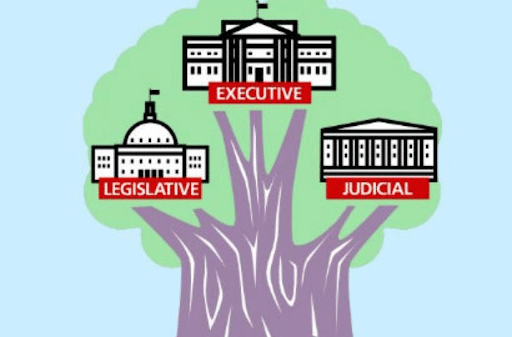
- Against separation of powers: Allowing bureaucrats, instead of the courts, to decide disputes, penalties, and compensation goes against the principle of separation of powers.
- One of the Directive Principles of State Policy, Article 50, states that the State shall take steps to separate the judiciary from the executive in the state's public services. Its goal is to protect the judiciary's independence from the executive branch.
How has the bureaucracy been able to assume the role of the Judiciary?
- The separation process started to take shape around 1970, when various State legislatures introduced measures like The West Bengal Separation of Judicial and Executive Functions Act, 1970. It separated the roles of judicial and executive magistrates in the Criminal Procedure Code, of 1898.
- However, even after separating the criminal magistracy from the executive, the challenge of safeguarding judicial independence from bureaucratic influence persisted.
- Three routes have been used by the bureaucracy to assume the role of the Judiciary.
- Tribunals: Government ministries established judicial tribunals to assume judicial responsibilities previously held by the judiciary. These tribunals often appointed bureaucrats as "technical members," undermining the judiciary's autonomy.
- For example, the Central Administrative Tribunal for administrative matters, the Securities Appellate Tribunal to hear appeals against decisions of financial sector regulators.
- Statutory bodies: The Union government created statutory regulators, such as the Securities and Exchange Board of India and the Competition Commission of India (CCI), vested with punitive powers against the private sector. These regulators were frequently led by senior bureaucrats.
- Legislations: In various legislations like the Prevention of Money Laundering Act, the Information Technology Act, and the Food Safety and Standards Act, the Union government introduced adjudicatory officers, predominantly bureaucrats.
- These officers were authorized to confirm property "attachment orders" and impose penalties on businesses.
- The Jan Vishwas Act perpetuates this approach by empowering bureaucrats as "adjudicatory officers" for imposing penalties.
What are the concerns?
- The constitutionality of tribunals such as the National Tax Tribunal and some regulators such as the CCI has been challenged before the courts over concerns of the executive encroaching upon judicial powers.
- Independence of judiciary: The Supreme Court is very clear that a “judicial function” can be discharged only by an independent judicial authority not under the control of the executive.
- Imposition of Penalities: The imposition of a penalty is a “judicial function” as any inquiry conducting, fact-finding followed by application of the law to the facts and determination of punishment or compensation is in essence a judicial function.
- Against rule of law: A fundamental principle, the "rule of law," holds that the government can't act as both prosecutor and judge. Here, the Jan Vishwas Act's provision allowing bureaucrats to investigate and penalize raises concerns.
Conclusion
A bigger worry is the erosion of the separation of powers. The bureaucratic push, often backed by unaware elected officials, challenges the independence of the judiciary. This shift in power dynamics could weaken the principle of checks and balances.
(*Click this link to read prelims specific weekly current affairs articles)
FAQs
Question: What is Article 50 of Indian Constitution?
Answer:
Article 50, states that the State shall take steps to separate the judiciary from the executive in the state's public services.
Its goal is to protect the judiciary's independence from the executive branch.
Question: What are the three pillars of democracy?
Answer:
Three pillars of any government are executive, legislature and judiciary.
Question: What is meant by separation of powers?
Answer:
The doctrine of separation of power signifies the division of different powers in between various organs of the State, Executive, Legislature and Judiciary.
UPSC Mains Practice Question:
|
MCQ
Question: In India, separation of judiciary from the executive is enjoined by (UPSC-2020)
(a) the Preamble of the Constitution
(b) a Directive Principle of State Policy
(c) the Seventh Schedule
(d) the conventional practice
Answer: (b) See the Explanation
- One of the Directive Principles of State Policy, Article 50, states that the State shall take steps to separate the judiciary from the executive in the state's public services. Its goal is to protect the judiciary's independence from the executive branch.
- Therefore, option (b) is the correct answer.
Download the PREPP App and attempt FREE IAS Exam Mock Tests and get complete study material!

Full Test - 04: UPSC CSE Prelims CSAT (Paper-II)
Full Test - 03: UPSC CSE Prelims CSAT (Paper-II)
UPSC CSE Prelims 2026 GS Paper 1 Question Paper (24-May-2026)
UPSC CSE Prelims 2026 CSAT Paper 2 Question Paper (24-May-2026)

17 February 2025 | The Hindu Must Read Articles | Current Affairs

16 February 2026 | The Hindu Must Read Articles | Current Affairs

13 February 2026 | The Hindu Must Read Articles | Current Affairs









Comments