India’s Excess Sugar Production Is Guzzling Groundwater
Relevance: GS 3 - Major crops-cropping patterns in various parts of the country, agricultural produce and issues and related constraint; GS 2 - Government policies and interventions for development in various sectors and issues arising out of their design and implementation.
(Source: The Hindu, 08/07/23)
Click here for Daily Current Affairs
Why in the news?
- This article discussed how excess sugar production due to Government policies have impacted groundwater resources and has suggested solutions.
- India surpassed Brazil in 2021-2022, to become the largest sugar producer in the world, producing 359 lakh tonnes. It has led to higher exports, with a record 110 lakh tonnes exported in 2021-2022.
Table of Contents
What are the reasons for the over-cultivation of Sugarcane?
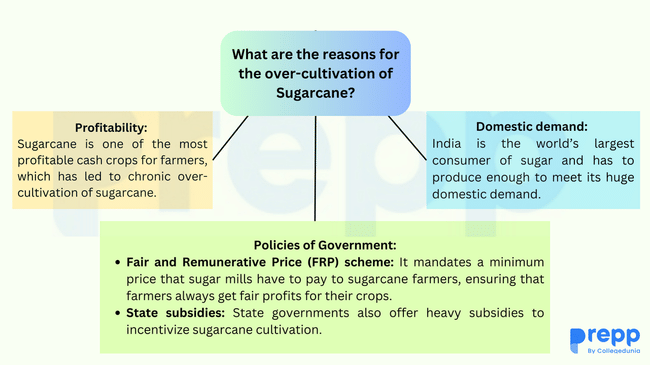
- Profitability: Sugarcane is one of the most profitable cash crops for farmers, which has led to chronic over-cultivation of sugarcane.
- Domestic demand: India is the world’s largest consumer of sugar and has to produce enough to meet its huge domestic demand.
- Policies of Government:
- Fair and Remunerative Price (FRP) scheme: It mandates a minimum price that sugar mills have to pay to sugarcane farmers, ensuring that farmers always get fair profits for their crops.
- State subsidies: State governments also offer heavy subsidies to incentivize sugarcane cultivation.
What are the consequences of excessive sugar production?
- Violation of International Trade Rules: Brazil, Australia, and Guatemala filed a complaint with the World Trade Organization (WTO) against India, claiming that India had violated international trade rules by offering excessive subsidies to its farmers and using unfair practices to gain an advantage in the global sugar market.
- The Organisation ruled against India and India also lost its appeal.
- Water-intensive cultivation: Sugarcane is a highly resource-intensive cash crop and requires 3,000 mm of rain for irrigation.
- A single tonne of sugarcane, yielding 100 kg of sugar, consumes approximately 2 lakh liters of groundwater for irrigation. The industrial processes for sugar manufacturing and refining further contribute to water consumption.
- Most of this groundwater is confined in aquifers and can’t be recharged by rainfall.
- An aquifer is a body of rock and/or sediment that holds groundwater.
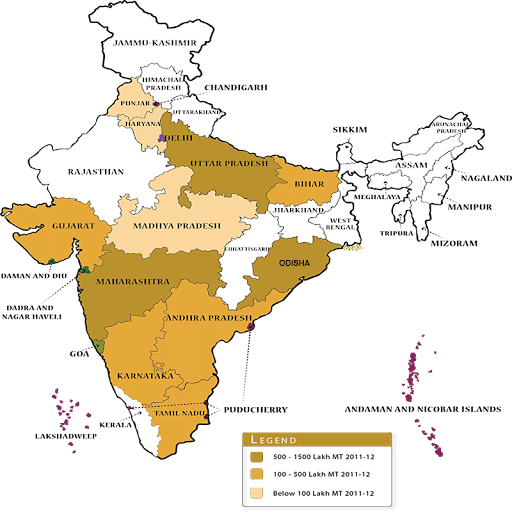
- Depletion of Groundwater: India's primary sugarcane-producing states are Maharashtra, Uttar Pradesh, and Karnataka contributes to 85-90% of the country's total sugar production and get 1,000-1,200 mm of rain, the remaining water is met from groundwater resources.
- According to a report by the Central Ground Water Board (CGWB) in 2022, a third of all its groundwater assessment units in Maharashtra, Uttar Pradesh, and Karnataka were ‘semi-critical’, ‘critical’ or ‘over-exploited’.
What are steps taken by the government to address this issue?
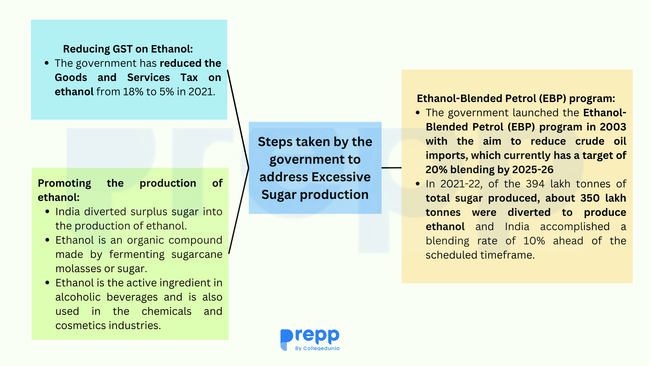
- Promoting the production of ethanol: India diverted surplus sugar into the production of ethanol.
- Ethanol is an organic compound made by fermenting sugarcane molasses or sugar.
- Ethanol is the active ingredient in alcoholic beverages and is also used in the chemicals and cosmetics industries.
- Reducing GST on Ethanol: The government has reduced the Goods and Services Tax on ethanol from 18% to 5% in 2021.
- Ethanol-Blended Petrol (EBP) program: The government launched the Ethanol-Blended Petrol (EBP) program in 2003 to reduce crude oil imports and curtail greenhouse gas emissions from petrol-based vehicles.
- In 2021-22, of the 394 lakh tonnes of total sugar produced, about 350 lakh tonnes were diverted to produce ethanol and India accomplished a blending rate of 10% ahead of the scheduled timeframe.
- The EBP Programme is on track to achieve the target of 20% blending by 2025-26.
- The use of ethanol-blended petrol (EBP) significantly reduces harmful emissions, such as carbon monoxide and various hydrocarbons, from vehicles.
What are the solutions to this problem?
- Fair and comprehensive subsidy schemes: Fair subsidies for various crops encourage diversification, balanced cultivation, and equitable farmer income distribution.
- Expanding profitable and resource-efficient crop options reduces pressure on essential natural resources.
- Promotion of Sustainable Practices: Promotion of environmentally responsible sugarcane cultivation practices that prioritize groundwater, such as drip irrigation, to tackle the issue in the long run.
- Drip Irrigation: Drip irrigation reduces water consumption by up to 70% relative to the current flood irrigation method.
- Drip irrigation is now mandatory in numerous Indian regions, including the three major sugarcane states of Uttar Pradesh, Maharashtra, and Karnataka and the government has also offered subsidies to farmers for setting up the systems.
- Investments in infrastructure: India needs to develop a comprehensive water-saving and management infrastructure.
- Cleaner practices such as rainwater harvesting, wastewater treatment, and canal irrigation networks, will help minimize stress on groundwater reservoirs as other water sources become available for irrigation.
- Investment in research: While the Central Ground Water Board (CGWB) conducts vital research and produces valuable data, gaps persist in understanding groundwater availability and distribution. Therefore, investment in groundwater research needs to be considered seriously.
Conclusion
- Excessive sugar production has environmental implications however export have enormous financial gain. Therefore, simply cutting sugar production isn’t a viable solution.
- A better and more sustainable way would be to assess and then correct incentives that skew in favor of sugarcane over other crops.
(*Click this link to read prelims specific weekly current affairs articles)
FAQs
Question: What are the uses of Ethanol?
Answer:
Ethanol is an organic compound made by fermenting sugarcane molasses or sugar. Ethanol is the active ingredient in alcoholic beverages and is also used in the chemicals and cosmetics industries. In the transport sector, the use of ethanol-blended petrol (EBP) significantly reduces harmful emissions, such as of carbon monoxide and various hydrocarbons, from vehicles.
Question: What is Fair and Remunerative Price?
Answer:
The Fair and Remunerative Price is the minimum price that sugar mills must pay farmers. It was implemented in 2009 to replace the Statutory Minimum Price (SMP). It is intended to alert farmers to the need to grow more or less cane in the next year. The price given to farmers for sugarcane under the FRP system is unrelated to the profits made by sugar mills.
Question: What is Drip Irrigation?
Answer:
Drip irrigation involves placing tubing with emitters on the ground along side the plants. The emitters slowly drip water into the soil at the root zone.
UPSC Mains Practice Question:
|
MCQ
Question: The Fair and Remunerative Price (FRP) of sugarcane is approved by the (UPSC:2015)
(a) Cabinet Committee on Economic Affairs
(b) Commission for Agricultural Costs and Prices
(c) Directorate of Marketing and Inspection, Ministry of Agriculture
(d) Agricultural Produce Market Committee
Answer: (a) See the Explanation
- The Cabinet Committee on Economic Affairs, approves Fair and Remunerative Price (FRP) based on a recommendation by the Commission for Agricultural Costs and Prices (CACP)
- Therefore, option (a) is the correct answer.
Download the PREPP App and attempt FREE IAS Exam Mock Tests and get complete study material!

Full Test - 04: UPSC CSE Prelims CSAT (Paper-II)
Full Test - 03: UPSC CSE Prelims CSAT (Paper-II)
UPSC CSE Prelims 2026 GS Paper 1 Question Paper (24-May-2026)
UPSC CSE Prelims 2026 CSAT Paper 2 Question Paper (24-May-2026)

17 February 2025 | The Hindu Must Read Articles | Current Affairs

16 February 2026 | The Hindu Must Read Articles | Current Affairs

13 February 2026 | The Hindu Must Read Articles | Current Affairs









Comments