Madhya Pradesh Strategy For Tigers Can Help Cheetahs Too
Relevance: GS3 - Conservation
(Source: The Hindu, Indian Express, 08/07/2023)
Why in the news?
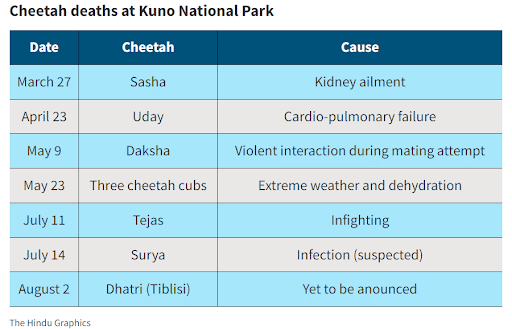
- Recently, one more cheetah has been confirmed dead by wildlife authorities at the Kuno National Park, Madhya Pradesh.
- This is the sixth death reported among the 20 cheetahs brought in from Namibia and South Africa.
- Hence, it was stated that the strategy used by Madhya Pradesh to increase its tiger population has the potential to be replicated for cheetah conservation as well.
Table of Contents

Increase in Tiger Population
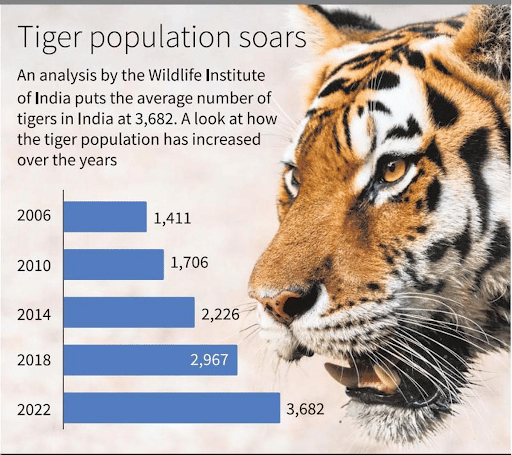
- India’s tiger population increased to 3,682 in 2022, up from 2,967 in 2018, which is an annual rise of 6 per cent.
- Madhya Pradesh (M.P.) has achieved a significant 50% increase in its tiger population. With 785 tigers as per the latest tiger estimation exercise, Madhya Pradesh is the leading Tiger State of India.
- India has 53 tiger reserves, with Madhya Pradesh accounting for six of them.
- The key to this success lies in the state's strategy of actively managing both predator (tiger) and prey populations.
Tiger Population Surge Strategy in Madhya Pradesh
- High prey density: The state has focused on maintaining high prey density in tiger reserves, such as the Kanha Tiger Reserve where there are at least 50 prey animals per square kilometer. This ensures an adequate food source for tigers and supports their population growth.
- Prey management: The Sanjay Dubri tiger reserve, previously devoid of tigers, has seen a transformation over 8 to 10 years. Chital and gaur were introduced into the reserve, and once their populations reached a crucial level, tigers were relocated there. Currently, the reserve hosts 16 tigers, showcasing the success of this strategy.
- Translocation of Tigers: The state has successfully translocated tigers from areas with high populations to other tiger reserves to ensure genetic diversity and manage population densities.
- Protection from poaching: Robust anti-poaching measures have led to consistent tiger population growth.
- Boma Technique: MP has adopted the boma technique, a method used in Africa, which involves luring animals into enclosures through funnel-like fencing. This technique is effective in capturing and relocating animals with minimal stress and mortality.
- Buffer zone creation: Madhya Pradesh has created buffer zones around the core tiger habitats. These buffer zones provide an additional layer of protection to tiger habitats and help minimize human-tiger conflicts.
- Efficient officers and staff deployment: The state has focused on appointing well-trained and efficient officers and staff in its tiger reserves. This ensures proper management and monitoring of tiger populations and their habitats.
- Community involvement: The involvement and support of local communities are crucial for successful tiger conservation. Madhya Pradesh has worked to build positive relationships with local communities and involve them in conservation efforts.
Decline of Tigers in Other States
|
Conclusion
- Madhya Pradesh's successful tiger conservation approach offers insights for cheetah conservation as well.
- The ongoing project to translocate African cheetahs to Madhya Pradesh has faced challenges, including deaths of relocated cheetahs.
- It is suggested that the principles of active prey management, which have proven effective for tigers, could also aid in establishing a viable cheetah population.
- M.P.'s success in tiger conservation through predator-prey population management serves as a model for enhancing biodiversity and maintaining ecological balance.
(*Click this link to read prelims specific weekly current affairs articles)
FAQs
Question: What is the Cheetah Reintroduction Action Plan?
Answer:
In 2022, the Ministry for Environment, Forests and Climate Change has launched the ‘Action Plan for Introduction of Cheetah in India’ under which 50 of these big cats will be introduced in the next five years.
Question: Where is Kuno National Park?
Answer:
The Kuno National Park, the new home of the cheetahs, is situated on the northern side of the Vidhyachal mountains and is spread across more than 700 square km. Kuno National Park is a national park and wildlife sanctuary in Madhya Pradesh, India. It takes its name from the Kuno River.
Question: What is Project Tiger?
Answer:
Project Tiger was established in 1973. It was one of the most significant conservation efforts launched in India to protect tigers. It was the first project of its kind in India to maintain the population of tigers and protect them from poaching and other threats.
MCQ
Question: Match List I (National Park/Sanctuary) with List II (State) and select the correct answer using the codes given below: (UPSC 2004)
| List-I | List-II |
|---|---|
| A. Kanger Ghati National Park |
|
| B. Nagerhole National Park |
|
| C. Kugti Wildlife Sanctuary |
|
| D. Sultanpur Bird Sanctuary |
|
Codes:
(a) A-3; B-2; C-1; D-4
(b) A-1; B-4; C-3; D-2
(c) A-3; B-4; C-1; D-2
(d) A-1; B-2; C-3; D-4
Answer: (b) See the Explanation
National Park/ Sanctuary
- Kanger Ghati National Park - Chhattisgarh
- Nagerhole National Park - Karnataka
- Kugti Wildlife Sanctuary – Himachal Pradesh
- Sultanpur Bird Sanctuary – Haryana
Therefore, option (b) is the correct answer.
Download the PREPP App and attempt FREE IAS Exam Mock Tests and get complete study material!

Full Test - 04: UPSC CSE Prelims CSAT (Paper-II)
Full Test - 03: UPSC CSE Prelims CSAT (Paper-II)
UPSC CSE Prelims 2026 GS Paper 1 Question Paper (24-May-2026)
UPSC CSE Prelims 2026 CSAT Paper 2 Question Paper (24-May-2026)

17 February 2025 | The Hindu Must Read Articles | Current Affairs

16 February 2026 | The Hindu Must Read Articles | Current Affairs

13 February 2026 | The Hindu Must Read Articles | Current Affairs









Comments