Starlink: Why The New Sovereign Of Low-Earth Orbit Is Bad News
Relevance: GS3 - Science and Technology- developments and their applications and effects in everyday life. Awareness in the fields of IT, Space, Computers GS2 - Bilateral, regional and global groupings and agreements involving India and/or affecting India’s interests.
(Source: The Hindu, 08/06/2023)
Click here for Daily Current Affairs
Why in the news?
- The article discusses the Starlink project and its impact in conflict-ridden areas like Ukraine and its associated dangers.
- The Starlink network of linked satellites that enables high-speed satellite internet access comprises around half the total 7500 satellites orbiting the Earth.
Table of Contents
What is Starlink?
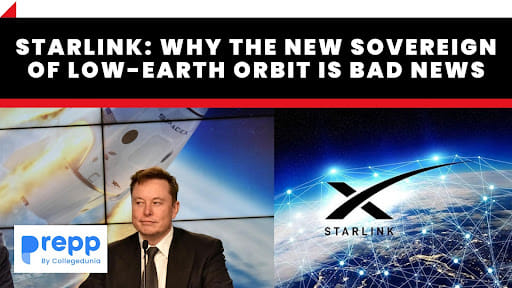
- Starlink is a project by SpaceX to build a broadband network that provides satellite-based internet access across the world.
- It consists of a constellation of low-earth orbit satellites which will be deployed within the altitude range of 350 - 1,200 Km.
- The small satellites would beam high-speed Internet to users via ground stations or terminals on Earth.
Advantages
- Reach: As the satellites are placed in the LEO, the latency between sender and receiver satellites is much lower.
- It allows for the internet to be provided in places where traditional techniques like fiber-optic cables have been unsuccessful.
- The low orbit allows for the provision of high-bandwidth internet with few glitches.
- Infrastructure: Starlink does not require any ground infrastructure like those of traditional internet providers.
- A small satellite dish or a receiver device is enough to access high-speed internet.
- Accessibility: A mobile application for both Android and iOS has been developed by SpaceX which uses augmented reality to help customers choose the ideal location and position for their receivers.
- Expansion plans: SpaceX plans to expand its satellite fleet to 12,000 satellites and potentially 42,000 in the long term.
Why has Starlink been more successful than its competitors?
- Costs: Companies that entered the field in the 1990s and 2000s mainly failed due to technical difficulties and high costs.
- Quality: The products also faced quality issues and limited business opportunities.
- Service: Starlink has however been able to deliver Internet services comparable to the average broadband experience through its satellites which are quite close to the earth.
- Poor competition: Competitors such as Viasat, OneWeb, Avanti, SES, Immarsaat, and Iridium have not been able to provide similar convenience, speed, or affordability.
What are the concerns about Starlink in the combat theatre?
- Starlink is easily accessible even in combat environments as its technologies are portable and can be rigged to run even in areas with unreliable electricity supply.
- This has also made drone warfare much easier.
- In the 2022 Russia-Ukraine crisis, fiber network lines and cell towers were among the first infrastructure to be destroyed which crippled Ukraine’s communications systems, making it dependent on SpaceX.
- The technology used to provide internet connectivity in a region is operated and controlled by the company, not the user.
- Therefore, if the Ukrainian government wanted to switch on/off access in a particular area, it would have to call up Starlink each and every time.
- This would include critical situations like when territory has fallen into enemy hands and technology in the region has been destroyed.
- The time difference between Ukraine and the U.S.A., where SpaceX is headquartered, would lead to operational complications.
- This could also mean that the company can also turn off the service whenever it wishes.
- Taiwan had proposed that Starlink operate in its territory through a joint venture with a domestic company (in a 49:51 ratio), but it was rejected.
- Concerns have been expressed over such monopolistic control, as China could influence SpaceX to switch off connections which would cripple Taiwan if China also snapped the undersea wires providing internet to the country.
- Starlink connectivity was provided to Iran via smuggled technology after internet services were banned in the country in 2022.
- Similarly, Starlink services could be customized to give any government greater control over its services which could reduce the company’s ability to interfere in operations.
Other concerns
- Space debris: Starlink satellites have a lifetime of just five years, following which they become dysfunctional but remain in space.
- The proposal to expand the Starlink fleet by launching 42,000 more satellites in the next few years could cause overcrowding in Earth’s orbit, impeding astronomers from studying the universe from Earth.
Starlink’s Monopoly
- Traditional infrastructure works on a public-utility principle in which operators don’t get to decide who uses the product.
- However, satellite internet companies are free to do so because of the nature of their technology and the lack of regulation in the sector.
- In 2022, SpaceX refused Ukraine’s request to provide Starlink connectivity near Crimea to send explosive-filled maritime drones into Russian ships.
- Starlink is not subject to the provisions of normal government-to-government defense deals, where decisions are taken by corporate employees and not government accountable to its citizens.
- Factors:
- The light regulatory stance of the Federal Communications Commission.
- The well-planned business strategies of the company
- Its partly reusable rockets make Starlink a relatively inexpensive option in comparison to its competitors.
- In comparison, its rival firm OneWeb, whose biggest shareholders are Bharti Airtel’s holding company and the U.K. government, was forced to abort a launch in Russia over Russian concerns regarding its use.
Conclusion
- More government-specific projects like the European Union’s plan to establish a “sovereign” satellite constellation by 2027 and China’s plans to deploy a 13,000-satellite LEO mega constellation.
- The concentration of satellite technology in the hands of one person or company is a major concern for countries and governments as it could affect their connectivity and subsequently their economies.
- Therefore more LEO satellite constellations providing internet access either owned by the government, private, or joint ventures are necessary.
(*Click this link to read prelims specific weekly current affairs articles)
FAQs
Question: What is satellite-based internet?
Answer:
Satellite internet connections use communication satellites to provide internet connectivity to users. Earlier Geostationary Orbit (or GEO) Satellites were used but now Low Earth orbit (LEO) satellites are favored. It is independent of optic fibers or phone lines and is similar to satellite TV.
Question: What is a low-earth orbit?
Answer:
It refers to orbits within 160 - 1000 km from the Earth. It hosts most of the scientific and weather satellites in a circular orbit. Satellites in LEO can follow a tilted plane, unlike GEO satellites.
UPSC Mains Practice Question:
|
MCQs
Question: Satellites used for telecommunication relay are kept in a geostationary orbit. A satellite is said to be in such as orbit when: (UPSC CSE 2011)
- The orbit is geosynchronous.
- The orbit is circular.
- The orbit lies in the plane of the earth’s equator.
- The orbit is at an altitude of 22,236 km.
Select the correct answer using the codes given below:
(a) 1, 2 and 3 only
(b) 1, 3 and 4 only
(c) 2 and 4 only
(d) 1, 2, 3 and 4
Answer: (a) See the Explanation
- A geostationary orbit is a geosynchronous orbit, i.e it is Earth-centered. Hence statement 1 is correct.
- It is a circular orbit around the Earth. Hence statement 2 is correct.
- It lies in the plane of the equator and follows the earth's rotation from west to east. Hence statement 3 is correct.
- It is at an altitude of 35, 786 km. Hence statement 4 is incorrect.
Download the PREPP App and attempt FREE IAS Exam Mock Tests and get complete study material!

Full Test - 04: UPSC CSE Prelims CSAT (Paper-II)
Full Test - 03: UPSC CSE Prelims CSAT (Paper-II)
UPSC CSE Prelims 2026 GS Paper 1 Question Paper (24-May-2026)
UPSC CSE Prelims 2026 CSAT Paper 2 Question Paper (24-May-2026)

17 February 2025 | The Hindu Must Read Articles | Current Affairs

16 February 2026 | The Hindu Must Read Articles | Current Affairs

13 February 2026 | The Hindu Must Read Articles | Current Affairs









Comments