5% Of Birds In India Are Endemic, Reveals Zoological Survey Of India Publication
Relevance: GS3 - Environment and Conservation, Prelims
(Source: The Hindu, 08/07/2023)
Click here for Daily Current Affairs
Why in the news?
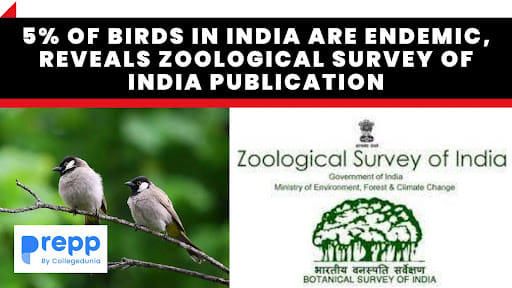
- Recently, the publication, titled "75 Endemic Birds of India," was released by the Zoological Survey of India (ZSI).
- According to a recent release, approximately 5% of bird species discovered in India are endemic and do not exist in any other regions globally.
Table of Contents
Key Findings of Endemic Bird Species
- Endemic Bird Diversity in India: India is home to 1,353 bird species, which represents approximately 12.40% of global bird diversity. Out of these 1,353 bird species, 78 (5%) are endemic to the country.
- Species with no record: It was highlighted that three species have not been recorded in the last few decades. They are the:
- Manipur Bush Quail (Perdicula manipurensis), listed as ‘Endangered’ by the IUCN Red List of Threatened Species with its last recorded sighting in 1907;
- the Himalayan Quail (Ophrysia superciliosa), listed as ‘Critically Endangered’ with its last recorded sighting in 1876; and
- the Jerdon’s Courser (Rhinoptilus bitorquatus), listed as ‘Critically Endangered’ with its last confirmed sighting in 2009.
- Geographical Distribution: The Western Ghats have the highest number of endemic species (28), followed by the Andaman and Nicobar Islands (25). The Eastern Himalayas, Southern Deccan plateau, and central Indian forest each have a few endemic species.
Bird species only found in the Andaman and Nicobar Islands
- Nicobar Megapode (Megapodius nicobariensis);
- Nicobar Serpent Eagle (Spilornis klossi);
- Andaman Crake (Rallina canningi);
- Andaman Barn Owl (Tyto deroepstorffi)
About Zoological Survey of India (ZSI)
|
Significance of India's Endemic Bird Species
- Biodiversity Conservation: Endemic bird species are a unique and irreplaceable part of a country's biodiversity. They represent the result of millions of years of evolution in a specific geographic area.
- Indigenous Cultural Significance: Many of India's endemic bird species are often featured in folklore, myths, and traditional practices. These species contribute to the identity and heritage of different regions within India.
- Ecological Balance: Endemic species often play specific ecological roles in their native ecosystems. They might have evolved to fill niches that are not occupied by other species, contributing to the overall balance of the ecosystem.
- Tourism and Recreation: Birdwatching and ecotourism have become popular activities in India and around the world. Many bird enthusiasts travel to specific regions to observe and photograph endemic species.
- Education and Awareness: Endemic species can serve as ambassadors for broader conservation efforts. Their uniqueness can capture people's attention and raise awareness about the importance of protecting natural habitats and biodiversity.
(*Click this link to read prelims specific weekly current affairs articles)
FAQs
Question: What is Endemic?
Answer:
Endemic refers to a species, phenomenon, or condition that is native or restricted to a specific geographic area or region and is not found naturally anywhere else.
Question: What is the IUCN Red List?
Answer:
The International Union for Conservation of Nature's Red List of Threatened Species, which was established in 1964, has evolved to become the world's most comprehensive information source on the global conservation status of animal, fungi, and plant species.
Question: What is the Zoological Survey of India (ZSI) ?
Answer:
It was founded on 1 July 1916 by the Ministry of Environment, Forest and Climate Change of the Government of India as a premier Indian organisation in zoological research. Its objective is to promote the survey, exploration and research of the fauna in the country.
MCQ
Question: In India, if a species of tortoise is declared protected under Schedule I of the Wildlife (Protection) Act, 1972, what does it imply? (UPSC 2017)
(a) It enjoys the same level of protection as the tiger.
(b) It no longer exists in the wild, a few individuals are kept under captive protection, and now it is impossible to prevent its extinction.
(c) It is endemic to a particular region of India.
(d) Both (b) and (c) stated above are correct in this context.
Answer: (a) See the Explanation
If a species of tortoise is declared protected under Schedule I of the Wildlife (Protection) Act, 1972, it enjoys the same level of protection as the tiger. The Wildlife Protection Act, 1972 provides for the protection of a listed species of animals, birds, and plants and also for the establishment of a network of ecological important protected areas within the country.
Schedule I
- This schedule covers endangered species.
- These species need rigorous protection and thus very harsh penalties for violation of the laws are for species under the schedule.
- Species under the schedule are prohibited to be hunted throughout India, except under threat to human life.
- Examples: tiger, blackbuck, Himalayan brown bear, brown and pillared deer, blue whale, common dolphin,hornbills, etc.
Therefore, option (a) is the correct answer.
Download the PREPP App and attempt FREE IAS Exam Mock Tests and get complete study material!

Full Test - 04: UPSC CSE Prelims CSAT (Paper-II)
Full Test - 03: UPSC CSE Prelims CSAT (Paper-II)
UPSC CSE Prelims 2026 GS Paper 1 Question Paper (24-May-2026)
UPSC CSE Prelims 2026 CSAT Paper 2 Question Paper (24-May-2026)

17 February 2025 | The Hindu Must Read Articles | Current Affairs

16 February 2026 | The Hindu Must Read Articles | Current Affairs

13 February 2026 | The Hindu Must Read Articles | Current Affairs









Comments