National Handloom Day
Relevance: GS1 - Role of women and women’s organization; Social empowerment; GS3 - Indian Economy; Employment, Growth and Development
(Source: Hindustan Times, PIB, 08/07/2023)
Why in the news?
- India observes National Handloom Day on August 7, every year.
- This day serves to showcase the vital role of the handloom industry in driving socio-economic progress and to enhance understanding and recognition of this sector's significance.
Table of Contents
History of National Handloom Day
- The Swadeshi Movement was founded on August 7, which is why this day is recognised as National Handloom Day.
- The Swadeshi Movement serves as a key aspect of India's struggle for independence and is also significant for the handloom industry.
- The swadeshi movement’s objective was also to revive domestic products and production processes.
- With the partition of Bengal, the Swadeshi Movement gained strength and it was on August 7, 1905 that a formal proclamation was made at the Calcutta Town Hall to boycott foreign goods and rely on Indian-made products.
- Rooted in the desire to boost domestic production and reduce dependence on imports, this movement led to widespread engagement in producing khadi, a hand-spun and handwoven fabric.
- A pivotal moment in the movement was marked when Pandit Jawaharlal Nehru hoisted the Indian flag made from khadi at Princess Park near India Gate.
- The inaugural National Handloom Day was launched by the Indian Government on August 7, 2015, in Chennai. Hence, this year, the 9th National Handloom Day is being celebrated.
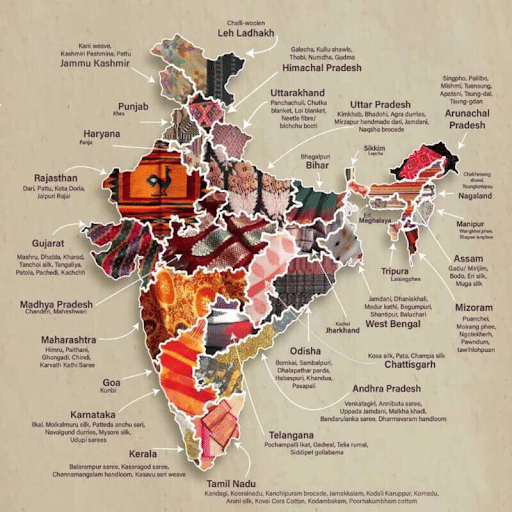
Handloom Sector in India
- The handloom sector of India is one of the biggest unorganized economic activities.
- It has a long tradition of outstanding artisanship that represents and preserves vibrant Indian culture.
- India's handloom artists are globally known for their unique hand spinning, weaving and printing style.
- This sector holds immense significance in both India's economy and society.
- The Handloom Census of 2019-20 revealed a substantial presence, with approximately 35,22,512 handloom workers spread throughout the nation.
- This sector acts as a source of livelihood for more than 43.31 lakh weavers, primarily hailing from rural and semi-urban regions.
Significance of Handloom Sector
- Cultural heritage and livelihood: The handloom sector in India stands as a vibrant representation of the nation's illustrious cultural heritage. Beyond its cultural significance, it holds immense economic importance, serving as a crucial source of livelihood for countless individuals across the country.
- Employment Contributor: Ranked as the second-largest employment generator after agriculture, the textiles and handloom sector plays a pivotal role in providing jobs to a substantial portion of the population.
- Empowering Women: The handloom sector also serves as a key driver of women's empowerment, with more than 70% of handloom weavers and allied workers being women.
Government Initiatives towards Handloom Sector
- National Handloom Development Programme (NHDP)
- The Yarn Supply Scheme (YSS)
- Handloom Weavers’ Comprehensive Welfare Scheme
- Comprehensive Handloom Cluster Development Scheme (CHCDS)
- Mahatma Gandhi Bunkar Bima Yojana
- Pradhan Mantri Mudra Yojana (PMMY)
- Market Access Initiative (MAI)
- Urban Haat
- Skill India
(*Click this link to read prelims specific weekly current affairs articles)
FAQs
Question: When is National Handloom day?
Answer:
India observes National Handloom Day on August 7, every year. This day serves to showcase the vital role of the handloom industry in driving socio-economic progress and to enhance understanding and recognition of this sector's significance.
Question: What is the handloom sector of India?
Answer:
It is one of the biggest unorganized economic activities. It has a long tradition of outstanding artisanship that represents and preserves vibrant Indian culture. India's handloom artists are globally known for their unique hand spinning, weaving and printing style.
Question: What is Market Access Initiative (MAI)?
Answer:
It is an Export Promotion Scheme. The scheme aims to act as a catalyst to promote India's exports on a sustained basis. The scheme is formulated on the basis of the product and country focus approach. It will evolve specific markets and specific products through market studies/surveys.
UPSC Mains Practice Question:
|
MCQ
Question: Consider the following statements: (UPSC 2023)
Statement-I: 7th August is declared as the National Handloom Day.
Statement-II: It was in 1905 that the Swadeshi Movement was launched on the same day.
Which one of the following is correct in respect of the above statements?
(a) Both Statement-1 and Statement-II are correct and Statement-II is the correct explanation for Statement-I.
(b) Both Statement-I and Statement-II are correct and Statement-II is not the correct explanation for Statement-I.
(c) Statement-I is correct but Statement-II is incorrect.
(d) Statement-I is incorrect but Statement-II is correct.
Answer: (a) See the Explanation
- National Handloom Day is observed annually on 7th August to honor handloom weavers and highlight India's handloom industry. The first National Handloom Day was held on 7th August 2015. Hence, statement 1 is correct.
- August 7 was chosen as National Handloom Day to commemorate the Swadeshi Movement, launched on the same day in 1905 to promote domestic production. Hence, statement 2 is correct.
Therefore, option (a) is the correct answer.
Download the PREPP App and attempt FREE IAS Exam Mock Tests and get complete study material!

Full Test - 04: UPSC CSE Prelims CSAT (Paper-II)
Full Test - 03: UPSC CSE Prelims CSAT (Paper-II)
UPSC CSE Prelims 2026 GS Paper 1 Question Paper (24-May-2026)
UPSC CSE Prelims 2026 CSAT Paper 2 Question Paper (24-May-2026)

17 February 2025 | The Hindu Must Read Articles | Current Affairs

16 February 2026 | The Hindu Must Read Articles | Current Affairs

13 February 2026 | The Hindu Must Read Articles | Current Affairs









Comments