Significance of Weathering - Geography Notes
Weathering is the process of breaking down or dissolving rocks and minerals on the surface of the Earth. Water, ice, acids, salts, plants, animals, and changes in the temperature of the environment are all agents of weathering. Weathering and erosion constantly change the rocky features of Earth. There is a huge significance of weathering, ranging from soil formation to the creation of coastal landforms such as sea caves, sea arches, etc. In this article, we will discuss in detail Weathering and its Significance which will be helpful for UPSC/IAS exam.
|
Table of Contents |
What is Weathering?
- Weathering refers to the breakdown and alteration of rocks and minerals at or near the Earth's surface as a result of atmospheric, chemical, and physical agents.
- Weathering processes are responsible for producing soil from parent rock and altering the rock's characteristics, preparing it for transportation through erosional processes.
- Weathering is the first stage in the denudation process, which includes weathering, erosion, transportation, and deposition.
- There are three main types of weathering:
- Physical (Mechanical) Weathering
- Chemical Weathering
- Biological Weathering
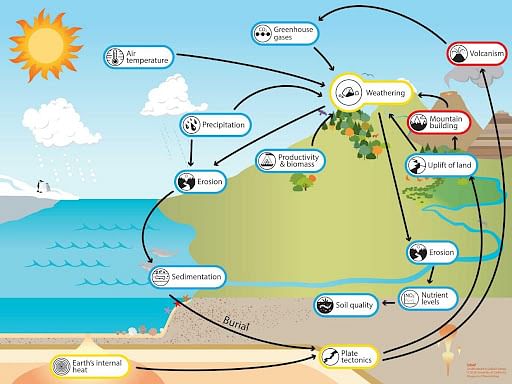
Elements influencing Weathering Process
Mechanical Weathering
- It is also called physical weathering. It causes rocks to crumble.
- This involves the physical breakdown of rocks into smaller pieces without a change in their chemical composition.
- Forces such as freezing and thawing, temperature fluctuations, plant roots, and abrasion can cause rocks to crack, flake, or disintegrate.
- The change in temperature can also contribute to mechanical weathering in a process called thermal stress.
- Change in temperature causes the rock to expand with heat and contract with cold.
- As this happens, again and again, the structure of the rock weakens and after some time, it breaks.
|
|
|
|---|---|
| Chemical Weathering | Biological Weathering |
| Physical Weathering | Denudational Processes |
| Mass Movements | Soil Formation Processes |
Chemical Weathering
- Chemical Weathering changes the molecular structure of rocks and soil.
- Agents of chemical weathering include water, oxygen, carbon dioxide, and organic acids.
- Common processes include hydrolysis, oxidation, carbonation, and solution.
- Sometimes, it dissolves large portions of limestone or other rock on the surface of the Earth to form a landscape called karst.
- One of the world’s best examples of karst is the Stone Forest, near Kunming, China.
Biological Weathering
- The weakening and subsequent disintegration of rock by plants, animals, and microbes is known as biological weathering.
- Plant roots that are growing can put stress or pressure on the rock.
- Despite the fact that the process is physical, the pressure is applied by a biological process (i.e., growing roots).
- Chemical weathering can also be caused by biological processes, such as the production of organic acids by plant roots or microorganisms, which aid in the dissolution of minerals.
Significance of Weathering
- Weathering is the first stage of the formation of soil.
- It produces many other natural resources, for example, clay which is used for making bricks.
- Another significance of weathering is it weakens the rocks, making them easier for people to exploit and break, for example, by mining and quarrying.
- Biodiversity and biomes are the result of vegetation, and forests rely upon the depth of weathering wraps.
- Root penetration cannot happen if the rocks are not weathered.
- It aids erosion, mass wasting, reduction of relief, and modifications in landforms.
- Weathering of rocks helps in the augmentation and concentrations of some ores of manganese, aluminum, iron, copper, etc. which have a great demand in the economy of the country.
- When some rock pieces and particles are broken, they eventually turn into sediments, which form different types of sedimentary rocks such as sandstones and limestones. Typically, the broken rock pieces are deposited by rivers and compacted by great pressure, resulting in the formation of sedimentary rock.
- Some weathered rocks, such as granite tors, are very interesting. As a result, they serve as a tourist attraction. The Bismarck rock in Mwanza, Tanzania, is one example.
- Some of these rocks appear to be so one-of-a-kind that locals are baffled as to how they came to be. They've converted them into local shrines where people can make offerings.
Factors Affecting Weathering Processes
Weathering types and rates vary at the regional and local spatial scales. Aside from climate, the type of rock (lithology) and the nature and extent of fractures or other flaws in it have a significant impact on the effectiveness of the various rock weathering processes.
Climate
- Different weathering processes are associated with different climatic conditions
- Chemical weathering, for example, is especially effective and rapid in humid climates.
- In arid climates, chemical weathering is much more limited.
- Salt weathering processes are very effective in marine coastal locations due to the abundance of salts, high humidity, and contact with seawater.
Rock Type
- The character of the bedrock, whether hard or soft, soluble or insoluble, broken or unbroken, has a significant impact on weathering.
- Weathering and erosion vary according to rock type; easily eroded rocks show more extensive weathering and erosion effects than resistant rocks.
- Some rocks, such as limestone, are more susceptible to chemical weathering, while harder rocks like granite are more resistant but can be broken down through physical processes.
Slope Variation
- A slope's geographic orientation—whether it faces north, southeast, or west—controls the slope's exposure to sun, wind, and precipitation.
- Steeper slopes may enhance mechanical weathering due to rockfalls and landslides.
Vegetation
- Although vegetative cover can protect rock by shielding it from raindrops and providing roots to stabilize soil
- It also produces organic acids from the partial decay of organic matter, which contributes to chemical weathering.
- Plant roots can enter crevices and break up a rock, exerting enough pressure to separate rock segments and expose more surface area to other weathering processes.
|
|
|
|---|---|
| Geography Notes | Physical Geography |
| Geomorphic Processes | Geomorphology |
| Distribution of Oceans and Continents Basins | Minerals and Rocks |
| Endogenic Processes | Exogenic Processes |
FAQs
Q1: What is weathering in geography?
Answer: Weathering is the process of breaking down rocks, soil, and minerals through physical, chemical, and biological means, without transportation.
Q2: What are the main types of weathering?
Answer: The three primary types are physical weathering, chemical weathering, and biological weathering.
Q3: Why is weathering significant in soil formation?
Answer: Weathering breaks down rocks into finer particles, providing essential minerals for soil development.
Q4: How does chemical weathering affect landscapes?
Answer: Chemical weathering alters the chemical composition of rocks, forming new minerals and resulting in features such as karst landscapes.
Q5: What factors influence the rate of weathering?
Answer: Key factors include climate, rock type, topography, and the presence of organisms.
MCQs
- Which type of weathering results from the expansion and contraction of rocks?
a) Chemical weathering
b) Biological weathering
c) Physical weathering
d) Erosion
Answer: (C) See the Explanation
- Which of the following landforms is created due to chemical weathering?
a) Delta
b) Karst landscape
c) Sand dunes
d) Glacial moraine
Answer: (B) See the Explanation
- Which climatic condition accelerates chemical weathering?
a) Hot and dry climate
b) Cold and arid climate
c) Warm and humid climate
d) Extremely cold regions
Answer: (C) See the Explanation
- Biological weathering is primarily caused by:
a) Wind and water
b) Plant roots and microorganisms
c) Ice formation
d) Mineral dissolution
Answer: (B) See the Explanation
- Which process distinguishes weathering from erosion?
a) Transportation of material
b) Breaking down rocks into smaller pieces
c) Formation of sediments
d) Deposition in riverbeds
Answer: (A) See the Explanation
GS Mains Questions and Model Answers
Q1: Discuss the role of weathering in the formation of soil.
Answer:v Weathering plays a vital role in soil formation by breaking down rocks into smaller particles over time. Physical weathering disintegrates rocks through temperature changes and mechanical forces, while chemical weathering alters the mineral composition, enriching the soil with essential nutrients. Biological weathering by organisms like plant roots and microorganisms further contributes to soil formation by adding organic matter. Weathering also creates a conducive environment for plants to grow by loosening the rock material. The rate of weathering depends on climate, rock type, and topography, ultimately influencing the texture and fertility of the soil.
Q2: Analyze the significance of chemical weathering in shaping landscapes.
Answer: Chemical weathering is a transformative process that alters the chemical composition of rocks, forming new minerals and contributing to unique landforms. Karst topography, with features like sinkholes and caves, is a prime example of chemical weathering in limestone regions. In tropical climates, weathering creates deep soil profiles, influencing agriculture and vegetation. The process also contributes to the carbon cycle by sequestering atmospheric carbon dioxide through mineral dissolution. However, it can weaken rocks, increasing susceptibility to landslides. Thus, chemical weathering plays a dual role in both landscape formation and environmental processes.
Q3: Examine the impact of climate on the weathering process.
Answer: Climate significantly influences the rate and type of weathering. Physical weathering predominates in arid and cold climates where temperature fluctuations cause expansion and contraction of rocks. In contrast, chemical weathering is more intense in warm and humid climates, where moisture facilitates chemical reactions. Tropical regions exhibit rapid weathering, resulting in thick soils, while polar regions experience minimal weathering due to limited moisture and biological activity. Thus, climatic factors shape the intensity, extent, and outcomes of weathering processes, affecting soil formation, vegetation patterns, and the stability of landscapes.
Previous Year Questions on Significance of Weathering
1. UPSC CSE Prelims 2019
Question: Which of the following is a result of chemical weathering?
a) Formation of sand dunes
b) Creation of river deltas
c) Dissolution of limestone in water
d) Accumulation of glacial moraines
Answer: c) Dissolution of limestone in water
Explanation: Chemical weathering dissolves rocks like limestone, leading to the formation of features like karst landscapes and sinkholes.
2. UPSC CSE Mains 2018
Question: How does weathering influence the evolution of landforms? (200 words)
Answer: Weathering is a fundamental process in the evolution of landforms. It breaks down rocks into smaller fragments, influencing landscape development over geological time. Physical weathering through temperature variations leads to rock disintegration, while chemical weathering alters the mineral composition of rocks, forming new minerals. For example, karst landscapes evolve due to the dissolution of limestone. Biological weathering by plant roots and microorganisms further modifies the landscape by breaking down rocks mechanically and chemically. Weathering also prepares rocks for transportation by erosion and deposition, which further shapes the landforms. Climatic factors, including temperature and rainfall, play a key role in determining the type and extent of weathering, making it an essential process in landscape evolution.
Download the PREPP App and attempt FREE IAS Exam Mock Tests and get complete study material!
Live Test : UPSC IAS : GS - Modern History - Subject Knowledge Test

Live Test : UPSC CSE Prelims CSAT (Paper-II) (Oct 20 - 23)
Full Test - 04: UPSC CSE Prelims CSAT (Paper-II)
Full Test - 03: UPSC CSE Prelims CSAT (Paper-II)
UPSC CSE Prelims 2026 CSAT Paper 2 Question Paper (24-May-2026)
UPSC CSE Prelims 2026 GS Paper 1 Question Paper (24-May-2026)

17 February 2025 | The Hindu Must Read Articles | Current Affairs

16 February 2026 | The Hindu Must Read Articles | Current Affairs

13 February 2026 | The Hindu Must Read Articles | Current Affairs









Comments