Chemical Weathering - Denudational Processes - Geography Notes
Chemical weathering is the process of chemical decomposition of rocks and soil. Chemical weathering involves the rock interacting with chemicals to alter the rock's composition. The chemical weathering processes such as dissolution, solution, carbonation, hydration, oxidation, and reduction operate on rocks to break down, dissolve, or reduce them to a fine state. In this article, we will discuss in detail Chemical Weathering which will be helpful for UPSC/IAS exam preparation.
|
Table of Contents |
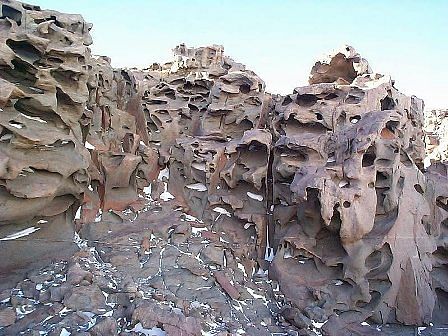
What exactly is Chemical Weathering?
- Chemical Weathering refers to the breakdown and decomposition of rocks and minerals at the Earth's surface as a result of chemical reactions with the atmosphere, moisture, and organic materials.
- Unlike physical or mechanical weathering, which primarily changes the size and shape of rocks without altering their composition, chemical weathering changes the chemical composition of rocks.
- All chemical reactions are sped up by acids created by microbial and plant-root metabolism, water, air (oxygen and carbon dioxide), and heat.
- Through chemical reactions involving oxygen, surface and/or soil water, and other acids, a range of weathering processes known as solution, carbonation, hydration, oxidation, and reduction operate on rocks to breakdown, dissolve, or reduce them to a fine clastic state.
- To accelerate all chemical processes, water, air (oxygen and carbon dioxide), and heat must be present.
- In addition to the carbon dioxide in the air, the breakdown of plants and animals increases the amount of carbon dioxide underground.
- These chemical reactions on various minerals are quite comparable to laboratory chemical reactions.
| Other Relevant Links | |
|---|---|
| Denudational Processes | Biological Weathering |
| Physical Weathering | Significance of Weathering |
Process of Chemical Weathering
- After forming inside the crust of Earth for millions of years, they reach the surface due to denudation and other such measures.
- Once they are on the surface, they come in contact with different ecological factors like water, air, etc.
- These factors make changes in the rocks. This can be either physical weathering or chemical weathering.
- Chemical weathering changes the structure of the rocks due to some form of chemical reaction on them.
- Agents like water, or acids (from acid rain), can react with specific elements present in the rock which reduces its strength leading to its breaking.
- After breaking, these are either carried away by agents like wind, air, etc., or get transformed into some other element, or are used up by the surroundings.
- They bring changes in the molecular structure of the rocks.
Classification of Chemical Weathering
Natural Dissolution
- Dissolution is the process of a gaseous, liquid, or solid solute dissolving in a solvent to form a solution.
- Due to their natural solubility (such as nitrates, sulfates, and potassium) and oxidation potential, iron-rich minerals will weather naturally through dissolution (rains).
- These minerals are easily leached out and accumulate in dry areas without leaving residue behind.

Natural Dissolution
Solution Weathering
- When the solvent is an acidic solution rather than plain water, solution weathering happens.
- A solution is a liquid mixture in which the solute (small component) is evenly distributed inside the large component (the solvent).
- Any solution with a higher concentration of hydrogen ions than water is considered acidic; solutions with a lower concentration of hydrogen ions than water are either basic or alkaline.

Solution Weathering
Carbonation Weathering
- Carbonation is the process of converting carbon dioxide into carbonates, bicarbonates, and carbonic acid.
- The process of atmospheric carbon dioxide-causing solution weathering is known as carbonation weathering.
- Rain dissolves small amounts of carbon dioxide from the air, generating a weak acid capable of dissolving minerals such as limestone (calcium carbonate).
- Caves arise when carbonic acid-containing subsurface water passes through limestone blocks, dissolves the limestone, and leaves empty pockets (caves) behind (Karst topography).
- Since cooler water stores more dissolved carbon dioxide gas, the carbonation process accelerates as the temperature drops.

Carbonation Weathering
Hydration
- Hydration is the chemical addition of water to atoms and molecules of a mineral, involving the hard attachment of H+ and OH- ions to the atoms and molecules.
- The increased volume created by rock minerals absorbing water produces physical tensions within the rock.
- Iron oxides, for example, are transformed into iron hydroxides, which have a higher volume.
- Since hydration is reversible, the rocks become fatigued and may disintegrate if the procedure is repeated continuously.

Hydration Weathering
Hydrolysis
- A water molecule is consumed in biological hydrolysis to impact the separation of a bigger molecule into component pieces.
- Pure water combines with silicate or carbonate minerals in biological hydrolysis, completely dissolving the original material (dissolution weathering).
- Biological hydrolysis is an essential response in regulating CO2 levels in the atmosphere and it can have an impact on climate.

Hydrolysis
Oxidation and Reduction
- In the case of weathering, oxidation means the combination of minerals and oxygen to form oxides (rust in the case of iron) or hydroxides.
- Due to the presence of iron oxide, red soil looks red.
- Oxidation occurs in places with easy access to air and water.
- The most commonly involved minerals in this process are iron, manganese, and sulfur.
- Reduction occurs when oxidized minerals are placed in a non-oxygenated environment. Such conditions usually exist below the water table in areas of stagnant water or moist soil.
- The red color of iron turns greenish-gray or bluish-gray when reduced.
Conclusion
Chemical weathering occurs due to the fact that the process is progressive and continuous, changing the mineralogy of eroding, breaking, or collapsing stones over time. Changes in rock composition are strongly influenced by the binding of water and oxygen through processes such as hydrolysis and oxidation. Chemical weathering is important in terms of the transportation of minerals in the soil and for different types of landforms.
|
|
|
|---|---|
| Geography Notes | Physical Geography |
| Geomorphic Processes | Geomorphology |
| Distribution of Oceans and Continents Basins | Minerals and Rocks |
| Endogenic Processes | Exogenic Processes |
FAQs
Question: What is Chemical Weathering?
Answer: Chemical weathering refers to the breakdown and decomposition of rocks and minerals at the Earth's surface due to chemical reactions with the atmosphere, water, and organic materials. Unlike physical weathering, which changes the size and shape of rocks, chemical weathering alters the chemical composition of the rocks.
Question: What are the main processes involved in chemical weathering?
Answer: The main processes of chemical weathering include dissolution, carbonation, hydration, hydrolysis, and oxidation-reduction. These processes break down or dissolve minerals, changing their composition and forming new stable minerals.
Question: How does water contribute to chemical weathering?
Answer: Water plays a critical role in chemical weathering by facilitating the chemical reactions that break down rocks. It acts as a solvent, helping to dissolve minerals, or it may combine with gases like carbon dioxide to form acids that accelerate weathering processes like carbonation and hydrolysis.
Question: What is carbonation in the context of weathering?
Answer: Carbonation is a type of chemical weathering where carbon dioxide from the atmosphere dissolves in water to form carbonic acid. This weak acid dissolves minerals like limestone, leading to the formation of caves and karst topography.
Question: How does oxidation affect rocks?
Answer: Oxidation occurs when minerals containing iron react with oxygen in the air or water, forming iron oxides (rust). This process changes the color and structure of rocks, often turning them reddish or yellowish, as seen in iron-rich rocks.
MCQs
- Which of the following processes is involved in chemical weathering?
A) Physical fragmentation
B) Carbonation
C) Frost wedging
D) Root expansion
Answer: (B) See the Explanation
Carbonation is a chemical weathering process where carbon dioxide dissolves in water, forming carbonic acid that dissolves minerals like limestone.
- What is the result of hydration in chemical weathering?
A) The rock shrinks
B) The rock dissolves in water
C) The rock absorbs water, increasing its volume
D) The rock hardens
Answer: (C) See the Explanation
Hydration occurs when water is chemically added to a mineral, causing it to expand and sometimes disintegrate due to increased volume.
- Which of the following is not a product of oxidation during chemical weathering?
A) Iron oxide
B) Sulfuric acid
C) Manganese oxide
D) Rust
Answer: (B) See the Explanation
Oxidation typically produces oxides such as iron oxide or manganese oxide, but sulfuric acid is not a direct product of oxidation.
- Which of the following is a key factor in the process of chemical weathering?
A) Temperature
B) Wind
C) Biological activity
D) Water
Answer: (D) See the Explanation
Water is essential in chemical weathering, facilitating the chemical reactions that break down minerals and rocks.
- What happens during hydrolysis in chemical weathering?
A) Minerals are dissolved in water
B) Minerals react with hydrogen ions in water to form clay minerals
C) Water causes the rock to crack
D) Air reacts with minerals to form oxides
Answer: (B) See the Explanation
Hydrolysis involves water reacting with minerals like feldspar to form clay minerals, which leads to the decomposition of the rock.
GS Mains Questions and Model Answers
Q1: Explain the different processes of chemical weathering and their effects on rocks.
Answer: The main processes of chemical weathering include carbonation, dissolution, hydration, hydrolysis, and oxidation-reduction.
Carbonation involves the reaction of carbon dioxide with minerals like calcium carbonate, dissolving them and creating features like caves and karst landscapes.
Dissolution happens when soluble minerals dissolve in water, weakening rock structures.
Hydration occurs when water molecules are added to minerals, causing them to expand and break apart.
Hydrolysis involves the breakdown of minerals into clay minerals and other products through reactions with water.
Oxidation causes minerals with iron content to react with oxygen, forming iron oxides, which change the color and structure of rocks, such as in the formation of rust. These processes all weaken rocks and contribute to soil formation.
Q2: Discuss the role of water in chemical weathering.
Answer: Water plays a vital role in chemical weathering by acting as a solvent, which facilitates the chemical reactions that break down minerals. Water enhances processes such as carbonation, where it dissolves carbon dioxide to form carbonic acid, which dissolves minerals like limestone. Water also contributes to hydrolysis, where minerals like feldspar react with hydrogen ions, resulting in the formation of clay minerals. Furthermore, water is involved in hydration, where it causes minerals to absorb water and expand, breaking down rock structures. Thus, water accelerates the chemical weathering process, making it one of the most important agents in rock decomposition.
Q3: How do oxidation and reduction contribute to chemical weathering?
Answer: Oxidation and reduction are essential processes in chemical weathering that involve the interaction of minerals with oxygen. In oxidation, minerals containing iron, such as magnetite or hematite, react with oxygen in the air or water to form iron oxide (rust), which weakens the rock structure and leads to disintegration. This is commonly seen in red soils and rocks. Conversely, reduction occurs when oxidized minerals lose oxygen in an anaerobic environment, such as below the water table. This process typically transforms the color of the minerals, turning them from red or yellow to greenish or bluish shades, indicating a change in their chemical structure. Both oxidation and reduction contribute to the breakdown and alteration of minerals, which are fundamental in the process of chemical weathering.
Previous Year Questions on Chemical Weathering
1. UPSC CSE 2023
Question: Describe the role of chemical weathering in shaping landforms.
Answer: Chemical weathering plays a significant role in shaping landforms by breaking down and dissolving rocks at the Earth's surface. Through processes like carbonation and hydrolysis, minerals in rocks are altered or dissolved, leading to the formation of distinctive landforms. For example, carbonation weathering results in the formation of karst topography, characterized by caves and limestone features, due to the dissolution of calcium carbonate. Similarly, hydrolysis leads to the formation of clay minerals, which can accumulate and create soil. The continuous process of chemical weathering contributes to the erosion of mountains, the formation of valleys, and the overall transformation of landscapes over time.
2. UPSC CSE 2022
Question: How does chemical weathering differ from physical weathering?
Answer: Chemical weathering differs from physical weathering in that it involves a change in the chemical composition of the rock, while physical weathering simply breaks rocks into smaller pieces without altering their chemical structure. Chemical weathering, through processes such as oxidation, hydration, and carbonation, leads to the dissolution of minerals and the formation of new substances like clay. In contrast, physical weathering processes, such as freeze-thaw or thermal expansion, break rocks apart mechanically but do not change the chemical composition of the minerals involved. Chemical weathering is often more effective in humid climates, where water and heat accelerate the breakdown of minerals.
Download the PREPP App and attempt FREE IAS Exam Mock Tests and get complete study material!

Full Test - 04: UPSC CSE Prelims CSAT (Paper-II)
Full Test - 03: UPSC CSE Prelims CSAT (Paper-II)
UPSC CSE Prelims 2026 GS Paper 1 Question Paper (24-May-2026)
UPSC CSE Prelims 2026 CSAT Paper 2 Question Paper (24-May-2026)

17 February 2025 | The Hindu Must Read Articles | Current Affairs

16 February 2026 | The Hindu Must Read Articles | Current Affairs

13 February 2026 | The Hindu Must Read Articles | Current Affairs









Comments