Physical Weathering - Denudational Processes - Geography Notes
Physical weathering, also known as mechanical weathering, is the process by which rocks, minerals, and soils disintegrate without undergoing chemical change. Various mechanisms involved in physical weathering are block disintegration due to temperature changes, granular disintegration due to temperature changes, shattering due to rain showers and heat, block disintegration due to frost, and exfoliation due to temperature and wind. The topic “Physical Weathering”, which is an important element of the UPSC Exam's Geography syllabus, should be thoroughly studied by candidates.
|
Table of Contents |

What is Physical Weathering?
- Physical weathering, also known as mechanical weathering, involves the breakdown of rocks and minerals into smaller pieces without any chemical change in their composition.
- This process is driven by physical forces, and the resulting fragments retain the properties of the original material.
- Physical weathering plays a significant role in landscape evolution, especially in arid regions where chemical weathering is less dominant.
- It also sets the stage for chemical weathering by increasing the surface area of rock fragments exposed to atmospheric conditions.
Various Mechanisms of Physical Weathering
Block disintegration due to temperature changes
- Block disintegration, like granite, occurs in the well-jointed rock.
- It's especially useful in locations with a wide diurnal temperature range of 10-15 degrees Celsius, as well as areas with barrel rocks that lack a protective vegetation cover.
- The joints in the rocks are separated into larger rectangular-shaped blocks in this method.

Granular disintegration due to temperature changes
- Granular disintegration occurs in rocks made up of many coarse-grained minerals.
- Minerals with a darker shade absorb more heat than those with a light color.
- This causes grain-by-grain separation from the rock due to differential expansion and contraction of mineral grains.

Shattering due to rain showers and heat
- Through the process of shattering, severe frost can disintegrate rocks along weak zones, resulting in very angular fragments with sharp corners and edges.
- At the foot of mountains or along slopes, shattering piles up rock particles known as screens.

Block disintegration due to frost
- When the temperature difference between day and night is significant, rocks expand and contract. As a result, rocks crack and these cracks allow water to enter.
- Water freezes in the fractures during the night, causing the rock to expand.
- The ice in the rock crevices melts during the day.
- The rock cracks after this process is performed multiple times. Rocks are split as a result of this.

Types of Physical Weathering
Exfoliation
Exfoliation, also known as unloading, is the process by which the outer layers of rock separate from the rest of the rock.
Exfoliation due to pressure release or unloading
- Due to the sheer underlying load, intrusive igneous rocks generated deep beneath the Earth's surface are under great pressure.
- As the overlaying load is removed due to erosion, vertical pressure is released, causing the higher layers of the rock to expand and fracture parallel to the surface.
- Exfoliation is the phenomenon of sheets of rock breaking away from exposed rocks along cracks over time.
- Sheeting is the term for exfoliation caused by pressure release.

Exfoliation due to thermal stress weathering
- Thermal stress weathering is induced by the subsequent expansion and contraction of rocks as a result of diurnal and seasonal temperature variations.
- The surface layers of rocks tend to expand more than the rock at depth, causing the surface layers to peel away (exfoliation).
- This method is most effective in dry areas and high elevations with large diurnal temperature fluctuations.
- Moisture can accelerate thermal expansion in rock, even if temperature changes are the primary driver.

Frost Weathering
- Frost weathering is caused by the formation of ice within the pores and cracks of rocks as a result of repeated freezing and thawing cycles.
- Frost weathering refers to a collective name of various processes that occur when ice is present.
- Frost cracking, frost wedging, and freeze-thaw weathering are examples of these processes.
- Water penetrates the pore spaces or fractures in rocks during the warm season.
- Water freezes into ice throughout the winter, and its volume expands as a result.
- Even where the rocks are enormous, this exerts great pressure on them, causing them to crumble.

Frost Wedging
- The recurrent freeze-thaw cycle causes freeze wedging.
- With subsequent freezing and thawing, water-filled cracks are pressed further apart.

Block Separation (Freeze-Thaw Weathering)
- Repeated freeze-thaw cycles weaken the rocks, which eventually break up in angular fragments along the joints.
- Block disintegration is the fracturing of rocks along joints into blocks.

Salt Weathering
- When saline solutions seep into cracks and fractures in rocks and evaporate, leaving salt crystals behind, this is known as salt weathering.
- Salt crystals expand throughout the crystallization process and when exposed to temperatures above normal.
- Individual grains within rocks separate due to expansion in near-surface pores and finally fall off (granular disintegration or granular foliation).
- Salt weathering is most often linked with arid areas, where high temperatures promote rapid evaporation and crystallization.

|
|
|
|---|---|
| Denudational Processes | Chemical Weathering |
| Biological Weathering | Significance of Weathering |
Significance of Physical Weathering
- It breaks down the initial rock into smaller pieces, thus preparing the rock material for soil formation. Therefore, the depth of the soil depends on the weathering of the rock.
- Biomes and biodiversity are essentially the results of forests (vegetation), which depend on the depth of the weathering mantle.
- Erosion is not significant if the rock is not weathered. That is, weathering helps reduce large amounts of waste, erosion, and undulations, and landscape changes are the result of erosion.
- Weathering of rocks and deposits helps to concentrate and enrich certain precious ores from iron, manganese, aluminum, copper, etc., which are very important to the national economy. Weathering is an important process of soil formation.
- When some rock pieces and particles are broken, they eventually turn into sediments, which form different types of sedimentary rocks such as sandstones and limestones.
- Typically, the broken rock pieces are deposited by rivers and compacted by great pressure, resulting in the formation of sedimentary rock.
- Weathering weakens rocks, making them easier to exploit, such as through mining and quarrying.
- Some weathered rocks, such as granite tors, are very interesting. As a result, they serve as a tourist attraction.
- Example - The Bismarck Rock in Mwanza, Tanzania, is one example. Some of these rocks appear to be so one-of-a-kind that locals are baffled as to how they came to be. They've converted them into local shrines where people can make offerings.
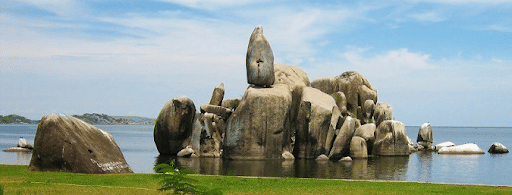
Bismarck Rock in Mwanza, Tanzania
Conclusion
Physical weathering contributes significantly to the weakening and disintegration of hillslope materials. Many landforms are affected by physical weathering processes. Weathering causes the destruction of rocks, which forms soil. It also contributes to erosion and mass transfer. It also contributes to the enrichment of ores such as iron, copper, and others that benefit the national economy.
|
|
|
|---|---|
| Geography Notes | Physical Geography |
| Geomorphic Processes | Geomorphology |
| Distribution of Oceans and Continents Basins | Minerals and Rocks |
| Endogenic Processes | Exogenic Processes |
FAQs
Question: What is physical weathering?
Answer: Physical weathering, also known as mechanical weathering, is the process of breaking down rocks into smaller fragments without changing their chemical composition. This type of weathering occurs due to physical forces such as temperature changes, freeze-thaw cycles, and the action of wind and water. Physical weathering is crucial in the denudational processes that shape landscapes, as it prepares rocks for further decomposition and erosion, ultimately contributing to soil formation and landform development.
Question: What are the main processes involved in physical weathering?
Answer: The main processes involved in physical weathering include:
- Freeze-Thaw Action: Water enters cracks in rocks, freezes and expands, causing the rock to fracture.
- Thermal Expansion: Rocks expand when heated and contract when cooled, leading to stress and eventual cracking.
- Exfoliation: The outer layers of rocks peel off due to temperature changes and pressure release.
- Mechanical Abrasion: Wind, water, or ice can carry particles that scrape against rocks, causing them to wear down.
- Biological Activity: Plant roots can penetrate rock crevices, exerting pressure that causes physical breakdown.
Question: How does physical weathering differ from chemical weathering?
Answer: Physical weathering and chemical weathering are two distinct processes that break down rocks:
- Physical Weathering: Involves the mechanical breakdown of rocks into smaller pieces without altering their chemical composition. It results from physical forces like temperature changes and pressure.
- Chemical Weathering: Involves chemical reactions that alter the minerals within rocks, leading to new minerals and the dissolution of existing ones. Factors such as water, oxygen, and acids contribute to this process.
Question: What role does physical weathering play in soil formation?
Answer: Physical weathering plays a crucial role in soil formation by breaking down parent rock material into smaller particles. This fragmentation increases the surface area for chemical weathering processes to occur, which further alters the mineral composition and creates soil. The combination of physical weathering, along with biological activity and the addition of organic matter, contributes to the development of fertile soils. Additionally, physical weathering helps retain moisture in the soil, promoting plant growth and ecological balance.
Question: What are the environmental impacts of physical weathering?
Answer: The environmental impacts of physical weathering include:
- Landscape Change: It contributes to the formation of various landforms such as valleys, cliffs, and plains, reshaping the Earth's surface over time.
- Soil Development: By breaking down rocks, physical weathering aids in soil formation, which is essential for agriculture and ecosystem health.
- Influence on Ecosystems: It affects drainage patterns and water retention in the landscape, influencing local habitats and biodiversity.
- Natural Resource Availability: Physical weathering can expose minerals and resources, making them available for extraction and use.
MCQs
1. What is the primary process of physical weathering?
A) Dissolution
B) Fracturing without chemical change
C) Formation of soil
D) Chemical alteration of minerals
Answer: (B) See the Explanation
Explanation: The primary process of physical weathering involves the fracturing of rocks without changing their chemical composition.
2. Which of the following is NOT a process associated with physical weathering?
A) Freeze-thaw action
B) Oxidation
C) Thermal expansion
D) Exfoliation
Answer: (B) See the Explanation
Explanation: Oxidation is a chemical weathering process, while freeze-thaw action, thermal expansion, and exfoliation are physical weathering processes.
3. How does physical weathering contribute to soil formation?
A) By altering soil pH
B) By increasing the rock surface area
C) By introducing nutrients
D) By reducing moisture
Answer: (B) See the Explanation
Explanation: Physical weathering contributes to soil formation by increasing the rock surface area, which enhances chemical weathering and nutrient availability.
4. What is one major effect of physical weathering on the landscape?
A) Increased humidity
B) Soil erosion
C) Formation of new minerals
D) Shaping landforms
Answer: (D) See the Explanation
Explanation: One major effect of physical weathering on the landscape is the shaping of landforms, such as valleys and cliffs.
5. Which environmental factor can accelerate physical weathering?
A) Temperature changes
B) Increased rainfall
C) Wind direction
D) Soil type
Answer: (A) See the Explanation
Explanation: Temperature changes can accelerate physical weathering through processes such as thermal expansion and freeze-thaw cycles.
GS Mains Questions and Model Answers
Q1: Discuss the significance of physical weathering in the denudational processes of landscapes.
Answer: Physical weathering plays a critical role in the denudational processes that shape landscapes. By breaking down rocks into smaller fragments, physical weathering facilitates subsequent erosion and sediment transport. This process contributes to the formation of various landforms, including valleys, hills, and plains. Moreover, physical weathering enhances soil formation, which is essential for supporting vegetation and sustaining ecosystems. The interplay between physical weathering and erosion creates dynamic landscapes that evolve over time, reflecting the ongoing processes of denudation and environmental change.
Q2: Analyze the relationship between physical weathering and chemical weathering in landscape evolution.
Answer: Physical weathering and chemical weathering are interconnected processes that jointly influence landscape evolution. Physical weathering breaks down rocks into smaller particles, increasing the surface area for chemical reactions. This fragmentation enhances the effectiveness of chemical weathering processes, which alter minerals and contribute to soil formation. Together, these processes shape the Earth's surface by transforming solid rock into soil and sediments. Understanding their relationship is essential for evaluating landscape dynamics and predicting how changes in environmental conditions, such as climate, may affect future weathering processes and landscape stability.
Q3: Evaluate the impact of human activities on physical weathering processes.
Answer: Human activities significantly impact physical weathering processes through land use changes, urbanization, and infrastructure development. Construction and mining activities can expose and destabilize rock surfaces, accelerating physical weathering through increased mechanical abrasion and fragmentation. Deforestation reduces vegetation cover, which can enhance soil erosion and promote weathering. Additionally, human-induced climate change, such as increased temperatures and altered precipitation patterns, can exacerbate physical weathering processes by influencing freeze-thaw cycles and hydrological regimes. Addressing these impacts requires sustainable land management practices that minimize disturbances and promote ecological balance.
Previous Year Questions on Physical Weathering
1. UPSC CSE Prelims 2021:
Question: Which of the following processes is a type of physical weathering?
A) Oxidation
B) Freeze-thaw
C) Hydrolysis
D) Carbonation
Answer: (B)
Explanation: Freeze-thaw is a process of physical weathering, while oxidation, hydrolysis, and carbonation are types of chemical weathering.
2. UPSC CSE Mains 2019 (GS Paper 1):
Question: "Examine the role of physical weathering in soil formation and landscape development." Discuss its importance in geographical processes.
Answer: Physical weathering plays a vital role in both soil formation and landscape development. By breaking down parent rock material into smaller particles, physical weathering increases the surface area available for chemical weathering, facilitating nutrient release and soil formation. This process contributes to the development of fertile soils that support diverse ecosystems and agriculture. Additionally, physical weathering shapes landscapes by creating landforms through the gradual erosion of rock surfaces. The interplay between physical weathering and other geomorphological processes influences the Earth's topography and ecological dynamics, making it a crucial aspect of geographical studies.
Download the PREPP App and attempt FREE IAS Exam Mock Tests and get complete study material!

Full Test - 04: UPSC CSE Prelims CSAT (Paper-II)
Full Test - 03: UPSC CSE Prelims CSAT (Paper-II)
UPSC CSE Prelims 2026 GS Paper 1 Question Paper (24-May-2026)
UPSC CSE Prelims 2026 CSAT Paper 2 Question Paper (24-May-2026)

17 February 2025 | The Hindu Must Read Articles | Current Affairs

16 February 2026 | The Hindu Must Read Articles | Current Affairs

13 February 2026 | The Hindu Must Read Articles | Current Affairs









Comments