Soil Formation Processes - Geography notes
Soil formation takes place by the process of weathering when the rocks break down to form soil particles. This rock degradation takes millions of years to complete. Physical, chemical, and biological weathering are the responsible factors for the creation of soil. The influences of heat, cold, water, wind, and rain cause the bedrock to crumble. The topic “Soil Formation Processes”, which is an important element of the UPSC Exam's Geography syllabus, should be thoroughly studied by candidates.
|
Table of Contents |

Soil - Concept
- Soil is a complex, multi-layered medium that covers a significant portion of the Earth's land surface.
- It is composed of mineral particles, organic matter, water, and air, and serves as a natural medium for the growth of plants.
- Sand, silt, and clay are the three basic components that give it its texture.
- The mineral texture of the soil varies depending on these three elements. The higher organic layer, known as humus, is formed as leaves and other elements decay.
- The humus content of soils has a significant impact on their fertility.
- Soil not only supports plant life but also plays an essential role in various biogeochemical cycles, making it crucial for life on Earth.
- Soil formation, also known as pedogenesis, is a complex process that transforms raw mineral material into the soil that covers much of the Earth's terrestrial surface.
| Other Relevant Links | |
|---|---|
| Mass Movements | Denudational Processes |
| Significance of Weathering | Chemical Weathering |
| Biological Weathering | Physical Weathering |
Soil Genesis
- Soil is the key component of the natural environment, linking climate and plants, and their relative fertility has a significant impact on man's activities.
- The science of soils is called pedology, and the process of soil formation is also known as pedogenesis.
- Soil is the top layer of the Earth's crust that has been worn by plants and animals.
- A soil profile is a vertical passage through this zone that contains multiple identifiable layers or horizons that allow different types of soil to be identified.
- Soil is a thin layer of mineral particles on the surface of the earth that generally contains a significant quantity of organic matter and is capable of supporting living plants.
- It covers the portion of the Earth's outer skin that stretches from the surface to the maximum depth to which living creatures can penetrate, which is essentially the area covered by plant roots.
- Soil is defined by its ability to create and store plant nutrients, which is facilitated by interactions between a variety of variables including water, air, sunshine, rocks, plants, and animals.
- Soil, despite its sparse distribution across the terrestrial surface, serves as a critical interface between the atmosphere, lithosphere, hydrosphere, and biosphere.
- Because most soil is made up of inorganic materials, it is normally classed as part of the lithosphere, yet it is inextricably linked to the other three spheres of the Earth.
- The physical and chemical degradation of rock exposed to the atmosphere, as well as the action of water trickling down from the top, starts the process of soil production (Genesis of Soil-Structure).
- Weathering is the process of disintegration.
- Weathering causes the solid rock to weaken and break down, as well as the fragmentation of cohesive rock masses and the formation of small rocks from larger ones.
- The main product is regolith ("blanket rock"), a loose coating of inorganic material that acts as a blanket over the unfragmented rock beneath it.

Regolith
- The regolith, in most cases, is made up of material that has weathered from the underlying rock and has a rudimentary particle size gradation, with the largest and least broken pieces at the bottom, immediately adjacent to the bedrock.
- However, the regolith can sometimes contain material that was brought from another location by wind, water, or ice.
- As a result, the regolith's composition may differ dramatically from one location to the next.
- The regolith's upper half-meter or so differs from the material below in a variety of ways, most notably in the intensity of biological and chemical activity.
- The upper section is made up of soil. It is the final product of weathering and is made up primarily of finely fragmented mineral particles.
- It usually has a lot of living plant roots, dead and rotting plant parts, living and dead tiny plants and animals, and a varying amount of air and water.
- Soil is a stage in a never-ending continuum of physical-chemical–biological processes, rather than the final outcome of a process.

Genesis of Soil
What is Soil Profile?
- A soil profile is a vertical section of soil that shows all of its strata.
- The soil profile runs from the surface of the soil to the source rock material.
- All of the weathered material inside the profile is included in the regolith.
- The regolith is made up of two parts: the solum and the saprolite.
- The solum encompasses the profile's top horizons and the most worn part.
- The saprolite is the least weathered layer above the solid, consolidated bedrock but beneath the regolith.
- A soil horizon is a separate stratum of soil. The horizon runs nearly parallel to the soil surface and has distinct qualities and characteristics from the layers above and below it.
- The soil profile is a valuable tool for fertilizer management. We can learn a lot about soil fertility by looking at a soil profile.
- The profile of the soil varies as it weathers and/or organic matter decomposes.
- A heavily worn, infertile soil, for example, usually has a light-colored layer in the subsurface soil from which nutrients have leached away.
- A highly fertile soil, on the other hand, frequently has a deep surface layer that is rich in organic matter.
Layers of Soil
- O Horizon: The O horizon is a surface horizon made up of organic material at different stages of decomposition. It is especially noticeable in forested environments where there is an accumulation of tree debris.
- A Horizon: The A horizon is a surface horizon composed primarily of minerals (sand, silt, and clay) with trace amounts of organic matter. This horizon is mostly the surface layer of many grasslands and agricultural soils.
- E Horizon: The E horizon is a severely leached subsurface horizon. The process through which soluble nutrients are lost from the soil as a result of precipitation or irrigation is known as leaching. Typically, the horizon is bright in hue. It is most commonly found beneath the O horizon.
- B Horizon: The B horizon is a subsurface horizon formed by the layer(s) above. It is a depositional location for minerals that have leached from the layer(s) above.
- C Horizon: A subsurface horizon is the C horizon. It is the least worn horizon. It is an unconsolidated, loose parent material, sometimes known as saprolite.
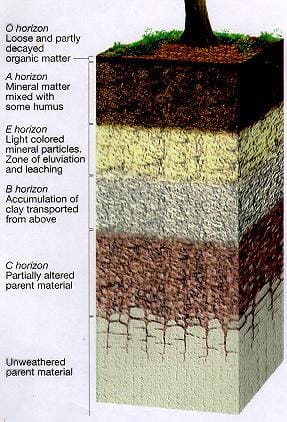
Horizons of Soil
Processes of Soil Formation
The four categories of soil-forming processes are soil enrichment, removal, translocation, and transformation.
Soil Enrichment
- Soil enrichment involves the addition of organic or inorganic substances to the soil.
- A good example is the mineral enrichment of silt on the surface caused by river floods or as wind-blown dust.
- Water transports humus from the O horizon to the A horizon below, resulting in organic enrichment.
Removal
- The substance is removed from the soil body through removal operations.
- This happens when soil particles are carried into streams and rivers by erosion.
- Another major removal process is leaching, which is the loss of soil compounds and minerals via solution in water flowing to lower levels.
- Cheluviation, which is comparable to leaching, is the downward movement of elements in the soil.
- It is caused by the action of organic molecules, also known as chelating agents.
- Plant acids are used instead of water in this process, as is the case with leaching.
Translocation
- The movement of materials upward or downward inside the soil is referred to as translocation.
Downward Translocation
- Eluviation is the process of fine particles, notably clays, and colloids, being translocated downward.
- The E horizon is formed by grains of sand or coarse silt left behind by this process.
- In a process known as illuviation, the material carried down from the E horizon—clay particles, humus, or sesquioxides of iron and aluminum—accumulates in the B horizon.
- A thin coating of wind-blown silt and dune sand has increased the soil profile at the top of the soil profile.
- Humus has enriched the A horizon, giving it a brownish tone, as it has moved lower from decaying organic materials in the O horizon.
Upward Translocation
- Another key step is calcium carbonate translocation.
- A substantial proportion of surplus soil water travels downward to the groundwater zone in damp regions.
- Decalcification occurs when water movement removes calcium carbonate from the entire soil.
- Soils that have lost the majority of their calcium are typically acidic and poor in bases.
- Not only would adding lime or crushed limestone rectify the acid state, but it will also replace the calcium that has been lost, which is a crucial plant nutrient.
- Annual precipitation is insufficient in arid climates to drain carbonate out of the soil and into the groundwater below.
- In a process known as calcification, it is taken down to the B horizon and deposited as white grains, plates, or nodules.
- Calcification can result in the formation of a hard pan, a cemented layer that obstructs both eluviation and illuviation.
- By restricting the exchange of nutrients, the soil becomes less fruitful.
- A pan can also form as a result of the illuviation of iron and aluminum oxides in colder areas.
- This type of pan can obstruct drainage and keep the soil waterlogged for an extended period of time, resulting in chemical depletion.
Upward Translocation in Deserts
- In desert settings, upward translocation is also possible.
- A layer of groundwater lies near the surface in some low locations, resulting in a flat, poorly drained area.
- Groundwater is pushed higher to replace evaporated water at or near the soil surface by capillary tension, similar to how a cotton wick draws oil upward in an oil lamp.
- The dissolved salts in this groundwater are frequently high.
- The salts are deposited and pile up as the salt-rich water evaporates. Salinization is the term for this procedure.
- Many plants are poisoned by large concentrations of these salts.
- In irrigated lands in a desert climate, salinization can damage the soil, with little possibility of recovery.
Transformation
- The change of material within the soil body is the last category of the soil-forming process.
- The conversion of minerals from primary to secondary types is one example; another is the degradation of organic materials by microbes into humus, a process known as humification.
- Organic matter can be totally altered to carbon dioxide and water in warm moist conditions, leaving almost no organic matter in the soil.

Translocation And Transformation of the Soil
Factors that Influence Soil Formation
The following are some of the factors that influence soil formation:

Factors Influencing Soil Formation
Parent Material
- Parent materials are the rocks that soils are created from.
- The parent material, in most circumstances, determines the color, mineral composition, and texture of the soil.
- The soil created may or may not have the same physical qualities as the parent rock in various circumstances.
- Climatic conditions cause chemical changes in the soil, which impact its physical qualities.
- The weathering process is exposed to the surface rocks.
- The rocks are turned into fine grains in this process, which serve as a foundation for the development of soil.
- In Indian conditions, the parent material is classified as follows:
- Ancient crystalline and metamorphic rocks
- Cuddapah and Vindhyan rocks
- Gondwana rocks
- Deccan basalts
- Tertiary and Mesozoic sedimentary rocks of extra peninsular India
Climate
- The most essential components in soil formation are temperature and rainfall.
- They determine the effectiveness of the parent material's weathering, the amount of water that seeps through the soil, and the kind of microorganisms that live there.
- In the same environment, two different parent materials may produce the same soil. Similarly, the same parent material can yield two distinct soil types in two distinct climates.
- The crystalline granites create laterite soil in the monsoonal region's more damp areas and non-laterite soil in the drier areas.
- Regardless of the parent rock, hot summers, and limited rainfall produce black soil, as seen in some places of Tamil Nadu.
- Granite and sandstone both give birth to sandy soil in Rajasthan's arid environment.
- Evaporation always exceeds precipitation in dry and semi-arid environments.
- There is minimal vegetation, and the soils are severely deficient in humus. As a result, the soils are always pale in color.
- Excessive evaporation causes soils in Rajasthan and the surrounding dry and semi-arid regions to accumulate lime. As a result, the soil is pedocal.
- Pedocal is a subdivision of the zonal soil order. It's a type of dirt that grows in semiarid and arid climates.
- It has a high calcium carbonate content and a low soil organic matter content.
- The process of vegetation breakdown is very slow in the Himalayan region's frigid weather, and the soils are acidic.
Topography
- Relief, or the configuration or shape of the ground surface, has an impact on soil formation.
- Soil horizons are dense on moderate slopes and thin on steep slopes in general.
- This is due to the fact that erosion removes soil more quickly on steeper slopes.
- Furthermore, slopes facing away from the Sun are shielded from direct sunlight, resulting in cooler, moister soils.
- Direct sun rays reach slopes towards the Sun, raising soil temperatures and increasing evapotranspiration.
- The water that reaches the soil surface is redistributed by topography.
- Runoff from the uplands causes wetter conditions in the lowlands, including salty sloughs and organic soils in some circumstances.
- Thus, topography affects soil processes, soil distribution, and the type of plants at the site as a redistributor of climate variables.
Organisms
- The impact of living plants and animals, as well as their nonliving organic products, on soil, is significant.
- Plant roots mix and disturb the soil as they grow, and they provide organic material straight to the topsoil strata.
- Many different species of bacteria, as well as burrowing mammals, live in the soil.
- Earthworms constantly rework the soil by digging and bypassing it through their intestinal tracts.
- Larger, tube-like entrances are made by moles, gophers, rabbits, badgers, prairie dogs, and other burrowing creatures.
- Earthworms' cultivating and mixing actions are extremely beneficial in terms of enhancing the structure, increasing fertility, reducing the risk of accelerated erosion, and deepening the soil profile.
- The existence of many well-nourished earthworms is always an indicator of productive, or potentially productive, soil, as evidenced by their presence.

Impact of Organisms in the Process of Soil Formation
Time
- The formation of soil features and properties takes time.
- For example, it may take hundreds to thousands of years for a fresh deposit of mineral matter, such as the clean, sorted sand of a dune, to acquire the structure and qualities of sandy soil.
- Soil-forming processes are relatively slow, and producing a thin layer of soil on a newly exposed surface can take decades.
- Soil formation is aided by a warm, moist atmosphere.
- The properties of the parent material, on the other hand, are usually far more important.
- Soil, for example, forms fast from sediments yet takes a long time to form from bedrock.
- According to a soil scientist's rule of thumb, 2.5 cm (1 in.) of topsoil takes around 500 years to create.
Human Activity
- The physical and chemical composition of the soil is also influenced by human activity.
- Clearing native plants for crops can cause erosion by eliminating organic matter-rich higher layers.
- For ages, vast swaths of agricultural soil have been ploughed and planted. As a result, these agricultural soils' structure and content have changed dramatically.
- These modified soils are frequently acknowledged as different soil classifications with equal importance to natural soils.
Significance of Soil Formation Processes
- With time, nutrients are continually taken from and added to soils as they form.
- The circumstances present during soil formation ultimately decide how much and what type of nutrients the soil can deliver and hold organically.
- Plant growth, human nourishment, and water filtration all require healthy soil formation.
- A landscape with healthy soil is more resilient to the effects of drought, flood, and fire.
- Soil aids in climate regulation and stores more carbon than all of the world's forests put together.
Conclusion
Soil is one of the most significant components of an ecosystem, containing both biotic and abiotic constituents. Soil contains both living and dead plant and animal debris, as well as air, water, and minerals. Phosphorus, potassium, and nitrogen gas are the most important minerals present in the soil that encourage plant growth.
|
|
|
|---|---|
| Geography Notes | Physical Geography |
| Geomorphic Processes | Geomorphology |
| Distribution of Oceans and Continents Basins | Minerals and Rocks |
| Endogenic Processes | Exogenic Processes |
FAQs
Question: What are the main factors influencing soil formation?
Answer: The main factors influencing soil formation include parent material, climate, topography, biological activity, and time. These factors determine the characteristics and composition of the soil.
Question: How does climate affect soil formation?
Answer: Climate affects soil formation by influencing the rate of weathering and organic matter decomposition. High temperatures and rainfall increase chemical weathering and leaching, resulting in deeper and more developed soils.
Question: What is leaching in soil formation?
Answer: Leaching is the process by which water carries soluble nutrients and minerals from the upper layers of the soil to the lower layers. It affects soil fertility and leads to the development of soil horizons.
Question: What is the significance of soil horizons?
Answer: Soil horizons are distinct layers in the soil profile that differ in composition, texture, and color. They help in understanding the soil formation process and its suitability for various uses such as agriculture.
Question: How does organic matter contribute to soil formation?
Answer: Organic matter, primarily in the form of humus, enhances soil fertility by improving nutrient retention, water-holding capacity, and soil structure, which supports plant growth.
MCQs
1. Which of the following is a key process in chemical weathering during soil formation?
A. Freezing and thawing
B. Root penetration
C. Hydrolysis
D. Abrasion
Answer: (C) See the Explanation
Hydrolysis is a chemical weathering process in which minerals react with water to form new compounds, leading to the breakdown of rocks into soil particles.
2. In which soil horizon is organic matter most abundant?
A. O Horizon
B. B Horizon
C. C Horizon
D. R Horizon
Answer: (A) See the Explanation
The O Horizon is the top layer of the soil profile, primarily composed of organic matter, including decomposed plant and animal material.
3. What is the primary factor controlling the rate of soil formation?
A. Parent material
B. Topography
C. Climate
D. Time
Answer: (C) See the Explanation
Climate is the primary factor influencing the rate of soil formation, as it affects the intensity of weathering and organic matter decomposition.
4. Which of the following describes the process of illuviation in soil formation?
A. The accumulation of organic material in the upper layers of soil
B. The leaching of nutrients from the soil
C. The accumulation of leached materials in the lower soil horizons
D. The mixing of soil by earthworms
Answer: (C) See the Explanation
Illuviation refers to the process where leached materials, such as clay, iron, or organic compounds, accumulate in the B Horizon of the soil profile.
5. Which soil formation process is driven by biological activity?
A. Hydrolysis
B. Carbonation
C. Humification
D. Oxidation
Answer: (C) See the Explanation
Humification is the process by which decomposed organic matter is converted into humus, a key component of soil that enhances its fertility and structure.
GS Mains Questions and Model Answers
1. Discuss the role of climate and parent material in the process of soil formation. Provide examples of different soil types formed under varied climatic conditions.
Answer: Climate and parent material play a significant role in the soil formation process. Climate determines the rate of weathering and organic matter decomposition. For example, in tropical regions with high rainfall and temperatures, intense chemical weathering and leaching occur, leading to the formation of deep, highly weathered soils such as laterites. On the other hand, in arid regions with low rainfall, physical weathering dominates, resulting in the formation of sandy or desert soils. Parent material, which refers to the underlying geological material, provides the mineral content of the soil. For instance, soils derived from granite tend to be acidic, while those from limestone are alkaline.
2. Explain the process of leaching and its impact on soil fertility. How does leaching differ in tropical and temperate climates?
Answer: Leaching is the process where water-soluble nutrients and minerals are washed away from the upper layers of the soil to the lower layers, which affects soil fertility. In tropical climates with high rainfall, leaching is more intense, leading to the depletion of essential nutrients like nitrogen, phosphorus, and potassium from the topsoil. This results in poor soil fertility, requiring fertilizers for agricultural use. In temperate climates, leaching occurs at a slower rate due to lower rainfall and milder temperatures, allowing soils to retain more nutrients and organic matter, making them more fertile.
3. Analyze the role of biological factors in soil formation and its contribution to soil fertility.
Answer: Biological factors such as plants, microorganisms, and animals play a vital role in soil formation. Roots penetrate rocks, contributing to their physical and chemical breakdown, while microorganisms decompose organic matter to form humus. Earthworms and other organisms mix the soil, improving its structure and aeration. The decomposition of plant and animal remains leads to the formation of humus, which enhances the soil’s water-holding capacity, nutrient retention, and fertility. The activity of microorganisms also aids in the nutrient cycling process, releasing essential elements like nitrogen and phosphorus back into the soil, supporting plant growth.
Previous Year Questions on Soil Formation
1. UPSC CSE Prelims 2019
Question: Which of the following processes is primarily responsible for the accumulation of clay and iron in the subsoil during soil formation?
A. Leaching
B. Illuviation
C. Humification
D. Oxidation
Answer: B
Explanation: Illuviation refers to the process where materials such as clay, iron, and organic compounds are transported from the upper layers and accumulate in the subsoil or B Horizon.
2. UPSC CSE Mains 2017 (GS Paper 1)
Question: Discuss the various factors influencing soil formation and explain how soil profiles develop over time.
Answer: Soil formation is influenced by several factors, including parent material, climate, topography, biological activity, and time. These factors work together to break down rocks and organic matter, leading to the formation of different soil horizons. The soil profile develops as minerals and organic matter accumulate in distinct layers. Over time, processes such as leaching, illuviation, and humification contribute to the development of horizons like the O Horizon (organic matter), A Horizon (topsoil), B Horizon (subsoil), and C Horizon (parent material). The balance of these factors determines the characteristics and fertility of the soil, making it suitable for various land uses, including agriculture.
Download the PREPP App and attempt FREE IAS Exam Mock Tests and get complete study material!
UPSC IAS : CSAT - Mini Live Test

Live Test : UPSC CSE Prelims CSAT (Paper-II) (Oct 20 - 23)
Full Test - 04: UPSC CSE Prelims CSAT (Paper-II)
Full Test - 03: UPSC CSE Prelims CSAT (Paper-II)
UPSC CSE Prelims 2026 GS Paper 1 Question Paper (24-May-2026)
UPSC CSE Prelims 2026 CSAT Paper 2 Question Paper (24-May-2026)

17 February 2025 | The Hindu Must Read Articles | Current Affairs

16 February 2026 | The Hindu Must Read Articles | Current Affairs

13 February 2026 | The Hindu Must Read Articles | Current Affairs









Comments