Rohini Panel Submits Long-Awaited Report: What Is ‘Sub-Categorisation’ Of OBCs?
Relevance: GS1 - Population and Associated Issues; GS2 - Government Policies & Interventions
(Source: Indian Express, 08/03/2023)
Click here for Daily Current Affairs
Why in the news?
- Recently, the long awaited report for the sub-categorisation of Other Backward Classes (OBC) caste groups was submitted to the President Droupadi Murmu.
- A four-member commission headed by Justice G Rohini was appointed to examine this issue and suggest corrective measures to ensure equitable distribution of benefits among OBC communities.
Table of Contents
- About Justice Rohini Commission
- What are the Terms of Reference of the Rohini Commission?
- Findings of the Report
- Challenges faced by the Rohini Commission
- What is Sub-categorization of OBCs?
- What is the need for sub-categorisation of OBCs?
- Status of OBC Reservation developed over the years
- Conclusion
- FAQs
- MCQs
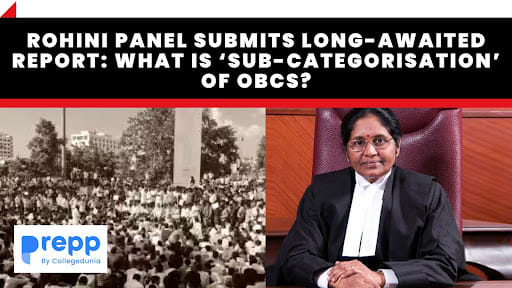
About Justice Rohini Commission
- The commission was set up on October 2, 2017, under Article 340 of the Constitution.
- It was tasked with sub-categorisation of the Other Backward Classes (OBCs) and equitable distribution of benefits reserved for them.
- It was headed by former Delhi High Court judge, Justice G. Rohini.
What are the Terms of Reference of the Rohini Commission?
- Examining Inequitable Distribution: The commission was to assess the extent of uneven allocation of reservation benefits among various OBC castes or communities included in the Central List.
- Mechanism for Sub-Categorization: It was mandated to devise a scientific approach, criteria, norms, and parameters for the sub-categorization within the broader OBC category.
- Identifying and Classifying: The commission was required to identify and classify specific castes, communities, sub-castes, or synonyms in the Central List of OBCs into their respective sub-categories.
- Identifying any discrepancies or errors: The commission was tasked with examining the entries in the Central List of OBCs and suggesting necessary revisions to address issues such as repetitions, ambiguities, inconsistencies, and errors in spelling or transcription.
Findings of the Report
- The Commission's analysis of 1.3 lakh central jobs and OBC admissions to central higher education institutions unveiled a significant disparity.
- Unequal Distribution: It showed that 97% of the total opportunities were concentrated by only 25% of the OBC sub-castes and 24.95% of these jobs and seats have gone to just 10 OBC communities.
- Underrepresented OBC Communities: Around 37% of the total OBC communities, amounting to 983 groups, were identified as having absolutely no representation within both job positions and educational institutions.
- Limited Representation: Within the framework of OBC sub-castes, a mere 2.68% representation in terms of recruitments and admissions was observed among 994 OBC sub-castes.
Challenges faced by the Rohini Commission
- Absence of data: The analysis suffered with the lack of accurate and updated data regarding the population of various OBC communities.
- Delayed in data collection: While the Census 2021 was intended to collect data on OBCs, the pandemic delayed the process.
- Demand for Caste Census: Various political parties and OBC groups have advocated for a caste census to provide accurate population data for informed policy decisions.
What is Sub-categorization of OBCs?
What is the need for sub-categorisation of OBCs?
Status of OBC Reservation developed over the years
|
Conclusion
The sub-categorization of OBCs aims to address the unequal distribution of reservation benefits within this group. The Justice Rohini Commission's efforts to classify and balance opportunities for various OBC communities reflect the need for more equitable representation.
(*Click this link to read prelims specific weekly current affairs articles)
FAQs
Question: What is the Justice Rohini Commission?
Answer:
The commission was set up on October 2, 2017, under Article 340 of the Constitution. It was tasked with sub-categorisation of the Other Backward Classes (OBCs) and equitable distribution of benefits reserved for them.
Question: What is the National Commission for Backward Classes (NCBC)?
Answer:
It is a constitutional body in India that was established to investigate and recommend the inclusion or exclusion of communities in the list of socially and educationally backward classes.
Question: What is the Mandal Commission?
Answer:
Mandal Commission was set up in 1979 by Morarji Desai government to identify the socially or educationally backward classes to consider the question of seat reservations and quotas for people to redress caste discrimination, and used eleven social, economic, and educational indicators to determine backwardness.
MCQ
Question: Consider the following statements: (UPSC 2019)
- National Commission for Backward Classes (NCBC) was set up in 1993
- 102nd Amendment Act of 2018 conferred a constitutional status on the Commission
Which of the following statements given above is/are correct?
(a) 1 only
(b) 2 only
(c) Both 1 and 2
(d) Neither 1 nor 2
Answer: (c) See the Explanation
- The Supreme Court directed the central government in the Mandal case (1992) to establish a permanent statutory body to investigate allegations of underinclusion, overinclusion, or non-inclusion of any class of people in the list of backward classes.
- As a result, the National Commission for Backward Classes (NCBC) was established in 19932. So statement 1 is correct.
- Later, the 102nd Amendment Act of 2018 granted the Commission constitutional status. So statement 2 is correct.
- The amendment added a new Article 338-B to the constitution to accomplish this.
- As a result, the Commission transitioned from a statutory to a constitutional organisation.
Therefore option (c) is the correct answer.
Download the PREPP App and attempt FREE IAS Exam Mock Tests and get complete study material!

Full Test - 04: UPSC CSE Prelims CSAT (Paper-II)
Full Test - 03: UPSC CSE Prelims CSAT (Paper-II)
UPSC CSE Prelims 2026 GS Paper 1 Question Paper (24-May-2026)
UPSC CSE Prelims 2026 CSAT Paper 2 Question Paper (24-May-2026)

17 February 2025 | The Hindu Must Read Articles | Current Affairs

16 February 2026 | The Hindu Must Read Articles | Current Affairs

13 February 2026 | The Hindu Must Read Articles | Current Affairs









Comments