GST Council Sticks To Its Guns, Imposes 28% Tax On Online Gaming
Relevance: GS3 - Indian Economy and issues relating to planning, mobilization, of resources, growth, development and employment, Government Budgeting GS2 - Powers, functions and responsibilities of various Constitutional Bodies, Government policies and interventions for development in various sectors and issues arising out of their design and implementation.
(Source: The Hindu, 08/03/2023)
Click here for Daily Current Affairs
Why in the news?
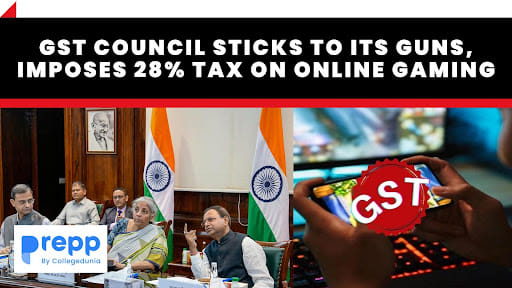
- Recently, the GST Council announced a 28% tax on the full face value of bets placed in casinos, horse races, and online gaming.
- The online gaming industry has claimed that this could lead to the loss of billions of dollars of investments and thousands of jobs in the industry, which is a sunrise sector.
Table of Contents
What is online gaming?
- According to the Ministry of Electronics and Information Technology, online gaming refers to games offered through the internet and accessible through an intermediary.
- It can be fantasy, skill, or e-sport based platforms.
- The gaming industry in India is estimated to be worth around $ 2.8 billion (FY22) and is expected to grow into a $5 billion industry by 2025.
What is the latest decision of the GST Council?
- The GST Council clarified that the 28% tax will be imposed on the full face value as gambling, gaming, and lottery are actionable activities under the GST law.
- The Union Government has stated that it will attempt to amend the GST law in the present Parliamentary session, states will also have to amend their GST laws to enable the implementation of the new changes by October 1st.
State’s Response
- Sikkim and Goa dissented over the process of the law and its implications for casino goers i.e. they wanted the 28% levy to apply to gross gaming revenue and not the entire face value.
- As they were small States and needed consideration, the Council agreed to revisit and review the implementation after 6 months.
- Tamil Nadu raised concerns about the law’s impact on the state’s ban on online gaming.
- The Union Finance Minister assured that the amended act would explicitly state that it was not applicable in regions where online gaming is banned.
- Delhi sought a review for the online gaming sector.
How will the new taxation work?
- The gaming platform charges users an entry fee to allow them to participate.
- A percentage of this entry fee, known as the gross gaming revenue (GGR), is deducted by the platform as part of its running costs and the rest is transferred to the prize pool.
- Example 1: Suppose a platform paid an entry fee of ₹100.
- Earlier the GGR was taxed at 18%. This meant that the operator would have to pay ₹3.6 as taxes on a GGR of ₹20.
- Following the changes, taxes will be levied on the entry bet i.e. ₹100 at 28%, raising the tax burden to ₹28.
- Example 2: Consider a customer who purchases chips worth ₹1,000 to enter a casino and then wins ₹300.
- In this case, the tax levied on the customer will not be levied on the whole ₹1,300, but only on the entry amount of ₹1,000.
What is the government’s justification for the new tax?
- Money laundering: The increased popularity of wagering and games of chance has led to an increase in instances of user harm and money laundering.
- Social evil: The GST Council opined that online gaming is a social evil and should be discouraged.
- The resultant reduction in revenue could serve a social and economic purpose.
- Sin tax: The 28% tax imposed on online gaming and betting on total consideration is similar to the sin tax imposed on cigarettes and alcohol.
Concerns associated with the new taxation
- Rising prices: The higher and uniform tax rate will make it more expensive for people to participate in online gaming.
- Taxes may have to be passed on to consumers by raising ticket prices.
- Illegal avenues: The rising prices is likely to make the industry unviable and push customers to offshore and illegal platforms where taxes are not imposed.
- GST burden: The new taxation system could lead to an increase in GST by 350% which would adversely affect the industry in a substantial way.
- Definition: The High Court of Karnataka has not upheld the stand of the Revenue Department that online gaming, horse racing, and casinos are betting and dismissed a ₹21,000 crore tax demand against Gameskraft Technologies.
- The Union Government has not differentiated between games of skill and games of chance.
- Industry viability: There will be less money available for platforms to charge the necessary platform fee thereby reduce the available pool of resources to be distributed as winnings.
- The existing 30% taxation levied on the final winnings is another disincentive.
Similar Taxation systems in other countries
- European Union
- Tax rate revenue is set at 15-20% while taxation on winning is between 15-50% depending on the amount and the state.
- United Kingdom
- 15% for the first $3.5 million earned on the Gross Gaming Revenue (GGR), and up to 50% for amounts over $17.8 million.
- Gambling winnings are tax-free but e-sports are taxed at 40-45%
- United States of America
- Online gaming is taxed 10% in most states but a 30% tax is imposed on any winnings through online gaming and e-sports winning.
Conclusion
- Most of the states in the country agree that gambling is a social menace and must be discouraged.
- The new tax structure will give gaming companies an opportunity to innovate and rebuild in India while clarifying uncertainties about the sector.
(*Click this link to read prelims specific weekly current affairs articles)
FAQs
Question: What is the difference between games of skill and games of chance?
Answer:
- Game of chance: Here, a player’s victory is dependent on luck regardless of his experience. They are easier to play because they do not require any technical knowledge.
- Game of skill: Here, players need to use their skills and strengths to win which is independent of luck. It requires strategies, and experience and allows for skill development through practice.
Question: What is the GST Council?
Answer:
The GST Council is a constitutional body under Article 279A which is responsible for making GST-related recommendations to the Union and State governments. It is chaired by the Union Finance Minister and has the Ministers of State of Revenue or Finance, and State Ministers of Finance or Taxation as members.
UPSC Mains Practice Question:
|
MCQs
Question: What is/are the most likely advantages of implementing ‘Goods and Services Tax (GST)?
- It will replace multiple taxes collected by multiple authorities and will thus create a single market in India.
- It will drastically reduce the ‘Current Account Deficit’ of India and will enable it to increase its foreign exchange reserves.
- It will enormously increase the growth and size of the economy of India and will enable it to overtake China in the near future.
Select the correct answer using the code given below: (UPSC CSE 2017)
(a) 1 only
(b) 2 and 3 only
(c) 1 and 3 only
(d) 1, 2 and 3
Answer: (a) See the Explanation
- The GST replaced the system of multiple taxes collected by multiple authorities and thus created a single market in the country. Hence statement 1 is correct.
- The Current Account Deficit will not be reduced by the introduction of a GST system as the CAD is influenced by oil prices and other essential imports. Hence statement 2 is incorrect.
- The growth of the economy will not be enormously increased by the introduction of the GST system. Hence statement 3 is incorrect.
Therefore, option (a) is the correct answer.
Download the PREPP App and attempt FREE IAS Exam Mock Tests and get complete study material!

Full Test - 04: UPSC CSE Prelims CSAT (Paper-II)
Full Test - 03: UPSC CSE Prelims CSAT (Paper-II)
UPSC CSE Prelims 2026 GS Paper 1 Question Paper (24-May-2026)
UPSC CSE Prelims 2026 CSAT Paper 2 Question Paper (24-May-2026)

17 February 2025 | The Hindu Must Read Articles | Current Affairs

16 February 2026 | The Hindu Must Read Articles | Current Affairs

13 February 2026 | The Hindu Must Read Articles | Current Affairs









Comments