Implementing PESA Act In Jharkhand Is Not An Easy Task
Relevance: GS2 - Government Policies And Interventions For Development In Various Sectors; Issues relating to development and management of Social Sector/Services; Issues Related to SCs & STs
(Source: Down to Earth, 08/03/2023)
Click here for Daily Current Affairs
Why in the news?
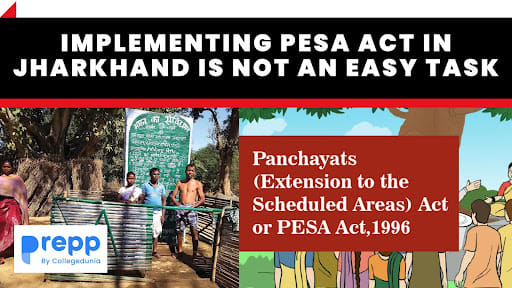
- Recently, the Jharkhand government has released draft rules for public consultation, aiming to enforce the Panchayats (Extension to Scheduled Areas) Act (PESA) of 1996.
- The draft rules confer specific rights upon Gram Sabhas in Scheduled Areas, including the resolution of traditional and family disputes, adjudication of cases falling under the Indian Penal Code (IPC), and the responsibility to uphold peace and order aligned with constitutional principles.
- The PESA Act is operational in Himachal Pradesh, Andhra Pradesh, Telangana, Rajasthan, Gujarat, Chhattisgarh, Madhya Pradesh, and Maharashtra, among the 10 states governed by the Fifth Schedule.
- However, the Act is yet to be implemented in Odisha and Jharkhand.
Table of Contents
About PESA Act
- The Provisions of the Panchayats (Extension to Scheduled Areas) Act or PESA was enacted in 1996 to ensure self-governance through gram sabhas for people living in Scheduled Areas.
- It recognises the right of tribal communities in Scheduled Areas to govern themselves through their own systems of self-government.
- It acknowledges their traditional rights over natural resources.
Provisions of the Act
- The draft provisions grant Gram Sabhas in Scheduled Areas the authority to make decisions regarding minor minerals' use, including sand and stone, allowing them to manage local resources.
- The Gram Sabha will possess the autonomy to establish committees independently, covering areas such as education, healthcare, agriculture, public property, village defense, infrastructure, etc.
- Gram Sabhas' permission will be mandatory for any mining activities, and they hold the power to reject regulations from central or state governments that impede traditional practices.
- Any tribal land acquisition will necessitate Gram Sabha consent.
- The draft provisions permit Gram Sabhas to conduct local-level hearings on issues under the Indian Penal Code.
Need for PESA act in Jharkhand
- Jharkhand, with a population of 8.64 million, harbors a substantial tribal community, comprising over a quarter of its populace at 26.3%.
- Among these indigenous individuals, more than half reside within 12,164 villages.
- Notably, 14 out of the state's 24 districts fall under the Fifth Schedule, providing a home to over 6.86 million tribal residents.
- The state of Jharkhand came into being 22 years ago in 2000, but till now PESA has not been enacted in the state of Jharkhand.
Challenges in implementing PESA in Jharkhand
- Tribal Opposition to Panchayat Elections: Some tribal groups are resistant to Panchayat elections in Fifth Schedule areas, posing a challenge to harmonizing the roles of elected Gram Panchayats and traditional Gram Sabhas.
- Conflicting Laws: The passage of the Forest (Conservation) Amendment Bill, 2023, which removes the need for Gram Sabha consent in non-notified forest areas, creates conflicts between this new law and PESA, potentially weakening the authority of Gram Sabhas.
- Resource Management: Effective management of resources like minerals, forests, and water bodies, while ensuring equitable distribution and preventing exploitation, requires meticulous planning and implementation.
- Funding and Development: Translating the promise of PESA into tangible development in marginalized regions demands proper allocation and utilization of funds, which might be complicated by bureaucratic processes.
How are Tribals and their Rights Protected in India?
|
Conclusion
- The draft rules introduced by the Jharkhand government to implement PESA hold the potential to empower tribal communities in Scheduled Areas.
- In navigating these challenges, the Jharkhand government needs to carefully address the concerns of tribal communities while working towards effective governance and development in the Scheduled Areas.
- The successful implementation of PESA in the state could bring about transformative change, offering marginalized communities a say in their own development and resource management.
(*Click this link to read prelims specific weekly current affairs articles)
FAQs
Question: What is the PESA Act?
Answer:
The Provisions of the Panchayats (Extension to Scheduled Areas) Act or PESA was enacted in 1996 to ensure self-governance through gram sabhas for people living in Scheduled Areas. It recognises the right of tribal communities in Scheduled Areas to govern themselves through their own systems of self-government.
Question: What is Schedule 5 of the Constitution?
Answer:
The fifth Schedule contains provisions as to the Administration and Control of Scheduled Areas and Scheduled Tribes.
Question: What is Gram Sabha?
Answer:
Gram Sabha means a village assembly, comprising members of a village. It is the legislative body that functions at the village level and considers the Gram Panchayat's yearly budget and audit reports. Article 243(b) of the Indian Constitution defines the term Gram Sabha.
UPSC Mains Practice Question:
|
MCQ
Question: The Government enacted the Panchayat Extension to Scheduled Areas (PESA) Act in 1996. Which one of the following is not identified as its objective? (UPSC 2013)
(a) To provide self-governance
(b) To recognize traditional rights
(c) To create autonomous regions in tribal areas
(d) To free tribal people from exploitation
Answer: (c) See the Explanation
PESA Act is enacted to extend Panchayati Raj institutions into areas mentioned in the Fifth Schedule of the Constitution. The creation of autonomous regions in tribal areas is mentioned in the Sixth Schedule of the Constitution.
Therefore, option (c) is the correct answer.
Download the PREPP App and attempt FREE IAS Exam Mock Tests and get complete study material!

Full Test - 04: UPSC CSE Prelims CSAT (Paper-II)
Full Test - 03: UPSC CSE Prelims CSAT (Paper-II)
UPSC CSE Prelims 2026 GS Paper 1 Question Paper (24-May-2026)
UPSC CSE Prelims 2026 CSAT Paper 2 Question Paper (24-May-2026)

17 February 2025 | The Hindu Must Read Articles | Current Affairs

16 February 2026 | The Hindu Must Read Articles | Current Affairs

13 February 2026 | The Hindu Must Read Articles | Current Affairs









Comments