India Among The 12 Countries Responsible For 52% Of The World’s Mismanaged Plastic Waste
Relevance: GS3 - Environmental Pollution and Degradation; Conservation
(Source: Down to Earth, 08/03/2023)
Click here for Daily Current Affairs
Why in the news?
- Recently, the 2023 Plastic Overshoot Day Report was released by Swiss-based research consultancy Earth Action (EA), which stated that on July 28, 2023, the world saw its first global Plastic Overshoot Day.
- This day marked the point at which the global plastic waste production surpassed the world's capacity for waste management.
Table of Contents
Major Findings of the Report
- Projected Plastic Waste: The report estimates that nearly 68,642,999 tonnes of additional plastic waste will enter the environment in 2023 due to plastic pollution.
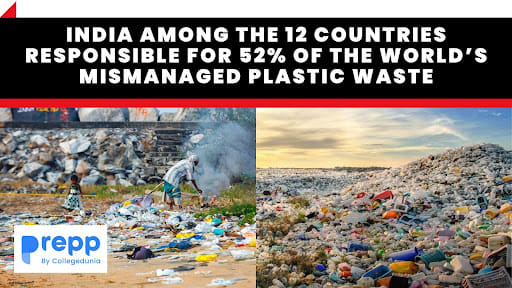
- Countries Responsible for Plastic Waste: India is among the 12 countries, along with China, Brazil, Indonesia, Thailand, Russia, Mexico, the United States, Saudi Arabia, the Democratic Republic of Congo, Iran and Kazakhstan, identified as responsible for 52% of the world's mismanaged plastic waste.
- Impact of Short-Life Plastics: Around 43% of the total 159 million tonnes of plastics produced globally in 2023 are expected to cause pollution. Short-life plastics, including plastic packaging and single-use items, are a significant contributor to plastic pollution.
- Per-Person Plastic Consumption: The report highlights disparities in per-person plastic consumption across countries.
- For instance, Iceland has the highest per-person consumption at 128.9 kg, while India's consumption is much lower at 5.3 kg, compared to the global average of 20.9 kg.
India’s Plastic Overshoot Day and Mismanaged Plastic Waste
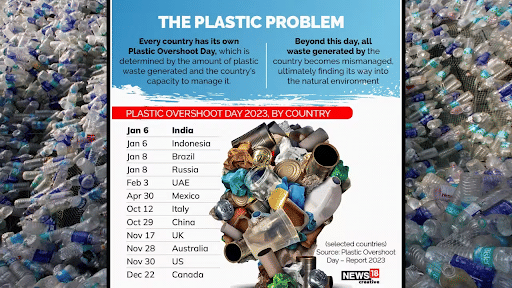
- India's Plastic Overshoot Day occurred on January 6, 2023, indicating that the country's plastic waste generation exceeded its waste management capacity.
- The date was determined based on the Mismanaged Waste Index (MWI).
- Mismanaged Waste Index (MWI) ranked India fourth, with 98.55% of the waste generated being mismanaged.
- In particular, three African countries, Mozambique, Nigeria and Kenya, have the highest rates of mismanaged waste.
India’s Plastic Pollution Report
- Staggering Plastic Waste Projection: In 2023, India is projected to encounter an astonishing 7,300,752 tons of plastic waste that will be mismanaged.
- Despite having a relatively low annual per capita plastic consumption of 5.3 kg, the cumulative plastic consumption in the country amounts to a staggering 7,408,124 tons of plastic waste.
- Plastic waste exports: The country contributes 59,260 tons of plastic to the global waste problem through exports, representing 0.8% of its total plastic waste.It imports 98,860 tons of plastic, accounting for 1.33% of its total plastic waste.
- Microplastics Pollution and Chemical Additives: The negative impact of plastic pollution on India's environment is evident through its release of 3,30,764 tons of microplastics into waterways. Improper waste management leads to the release of 44,535 tons of pollution stemming from chemical additives used in plastics.
- Primary Sources of Microplastics Pollution: Microplastics from tire wear, textile fibers, and paint and not just improper disposal, drive plastic pollution in India.
- Projected Impact on Plastic Overshoot: The nation is expected to emit 16.7 days' worth of plastic overshoot into the environment in 2023.
Criticism of the Report
- Some experts and organizations have questioned the accuracy and methodology of the Mismanaged Waste Index (MWI) used in the report to assess the mismanagement of plastic waste in different countries, particularly in the case of India.
- The report's findings are contradicted by data from other sources, such as India's Centre for Science and Environment (CSE).
- For example: According to a report by CSE titled "The Plastic Life Cycle," India currently recycles only 12.3% of its plastic waste and destroys about 20%.
- The Ministry of Environment, Forests and Climate Change has developed a centralized Extended Producer Responsibility (EPR) portal, revealing that India possesses the collective capability to process 14.2 million tonnes of plastic waste annually.
- This capacity encompasses both recycling and incineration methods, suggesting that the country can effectively process 71% of the total primary plastic it produces.
Measures to mitigate Plastic Pollution
- The report emphasizes the urgent need for action to combat plastic pollution, suggesting measures such as Extended Producer Responsibility (EPR) policies and phasing out non-circular plastics.
- Governments can implement bans or restrictions on the production and use of single-use plastics, especially those that are not easily recyclable or biodegradable.
- Global treaties and agreements, like the proposed UN Plastic Treaty, can help set international standards for plastic waste management and pollution reduction.
- Individuals can contribute by making conscious choices to reduce their use of single-use plastics, opting for reusable products, and properly disposing of plastic waste.
(*Click this link to read prelims specific weekly current affairs articles)
FAQs
Question: What is Plastic Overshoot Day?
Answer:
Plastic Overshoot Day refers to the day at which the global plastic waste production surpassed the world's capacity for waste management.
Question: What is Mismanaged Waste?
Answer:
Mismanaged waste refers to waste that is not properly collected, treated, or disposed of, leading to its improper release into the environment. This can include waste that is littered, illegally dumped, or inadequately managed in terms of recycling, landfilling, or incineration.
Question: What is Extended Producer Responsibility (EPR)?
Answer:
Extended producers’ Responsibilities is a globally recognized policy used as an effective tool to put the onus on the producers for efficient end of life waste management of the plastic, electronic and electrical equipment.
MCQ
Question: "Climate Action Tracker," which monitors the emission reduction pledges of different countries, is a: (UPSC 2022)
(a) Database created by a coalition of research organizations
(b) Wing of "International Panel of Climate Change"
(c) Committee under the "United Nations Framework Convention on Climate Change"
(d) Agency promoted and financed by the United Nations Environment Programme and World Bank.
Answer: (a) See the Explanation
The Climate Action Tracker is an independent scientific analysis that tracks government climate action and measures it against the globally agreed Paris Agreement aim of "holding warming well below 2°C, and pursuing efforts to limit warming to 1.5°C." A collaboration of two organisations, Climate Analytics and NewClimate Institute, the CAT has been providing this independent analysis to policymakers since 2009.
Therefore, option (a) is the correct answer.
Download the PREPP App and attempt FREE IAS Exam Mock Tests and get complete study material!

Full Test - 04: UPSC CSE Prelims CSAT (Paper-II)
Full Test - 03: UPSC CSE Prelims CSAT (Paper-II)
UPSC CSE Prelims 2026 GS Paper 1 Question Paper (24-May-2026)
UPSC CSE Prelims 2026 CSAT Paper 2 Question Paper (24-May-2026)

17 February 2025 | The Hindu Must Read Articles | Current Affairs

16 February 2026 | The Hindu Must Read Articles | Current Affairs

13 February 2026 | The Hindu Must Read Articles | Current Affairs









Comments