How UIDAI Is Using AI To Tackle Payment Frauds
Relevance: GS 3- Science and Technology- developments and their applications and effects in everyday life. Achievements of Indians in science & technology; indigenization of technology and developing new technology, Indian Economy GS2 - Statutory, regulatory and various quasi-judicial bodies
(Source: Indian Express, 08/03/2023)
Click here for Daily Current Affairs
Why in the news?
- Recently, the UIDAI has announced that it will use Artificial Intelligence based systems to reduce the occurrence of bank fraud cases linked with the AePS.
- This would include technologies to verify fingerprinting and facial recognition.
- According to the Haryana Police, cybercriminals are conducting financial fraud by siphoning off vital data and cloning fingerprints from the AePS system.
Table of Contents
What are the new initiatives by the UIDAI?
Fingerprint authentication
- The UIDAI has introduced an in-house Finger Minutiae Record–Finger Image Record (FMR-FIR) modality that is based on Artificial Intelligence or Machine Learning technology.
- Reason for development: It was implemented due to people creating fake fingerprints using silicone to steal money from bank accounts.
- More than 2000 AePS-related complaints were received by the RBI’s ombudsman between 2021 and 2023.
- Working
- It uses a combination of finger minutiae and finger images to check the likeness of the captured finger.
- It prevents AePS frauds using spoofed fingerprints during Aadhaar authentication by checking the liveness of a fingerprint to detect if the fingerprint used in the authentication process is cloned.
- The AI-based technology is capable of identifying whether a fingerprint is from a ‘live’ finger, or a cloned one
Facial Recognition
- The National Payments Corporation of India and Airtel Payments Bank introduced a facial-recognition-based authentication technique for AePS transactions.
- This technology has also been developed in-house by the UIDAI.
Payment Frauds in India
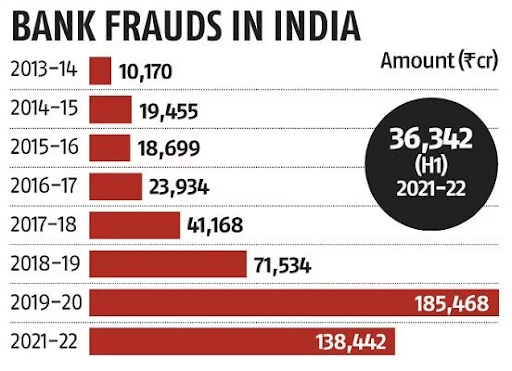
- 2.62 lakh financial crimes including money laundering, bribery, corruption, and other frauds were reported in FY 2020-21, as per data available from the Union Ministry of Home Affairs.
- The volume of such crimes rose to 6.94 lakhs in 2022 according to a report by the Standing Committee on Finance.
- According to data obtained from the RBI, online frauds could increase to 20 million by 2023 from over 700,000 in FY21.
Challenges
- Corruption: They have not been able to prevent financial fraud related to AePS in which a business correspondent, who is an integral part of the payment supply chain, is involved.
- They misrepresent amounts by inputting higher amounts in their system and do not provide mandatory receipts.
- Implementation: Financial institutions have struggled to implement fraud prevention solutions which affect their ability to deliver a satisfactory customer experience.
- Governance, validation, and reporting challenges also adversely affect the implementation of advanced technological solutions.
- Lack of Awareness: As the majority of the AePS user base is based in rural areas they lack awareness of modern technology and potential dangers.
- Advanced threats: The increased automation and introduction of technological innovations open up the threat of emerging risks such as ransomware attacks.
Conclusion
- Emerging technologies such as Artificial Intelligence (AI), data analysis, robotics process automation (RPA), and blockchain technology can help detect and mitigate procurement frauds in a more efficient manner than conventional tools.
AePS
|
(*Click this link to read prelims specific weekly current affairs articles)
FAQs
Question: What is facial recognition?
Answer:
Facial recognition is an algorithm-based technology that creates a digital map of the face by mapping facial features, which are then compared against the database. It is a biometric-based technology used in criminal identification and authentication.
Question: Who is the business correspondent?
Answer:
A business correspondent is an informal bank agent equipped with a biometric Point-of-Sale (PoS) machine, which works like a micro ATM. They deliver banking services outside the bank.
Question: What is the NPCI?
Answer:
The National Payments Corporation of India (NPCI) is a Not for Profit Company that acts as an umbrella organization for retail payments and settlement systems in India. It was established by the Reserve Bank of India (RBI) and the Indian Banks’ Association (IBA) with the aim of creating a robust Payment & Settlement Infrastructure in India.
MCQs
Question: Consider the following statements:
- Aadhaar can be used as proof of citizenship and domicile.
- Once issued, the Aadhaar number cannot be deactivated or omitted by the issuing authority.
Which of the statements given above is/are correct? (UPSC CSE 2018)
(a) 1 only
(b) 2 only
(c) Both 1 and 2
(d) None of the above
Answer: (d) See the Explanation
- According to the Aadhar Act, the Aadhar card or number is not proof of citizenship or domicile. Hence statement 1 is incorrect.
- The Aadhar Act states that the Aadhar number can be deactivated or omitted by the issuing authority, i.e. the UIDAI. Hence statement 2 is incorrect.
Therefore, option (d) is the correct answer.
Question: Consider the following statements:
- The AePS has been developed by C-DAC.
- It promotes financial inclusion.
- Interoperable transactions are permitted through ATMs.
How many of the above statements are corrected?
(a) Only 1
(b) Only 2
(c) All 3
(d) None of the above
Answer: (b) See the Explanation
- The Aadhar-enabled Payments System (AePS) has been developed by the National Payments Corporation of India (NPCI). Hence statement 1 is incorrect.
- It allows easy access to basic financial services. Hence statement 2 is correct.
- Bank accounts can be accessed interoperably through the ATM of any bank. Hence statement 3 is correct.
Therefore, option (b) is the correct answer.
Download the PREPP App and attempt FREE IAS Exam Mock Tests and get complete study material!

Full Test - 04: UPSC CSE Prelims CSAT (Paper-II)
Full Test - 03: UPSC CSE Prelims CSAT (Paper-II)
UPSC CSE Prelims 2026 GS Paper 1 Question Paper (24-May-2026)
UPSC CSE Prelims 2026 CSAT Paper 2 Question Paper (24-May-2026)

17 February 2025 | The Hindu Must Read Articles | Current Affairs

16 February 2026 | The Hindu Must Read Articles | Current Affairs

13 February 2026 | The Hindu Must Read Articles | Current Affairs









Comments