Goods and Services Tax Council - Indian Polity Notes
The Government of India (GoI) established the Goods and Services Tax Council (GST Council) to modify, regulate, and reconcile India's goods and services tax. The Council replaces all existing multiple taxation processes and introduces new taxation methods to make the taxation process easier for taxpayers. The Goods and Services Tax Council (GST Council) is a constitutional body that makes recommendations to the Union and State Governments on GST-related issues. Article 279A of the Constitution establishes a Goods and Services Tax Council. This article explains about the Goods and Services Tax Council which is important for UPSC Indian Polity Preparation.
| To Read update on this topic: |
Table of Contents
- Establishment of the Council
- Goods and Services Tax Council
- Composition of GST Council
- Quorum and powers
- Functions of the Goods and Services Tax Council
- Process of Decision-making
- Other Functions of the Council
- Various Types of Indirect Taxes in India
- Issues in GST Regime in India
- Erosion of ‘trust’ and ‘trustworthiness’
- Suggestions to improve the GST regime in India
- Conclusion
- FAQs
- MCQs
Establishment of the Council
- The 101st Amendment Act of 2016 (122nd Amendment Bill), paved the way for the implementation of a new tax regime in the country. i.e. goods and services tax - GST.
- This tax's smooth and efficient administration necessitates cooperation and coordination between the centre and the states.
- The amendment provided for the establishment of a Goods and Services Tax Council, or GST Council, to facilitate this consultation process.
- The amendment to the Constitution added a new Article 279-A. This Article gave the President the authority to appoint a GST Council by executive order.
- As a result, the President issued the order in 2016 and established the Council.
- The Council's Secretariat is based in New Delhi. The Union Revenue Secretary serves as the Council's ex-officio Secretary.
|
“GST Council exemplifies India's commitment to cooperative federalism, serving as a platform where the Centre and states collaborate to harmonize taxation policies.” |
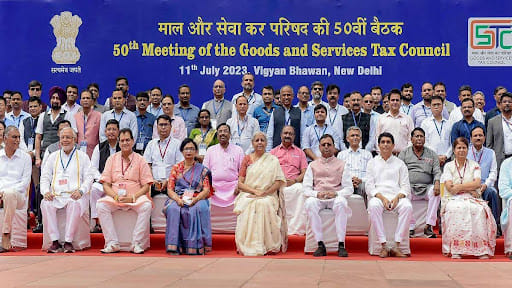
Goods and Services Tax Council
- The Goods and Services Tax Council (GST Council) is a constitutional body that makes recommendations to the Union and State Governments on Goods and Services Tax issues.
- The Council's functions will be guided by the need for a harmonised GST structure and the development of a harmonised national market for goods and services.
- Furthermore, the Council must determine the procedure in carrying out its functions.
- Vision: To establish the highest standards of cooperative federation in the functioning of the Council, the first constitutional federal body with the authority to make all major GST decisions.
- Mission: To evolve a GST structure that is information technology driven and user friendly through a process of broad consultation.
- Its goal is to ensure a uniform GST system to avoid conflict or confusion, as well as the development of a harmonised national market for goods and services.
Composition of GST Council
- The members of the council will be as follows:
- The Union Finance Minister of India will serve as the chairperson of this council.
- The respective states will nominate the State Finance Ministers/ or any other Minister as a member of the council.
- The Union Minister of State in charge of revenue or finance will also be a member of this council.
- The representatives of the states shall choose amongst themselves one “Vice-president”.
- In addition, the Union Cabinet decided to make the Chairperson of the Central Board of Excise and Customs (CBEC) a permanent invitee (non-voting) to all Council proceedings.
Quorum and powers
- The council shall meet from which one-half of its members will constitute a quorum, which will have the power to make decisions on the following listed matters:
- Threshold exemption limit i.e. the turnover below which goods and services will be exempted from GST.
- Rate of GST to be levied, and special provisions with respect to the states of Arunachal Pradesh, Jammu and Kashmir, Assam, Meghalaya, Manipur, Nagaland, Mizoram, Sikkim, Tripura, Himachal Pradesh and Uttarakhand, categorised as special-category states.
- Laws on the model of GST, rules for determining Inter-state supply transactions and determining the place of supply or any other matter.
- Further, the GST Council is also empowered to establish a mechanism to adjudicate any dispute between the Centre and the States or between any States.
Functions of the Goods and Services Tax Council
The Council is required to make recommendations to the centre and the states on the following matters:
- The taxes, cesses and surcharges levied by the centre, the states and the local bodies would be merged in GST.
- The goods and services that may be subjected to GST or exempted from GST.
- Model GST Laws, principles of levy, apportionment of GST levied on supplies in the course of inter-state trade or commerce and the principles that govern the place of supply.
- The threshold limit of turnover below which goods and services may be exempted from GST.
- The rates include floor rates with bands of GST.
- Any special rate or rates for a specified period to raise additional resources during any natural calamity or disaster.
- Special provision with respect to the states of Arunachal Pradesh, Assam, Jammu and Kashmir, Manipur, Meghalaya, Mizoram, Nagaland, Sikkim, Tripura, Himachal Pradesh and Uttarakhand.
- Any other matter relating to GST, as the Council may decide.
- In addition, the council shall also recommend the date on which the GST may be levied on petroleum crude, high-speed diesel, petrol, natural gas and aviation turbine fuel.
Process of Decision-making
The decision shall be taken by at least three-fourth majority out of which:
- The vote of the Central Government will have one-third of the weightage.
- The vote of all the State Governments shall account for two-third of weightage.
Any act or proceeding of the Council will not be rendered invalid on the following grounds:
- Any vacancy or defect in the Council's constitution;
- Any defect in the appointment of a person as a member of the Council; or
- Any procedural irregularity of the Council that does not affect the merits of the case.
Other Functions of the Council
- The Council shall recommend the date on which the GST on petroleum crude, high speed diesel, motor spirit (petrol), natural gas, and aviation turbine fuel will be levied.
- When there is a disagreement about its recommendations or their implementation, the Council shall establish a mechanism to resolve the disagreement: between the centre and one or more states; or between the centre and any state or states on one side and one or more other states on the other side; or between two or more states.
- For a period of five years, the Council must recommend compensation to states for revenue losses caused by the implementation of GST.
- The Parliament denies compensation based on this recommendation. As a result, the law was passed by Parliament in 2017.
Goods and Services Tax (GST)
|
Various Types of Indirect Taxes in India
- Service tax: This tax is levied by an entity in return for the service provided by them. The service tax is collected by the Government of India and deposited with them.
- Excise duty: When any product or good is manufactured by a company in India, then the tax levied on those goods is called Excise Duty. The manufacturing company pays the tax on the goods and in turn recovers the amount from their customers.
- Value Added Tax: Also known as VAT, this type of tax is levied on any product sold directly to the customer and is movable. VAT consists of Central Sales Tax which is paid to the Government of India State Central Sales Tax which is paid to the respective State Government.
- Custom Duty: This is a tax levied on the goods imported to India. Sometimes, Custom Duty is also levied on products that are exported out of India.
- Stamp Duty: This is a tax levied on the transfer of any immovable property in a state of India. The state government in whose state the property is located charges this type of tax. Stamp tax is also applicable on all legal documents too.
- Entertainment Tax: This tax is charged by the state government and is applicable to any products or transactions related to entertainment. Purchasing of any video games, movie shows, sports activities, arcades, amusement parks, etc. are some of the products on which Entertainment Tax is charged.
- Securities Transaction Tax: This tax is levied during the trading of securities through the Indian Stock Exchange.
The GST replaced the following taxes:
Taxes currently levied and collected by the Center
- Central Excise duty
- Duties of Excise (Medicinal and Toilet Preparations)
- Additional Duties of Excise (Goods of Special Importance)
- Additional Duties of Excise (Textiles and Textile Products)
- Additional Duties of Customs (commonly known as CVD)
- Special Additional Duty of Customs (SAD)
- Service Tax
- Central Surcharges and Cesses so far as they relate to supply of goods and services
State taxes that would be subsumed under the GST are:
- State VAT
- Central Sales Tax
- Luxury Tax
- Entry Tax (all forms)
- Entertainment and Amusement Tax (except when levied by the local bodies)
- Taxes on advertisements g. Purchase Tax
- Taxes on lotteries, betting and gambling
- State Surcharges and Cesses so far as they relate to supply of goods and services
Issues in GST Regime in India
- The 15th Finance Commission report formally acknowledges that the GST regime in India is an economic failure that did not deliver on its early promises.
- Multiple Tax Rates: Unlike many other economies which have implemented this tax regime, India has multiple tax rates.
- This hampers the progress of a single indirect tax rate for all the goods and services in the country.
- New Cesses crop up: While GST scrapped multiplicity of taxes and cesses, a new levy in the form of compensation cess was introduced for luxury and sin goods. This was later expanded to include automobiles.
- Economy Outside GST purview: Nearly half the economy remains outside GST. E.g. petroleum, real estate, electricity duties remain outside GST purview.
- The complexity of tax filings: The GST legislation requires the filing of the GST annual returns by specified categories of taxpayers along with a GST audit. But, filing annual returns is a complex and confusing one for the taxpayers.
- Apart from that, the annual filing also includes many details that are waived in the monthly and quarterly filings.
- Higher tax rates: Though rates are rationalised, there are still 50 percent of items that are under the 18 per cent bracket.
- Apart from that, there are certain essential items to tackle the pandemic that were also taxed higher. For example, the 12% tax on oxygen concentrators, 5% on vaccines, and on relief supplies from abroad
Erosion of ‘trust’ and ‘trustworthiness’
Recently the GST Compensation issue between the Centre and the State led to decreasing trust in the centre by some states. Apart from that, the other issues eroding the Co-operative federalism are,
- End of revenue guarantee: During the enactment of GST, the Centre promised compensation for loss of revenue faced by states. This revenue guarantee ends in July 2022.
- Citing the pandemic, some states are demanding more compensation time
- Loss of fiscal autonomy of states: States surrendered the majority of their indirect taxation powers for the implementation of GST.
- At present, States have no taxation powers over them. But the GST revenues are uncertain, and the States also do not witness on the ground.
- The issue of Pandemic: The second wave of Covid-19 infections put greater onus on the States, such as mobility restrictions, vaccination sequencing, and even procurement of Vaccines. With less tax revenue on hand, the States cannot meet all the needs to tackle the pandemic.
Suggestions to improve the GST regime in India
- Simplify GST Structure: Reduce the number of tax slabs to simplify the tax structure.
- Simplify Return Filing: Streamline the return filing process by reducing the complexity of forms, making it easier for businesses to comply.
- Simplify Compliance for Small Businesses: Introduce more simplified compliance procedures for Micro, Small, and Medium Enterprises (MSMEs), such as a single return form and quarterly filing.
- Improve Input Tax Credit (ITC) Mechanism: Implement a robust automated system for matching ITC claims with supplier invoices, reducing manual intervention and errors.
- Enhance GST Council Functioning: Increase Stakeholder Engagemen like industry representatives, tax professionals to gather diverse perspectives and practical insights.
- Strengthen Anti-evasion Measures: Leverage data analytics and artificial intelligence to detect and prevent tax evasion and fraud.
- Implement E-invoicing and E-way Bills: Ensure full implementation and compliance with e-invoicing and e-way bill systems to track the movement of goods and prevent tax leakage.
- Establish GST Tribunals: Set up GST Appellate Tribunals across states to provide a specialized and faster dispute resolution mechanism.Simplify and expedite the adjudication process to resolve disputes quickly and fairly.
Conclusion
The introduction of GST is a step in the right direction toward the formalisation of India's economy. But in order to include people in the Direct tax bracket, the Centre and States must recognise the restrictions imposed by Indirect Taxes. A constitutional body called the Goods and Services Tax Council (GST Council) is tasked with advising the state and central governments on matters pertaining to the GST. However, in order to put the GST Regime back on track, India needs to take some radical measures, such as extending the revenue guarantee to the States, limiting cesses, and most importantly, respecting the fiscal needs of the State governments.
| Other Relevant Links | |
|---|---|
| Indian Polity UPSC Notes | Legislative Relations |
| Financial Relations | Administrative Relations |
| Indian Parliament | Trends in Centre-State Relations |
| Federal System | Parliamentary System |
FAQs
Question: What is the GST Council?
Answer: The GST Council is a constitutional body responsible for making recommendations on the Goods and Services Tax (GST) in India. It consists of the Union Finance Minister and the Finance Ministers of the states, ensuring cooperative federalism in the implementation of GST.
Question: What are the main functions of the GST Council?
Answer: The primary functions of the GST Council include deciding the GST rates, reviewing and recommending changes to the GST laws, and addressing issues related to the implementation of GST. It aims to simplify the tax structure and ensure smooth compliance.
Question: How does the GST Council promote cooperative federalism?
Answer: The GST Council promotes cooperative federalism by facilitating discussions between the central and state governments. It ensures that both levels of government work together in formulating tax policies, resolving disputes, and addressing the concerns of taxpayers.
Question: What role does the GST Council play in rate determination?
Answer: The GST Council plays a crucial role in determining the GST rates applicable to various goods and services. It reviews the rates periodically to ensure they align with economic conditions and the needs of taxpayers, aiming for fairness and transparency.
Question: How often does the GST Council meet?
Answer: The GST Council meets at least once every quarter, although additional meetings may be convened as necessary to address urgent issues or to discuss proposed changes to the GST framework.
MCQs
- Who heads the GST Council in India?
a) Prime Minister
b) President
c) Union Finance Minister
d) Chief Minister
Answer: (C) See the Explanation
c) Union Finance Minister. The GST Council is chaired by the Union Finance Minister, who leads discussions on GST-related matters.
- Which of the following is NOT a function of the GST Council?
a) Recommend tax rates
b) Resolve disputes
c) Enforce tax laws
d) Review GST implementation
Answer: (C) See the Explanation
c) Enforce tax laws. The GST Council makes recommendations and addresses issues but does not have the power to enforce tax laws.
- How does the GST Council ensure the representation of states?
a) By including only Union ministers
b) By including state finance ministers
c) By appointing governors
d) By excluding the central government
Answer: (B) See the Explanation
b) By including state finance ministers. The GST Council comprises the Union Finance Minister and the Finance Ministers of the states to ensure representation.
- What is the significance of the GST Council in India’s tax structure?
a) It facilitates uniformity in tax rates across states
b) It eliminates all taxes
c) It increases tax evasion
d) It reduces government revenue
Answer: (A) See the Explanation
a) It facilitates uniformity in tax rates across states. The GST Council helps maintain consistency in tax rates and compliance across the country.
- How frequently does the GST Council review the GST rates?
a) Once a year
b) Once every two years
c) Periodically as needed
d) Only at the time of budget presentation
Answer: (C) See the Explanation
c) Periodically as needed. The GST Council reviews the rates periodically based on economic conditions and taxpayer feedback.
GS Mains Questions and Model Answers
Q1: Discuss the role of the GST Council in promoting economic integration in India.
Answer: The GST Council plays a pivotal role in promoting economic integration in India by establishing a unified tax regime that minimizes tax cascading and promotes seamless trade across state borders. By harmonizing tax rates and compliance procedures, the Council facilitates a single market, encouraging businesses to operate efficiently without the burden of multiple taxation. This integration not only simplifies the tax structure but also enhances the ease of doing business, thereby attracting investments and boosting economic growth. The cooperative federalism model adopted by the GST Council allows for collaborative decision-making between the central and state governments, fostering trust and transparency in fiscal policies. Consequently, the GST Council's efforts in standardizing tax practices significantly contribute to India's economic cohesiveness and development.
Q2: Evaluate the effectiveness of the GST Council in addressing the challenges faced by the GST regime in India.
Answer: The effectiveness of the GST Council in addressing challenges within the GST regime is notable, as it has played a crucial role in refining and adapting the tax framework since its implementation. Challenges such as revenue shortfalls, compliance issues, and the need for continuous updates in tax rates have been effectively addressed through periodic meetings and consultations. The Council has made significant amendments to the GST laws, streamlined procedures, and provided relief measures to taxpayers, enhancing compliance and reducing disputes. However, challenges remain, such as ensuring uniformity in state tax practices and addressing concerns regarding the technology used for GST filing. The ongoing dialogue and adjustments made by the GST Council reflect its commitment to improving the GST framework, although the need for further reforms persists to address emerging issues in the tax landscape.
Q3: Analyze the impact of the GST Council's decisions on the informal sector in India.
Answer: The decisions made by the GST Council significantly impact the informal sector in India, which comprises a large portion of the economy. While the GST aims to formalize economic activities and enhance compliance, the introduction of the tax has posed challenges for small and informal businesses that may lack the resources to adhere to the new tax regime. The GST Council's efforts to provide relief measures, such as exempting small businesses with turnover below a certain threshold from GST registration, have helped mitigate some negative impacts. Additionally, the simplification of the tax filing process and the introduction of technology-driven solutions have facilitated better compliance among informal sector players. However, the need for continuous support and education on GST compliance remains crucial to ensure that the informal sector can transition smoothly into the formal economy without undue hardship.
Previous Year Questions on Goods and Services Tax Council
1. UPSC CSE Mains 2019
Question: Examine the role of the GST Council in ensuring fiscal federalism in India.
Answer: The GST Council plays a fundamental role in ensuring fiscal federalism in India by acting as a platform for cooperative governance between the central and state governments. As a constitutional body, it comprises representatives from both levels of government, ensuring that decisions regarding the Goods and Services Tax reflect the interests of both parties. This cooperation is essential for maintaining a unified tax system that allows for shared revenue from GST collections, which supports fiscal health at both state and central levels. The Council's ability to recommend tax rates, resolve disputes, and address implementation challenges reinforces the principle of cooperative federalism, wherein both the center and states work together for economic growth. The GST Council's decisions have far-reaching implications for fiscal policies, enhancing the capacity of states to generate revenue while promoting a stable economic environment across the country.
2. UPSC CSE Mains 2020
Question: Discuss the significance of the GST Council in the context of India's economic reforms.
Answer: The GST Council is of paramount significance in the context of India's economic reforms as it represents a transformative shift towards a unified tax structure, aimed at reducing the complexities associated with the previous indirect tax system. The Council's establishment is a testament to the government's commitment to reforming tax administration by fostering transparency, accountability, and efficiency. By streamlining the tax system and eliminating the cascading effect of taxes, the GST Council has facilitated easier compliance for businesses, thereby enhancing the ease of doing business in India. Its role in periodic reviews of GST rates and policies ensures that the tax framework remains responsive to the changing economic landscape. The Council also exemplifies the spirit of cooperative federalism, where both central and state governments collaboratively address issues arising from tax reforms, thereby contributing to overall economic stability and growth. The impact of the GST Council's decisions extends beyond mere taxation, influencing investment, consumption, and the overall economic environment in India.
*email: contactus@prepp.in
Download the PREPP App and attempt FREE IAS Exam Mock Tests and get complete study material!
UPSC IAS : CSAT - Mini Live Test

Live Test : UPSC CSE Prelims CSAT (Paper-II) (Oct 14 - 17)
Full Test - 04: UPSC CSE Prelims CSAT (Paper-II)
Full Test - 03: UPSC CSE Prelims CSAT (Paper-II)
UPSC CSE Prelims 2026 GS Paper 1 Question Paper (24-May-2026)
UPSC CSE Prelims 2026 CSAT Paper 2 Question Paper (24-May-2026)

17 February 2025 | The Hindu Must Read Articles | Current Affairs

16 February 2026 | The Hindu Must Read Articles | Current Affairs

13 February 2026 | The Hindu Must Read Articles | Current Affairs









Comments