Patna High Court Finds Caste Based Survey Of Bihar Government 'Perfectly Valid', Allows Resumption
Relevance: GS1 - Population and Associated Issues; GS2 - Government Policies & Interventions
(Source: The Hindu, 08/02/2023)
Click here for Daily Current Affairs
Why in the news?
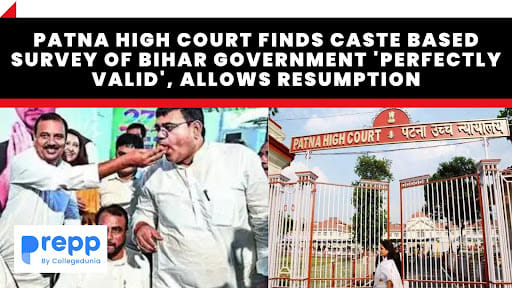
- Recently, the Patna High Court dismissed all petitions filed against the decision of the Bihar Government to conduct a caste-based survey.
- The high court has, in effect, paved the way for a caste-based survey in the state of Bihar.
Table of Contents
Background of Caste Based Survey in Bihar
- The Bihar government had launched the exercise in January, 2023 and had aimed at compiling data on each family in a two-phase process.
- The entire exercise was scheduled to end by May 2023.
- The first round of caste-based survey in Bihar was conducted between January 7 and 21. The second round started on April 15 and was supposed to continue till May 15.
- But several petitions were filed against the move and the Bihar High Court had put an interim stay on the survey on 4 May.

What is a Caste Based Survey?
- It refers to the comprehensive categorization of India's population according to their respective castes, encompassing all caste groups, with a particular focus on the Other Backward Classes (OBCs), in addition to the Scheduled Castes (SCs) and Scheduled Tribes (STs).
- The first population census in 1872 by the British included caste enumeration, listing various castes and their traditional occupations across provinces.
- The 1931 Census was the last comprehensive collection of caste data, categorizing populations based on occupations like priests, warriors, traders, and more.
Objective of conducting a Caste Survey
- Caste has been identified as a significant factor for understanding historical disadvantages, as marginalized communities have historically faced discrimination based on their caste identities.
- The aim and purpose of the caste survey is to identify Backward Classes, Scheduled Castes and Scheduled Tribes and to uplift them and ensure equal opportunities not only by affirmative action, but also providing employment, ensuring admission to educational institutions.
- Consequently, the framers of the Constitution recognized that Article 15 and Article 16 are crucial in preventing discrimination based on factors like caste and ensuring equal opportunities in public employment.
- It was believed that these provisions should be coupled with measures aimed at uplifting marginalized sections of society and bridging the gap between them and the more privileged classes.
Various types of Census Conducted in India
- Population Census: Conducted every decade, it offers comprehensive data on population, encompassing demographics, social traits, and economic attributes.
- Housing Census: Focuses on housing conditions and amenities available to the populace.
- Agriculture Census: Provides insights into the agricultural domain, covering aspects like land usage, irrigation, and crop yield.
- Livestock Census: Gathers data on livestock numbers, including cattle, buffalo, sheep, goats, pigs, and poultry.
- Economic Census: Targets the non-agricultural sector, gathering information about businesses, industries, and employment trends.
Exercises to bring OBC Reservation
Caste Surveys held in other states
|
(*Click this link to read prelims specific weekly current affairs articles)
FAQs
Question: What is a Caste Based Survey?
Answer:
It refers to the comprehensive categorization of India's population according to their respective castes, encompassing all caste groups, with a particular focus on the Other Backward Classes (OBCs), in addition to the Scheduled Castes (SCs) and Scheduled Tribes (STs).
Question: What is Socio-Economic Caste Census (SECC)?
Answer:
The Socio-Economic Caste Census (SECC) 2011 is the first-ever census to collect detailed data from rural and urban households. It has generated data on a wide range of social and economic indicators pertaining to households across the country.
Question: What is the Rohini Commission?
Answer:
The commission was set up by the President under Article 340 of the Indian Constitution on October 2, 2017. It is headed by former Delhi High Court judge, Justice G. Rohini. Its objective was to examine the issues related to the sub-categorisation of Other Backward Classes.
MCQ
Question: Consider the following statements: (UPSC 2009)
- Between Census 1951 and Census 2001, the density of the population of India has increased more than three times.
- Between Census 1951 and Census 2001, the annual growth rate (exponential) of the population of India has doubled.
Which of the statements given above is/are correct?
(a) 1 only
(b) 2 only
(c) Both 1 and 2
(d) Neither 1 nor 2
Answer: (d) See the Explanation
- One of the significant indicators of population concentration is population density, which is measured as the number of individuals per square kilometer. India's population density was 324 people per square kilometer in 2001 and 117 in 1951. This indicates that the density increased by more than two times but not three times. Hence, statement 1 is incorrect.
- At the start of the 20th century, specifically in 1901, India's population density was notably lower at 77 individuals per square kilometer. Over the subsequent decades, this figure progressively rose, reaching 324 in 2001. Comparing growth rates, the average annual growth rate in 2001 stood at 1.93, while it was 1.25 in 1951. This denotes an increase but not a doubling of the growth rate. Hence, statement 2 is incorrect.
Therefore, option (d) is the correct answer.
Download the PREPP App and attempt FREE IAS Exam Mock Tests and get complete study material!

Full Test - 04: UPSC CSE Prelims CSAT (Paper-II)
Full Test - 03: UPSC CSE Prelims CSAT (Paper-II)
UPSC CSE Prelims 2026 GS Paper 1 Question Paper (24-May-2026)
UPSC CSE Prelims 2026 CSAT Paper 2 Question Paper (24-May-2026)

17 February 2025 | The Hindu Must Read Articles | Current Affairs

16 February 2026 | The Hindu Must Read Articles | Current Affairs

13 February 2026 | The Hindu Must Read Articles | Current Affairs









Comments