Climate Finance Adds Another Layer Of Inequity To Climate Change
Relevance: GS3 - Conservation, environmental pollution and degradation, environmental impact/ assessment.
(Source: The Hindu, 08/02/2023)
Click here for Daily Current Affairs
Why in the news?
- This article has discussed the inequality in climate financing and the burden on less developed countries.
- Sub-Saharan countries are among the countries that are most vulnerable to the dangers of climate change but are in deep debt distress which restricts them from taking proactive initiatives to limit climate change.
Table of Contents
Climate finance
- Climate finance refers to local, national, or international financing from public, private, and alternative sources to support climate change mitigation and adaptation.
- Countries and communities require extensive financing to adapt and mitigate the effects of climate change due to its unpredictable and extreme nature.
- Rapid, large-scale emissions reductions are required alongside the transition from high-carbon production to cleaner methods across all sectors, which requires considerable upfront investments.
- Developing and less developed countries are limited in their capabilities to respond, prevent and manage climate change. Therefore, they require the support of more developed countries in climate financing.
- Heavy investments in green technology are required to combat climate change and keep global warming below 1.5°Celsius.
Why are developed countries to blame for climate change?
- A small number of high-income countries are to blame for climate change, its effects are disproportionately severe in low-income countries.
- Financing from developed to developing nations is critical to resolving this historical injustice.
- Economically developed countries must invest in climate adaptation and mitigation, especially in helping less developed countries such as their former colonies and dependents) deal with its effects.
- While North American and European countries are historically and presently the largest contributors to the climate crisis, it is the countries of sub-Saharan Africa, South Asia, and Latin America that are suffering the most in terms of extreme natural phenomena and debt distress.
Evidence
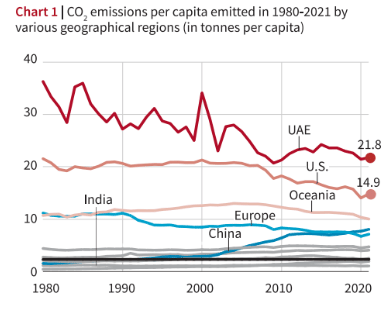
- Average per capita emissions: Global average emissions per capita are double the baseline target (in black) set by the Institute for European Environmental Policy (2.3 tonnes per capita) which is needed to limit global warming to within 1.5°C.
- It has been over 4.7 tonnes since 2010 while Africa and India have been consistently below the baseline.
- China’s per capita emissions rose to 8 tonnes in 2021.
- Although the average emissions of the U.S.A. (14.9) and the U.A.E. (21.8) have declined, they are still the highest in the world.
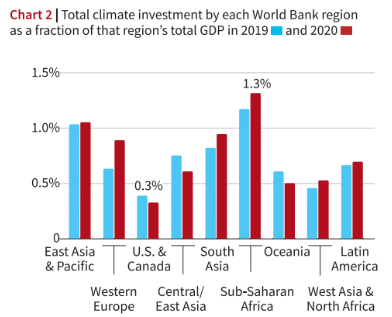
- Investments: The total investment in climate-related investments ( public and private investment in climate adaptation and mitigation, fossil fuel reduction, and reforestation) by World Bank regions as a fraction of their total GDP in 2019 and 2020 was unequally distributed.
- Sub-Saharan Africa had the highest fraction of investment in climate financing (1.3%) followed by East Asia and the Pacific (1%) and South Asia (0.9%).
- In comparison, traditional polluters like the U.S.A. and Canada invested only around 0.3% of their GDP in climate finance.
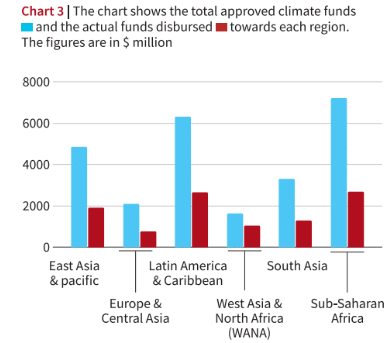
- Multilateral funds: A large fraction of the funds available to the Global South are from multilateral climate funds such as the Green Climate Fund and the Clean Technology Fund.
- These climate funds are predominantly funded by economically developed countries.
- However, the funds have not been distributed appropriately. Although, $3.3 billion has been approved for South Asia since 2003, only $1.3 billion has been actually disbursed.
- Similarly, only 40% of the approved funding was reported by countries across the globe.
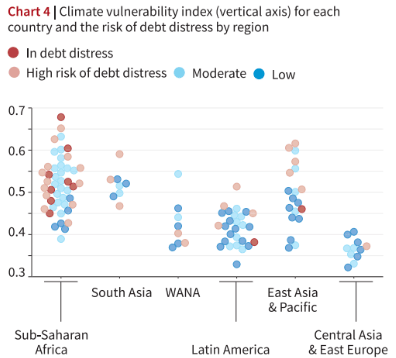
- Debt and vulnerability: The majority of countries facing debt distress are from Sub-Saharan Africa which is extremely vulnerable to climate change.
- Overall countries that are more vulnerable to climate change are at a higher risk of debt distress.
- Three out of eight South Asian countries were also found to be facing debt distress.
- Climate vulnerability is calculated using the ND-GAIN Index and the IMF’s Debt Sustainability Framework which calculates debt distress.
FAQs
Question: What is the Notre Dame Global Adaptation Initiative Index?
Answer:
The ND-GAIN Index summarizes a country's vulnerability to climate change and other global challenges. It aims to help businesses and the public sector prioritize investments in order to respond efficiently to immediate global challenges ahead. It is prepared by Save the Children International, a child rights NGO to assess the impact of climate change on children under Notre Dame University’s Environmental Change Initiative (ND-ECI).
Question: What is global warming?
Answer:
Global warming refers to the gradual increase in the earth’s temperature near the surface due to the greenhouse effect caused by increased concentrations of carbon dioxide, CFCs, and other pollutants. It has been attributed to natural and anthropogenic causes.
MCQs
Question: Which of the following statements regarding the ‘Green Climate Fund’ is/are correct?
- It is intended to assist developing countries in adaptation and mitigation practices to counter climate change
- It is founded under the aegis of UNEP, OECD, Asian Development Bank and World Bank
Select the correct answer using the code given below. (UPSC CSE 2015)
(a) 1 only
(b) 2 only
(c) Both 1 and 2
(d) None of the above
Answer: (a) See the Explanation
- The Green Climate Fund (GCF) was developed within the UNFCCC Framework to redistribute money from developed nations to developing nations and assist them in adaptation and mitigation practices to counter climate change. Hence statement 1 is correct.
- The Fund is governed and supervised by the Board with full responsibility for funding decisions and is guided by the COP. Hence statement 2 is incorrect.
Therefore, option (a) is the correct answer.
Question: Consider the following statements:
- It is part of the Climate Investments Fund.
- The COP acts as the trustee for the Clean Technology Fund.
Which of the above statements is/are correct?
(a) Only 1
(b) Only 2
(c) Both 1 and 2
(d) None of the above
Answer: (a) See the Explanation
- The Climate Investments Fund comprises two funds - Clean Technology Fund (CTF) and Strategic Climate Fund (SCF). Hence statement 1 is correct.
- The CIF is a collaborative effort among the Multilateral Development Banks (MDBs) and countries to bridge the financing and learning gap.
- The World Bank acts as trustee for Clean Technology and holds in trust the funds, assets, and receipts of all CIF funds. Hence statement 2 is incorrect.
Therefore, option (a) is the correct answer.
Download the PREPP App and attempt FREE IAS Exam Mock Tests and get complete study material!

Full Test - 04: UPSC CSE Prelims CSAT (Paper-II)
Full Test - 03: UPSC CSE Prelims CSAT (Paper-II)
UPSC CSE Prelims 2026 GS Paper 1 Question Paper (24-May-2026)
UPSC CSE Prelims 2026 CSAT Paper 2 Question Paper (24-May-2026)

17 February 2025 | The Hindu Must Read Articles | Current Affairs

16 February 2026 | The Hindu Must Read Articles | Current Affairs

13 February 2026 | The Hindu Must Read Articles | Current Affairs









Comments