The Holocene Climate Anomalies
Relevance: GS3 - Conservation, environmental pollution and degradation, environmental impact assessment.
(Source: The Hindu, 07/25/2023)
Click here for Daily Current Affairs
Why in the news?
- The author, Raghu Murtugudde, a visiting Professor at IIT Bombay, has discussed whether any one day can be called the warmest day in 100,000 years.
- Temperature estimates from the period prior to the discovery of thermometers are based on palaeo proxies that do not directly measure temperature but only provide weekly or seasonal estimates.
Table of Contents

How are temperature estimates of earlier ages obtained?
- In order to estimate the temperature during the periods before the discovery of the thermometer, scientists use palaeo proxies.
- Palaeo proxies are biological and chemical signatures that indicate that the temperature in a region was warmer or colder than a specific baseline.
- However, they do not directly measure temperatures. Instead, they are just responses displayed by physical, biological, and chemical processes to temperatures above or below the baseline.
- The baselines used in palaeo proxies are obtained from modern times through the use of thermometers.
- Scientists also use isotopes that undergo a steady state of radioactive decay to understand past temperatures.
- Using the rate of decay and the expected quantity of the isotope allows them to calculate how long it took to diminish.
- Assumption: The Palaeo proxy method assumes that the proxy-producing processes worked similarly in the past and at present.
What are historical temperatures used for?
- Experts have tried to use historical temperature-related anomalies to understand whether warming during the Holocene epoch can explain how modern humans respond to climate change.
- Climate-related events were not the only causes for the fall of various civilizations during the Anthropocene Epoch.
- The bipedal ancestors of modern humans also survived larger climatic changes over hundreds of thousands of years including glacials and deglacials for at least a million years.
- This could provide an example of strategies that could be adapted to respond to present-day climate change.
- The palaeoclimate is a rear-view mirror for students of future climate, but only over longer timescales.
- Scientists and officials have displayed enhanced participation in climate negotiations, while governments have attempted to adhere to their climate commitments and implement grassroots initiatives to support communities dealing with the consequences of climate change.
Why is the palaeo proxy method unsuitable to predict daily temperatures?
Time Scale
- Proxies are typically buried under water and lake sediment for hundreds of thousands of years which means they can only record temperature anomalies on century or millennia scales.
- They are affected by ocean water and microbes, which makes it impossible to identify even decadal and annual changes in temperature.
- Scientists have obtained temperature anomaly estimates on shorter time scales from other sources such as tree rings, corals, and terrestrial and marine organism shells.
- However, these can provide estimates on a weekly or seasonal scale at best.
Spatial
- Proxies are representations of local or regional estimates of temperature anomalies.
- However, such estimates have a high degree of associated uncertainty, even for the Holocene period (from 9700 BC).
- Therefore, there is no palaeo proxy available to identify daily temperatures.
What is the Holocene epoch?
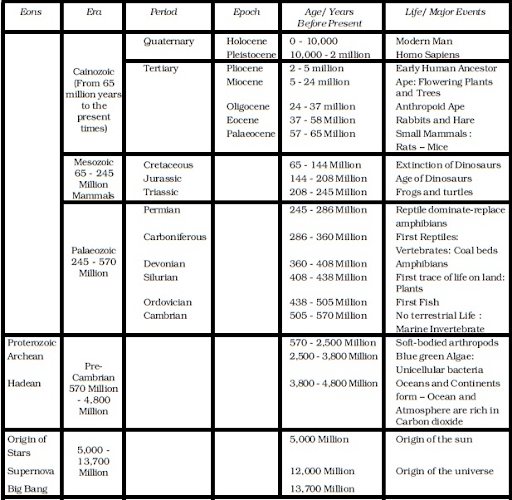
- The Holocene Epoch which began around 11,000 years ago is the present age.
- It is also known as the Anthropocene Epoch or the “Age of Man” because the majority of its dominant characteristics are a result of global changes brought about by human activity.
- Geologically, it is the second epoch in the current Quaternary period and followed the Paleolithic Ice Age.
- It is characterized by rapid proliferation, growth, and impacts on a worldwide scale.
- In 2018, the International Union of Geological Sciences categorized the Holocene Epoch into three distinct ages based on the climate.
- Greenlandian (11,700 years ago to 8,200 years ago),
- Northgrippian(8,200 years ago to 4,200 years ago) and
- Meghalayan(4,200 years ago to the present)
Features
- It has been a period of warming with the glaciers of the late Paleolithic period retreating and the Tundra changing into forests.
- This resulted in the extinction of large mammals which had adapted to the extreme cold.
- Eg: Woolly rhinoceros and mammoth.
- This led to changes in the diets of humans. The share of smaller animals and plants increased.
- This period saw the introduction of agricultural activities (around 8000 BCE) and the domestication of goats, sheep, and cattle.
- It has been a period of development in terms of science and technology, whose knowledge has helped humans to predict the effects of and mitigate to some extent the environmental damage caused by their activities.
Conclusion
- Global warming can produce record-breaking warm months and years – but we should be cautious about supposedly a record-breaking warm day, more so since even thermometer-based records are few and far between to make reliable claims of daily temperature records at the global scale.
- The idea of the hottest day could be used to convince people to change their behaviors in order to reduce individual contributions to climate change and compel governments to take proactive measures to combat climate change.
- However, it could be dangerous to urge climate action at the cost of scientific rigor and could lead to a loss of scientific credibility.
(*Click this link to read prelims specific weekly current affairs articles)
FAQs
Question: What is an epoch?
Answer:
In geology, an epoch is a time period defined by evidence in rock layers and usually lasts for millions of years.
Question: What is climate change?
Answer:
Climate change is the periodic modification of Earth’s climate due to the changes in the atmosphere and interactions of the atmosphere with other geological, chemical, biological, and geographical factors within the Earth’s system.
MCQs
Question: Consider the following statements:
- The Holocene epoch is also known as the age of mammals.
- Agricultural activities were developed during the Holocene era.
Which of the above statements is/are correct?
(a) 1 only
(b) 2 only
(c) 1 and 2
(d) None
Answer: (b) See the Explanation
The Holocene epoch is also known as the Age of Humans. The Cenozoic era is also known as the era of animals. Hence statement 1 is incorrect.
Agriculture was developed during the Holocene epoch in around 8000 BCE. Hence statement 2 is correct.
Therefore, option (b) is the correct answer.
Download the PREPP App and attempt FREE IAS Exam Mock Tests and get complete study material!

Full Test - 04: UPSC CSE Prelims CSAT (Paper-II)
Full Test - 03: UPSC CSE Prelims CSAT (Paper-II)
UPSC CSE Prelims 2026 GS Paper 1 Question Paper (24-May-2026)
UPSC CSE Prelims 2026 CSAT Paper 2 Question Paper (24-May-2026)

17 February 2025 | The Hindu Must Read Articles | Current Affairs

16 February 2026 | The Hindu Must Read Articles | Current Affairs

13 February 2026 | The Hindu Must Read Articles | Current Affairs









Comments