Who Are The Paharis And Paddaris, Proposed For ST Status In J&K?
Relevance: GS2 - Issues Related to SCs & STs; Mechanisms, laws, institutions, and Bodies constituted for the protection and betterment of these vulnerable sections.
(Source: Indian Express, 08/02/2023)
Click here for Daily Current Affairs
Why in the news?
- Recently, the Government has introduced the Constitution (Jammu and Kashmir) Scheduled Tribes Order (Amendment) Bill, 2023, which aims to include four communities in the Scheduled Tribes (STs) list in Jammu and Kashmir.
- The communities being considered for inclusion are "Gadda Brahmin," "Koli," "Paddari Tribe," and "Pahari Ethnic Group."
Table of Contents
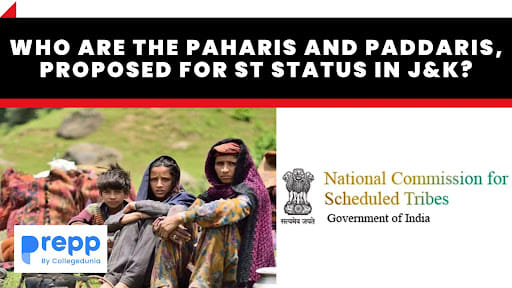
Who are the Paharis and Paddari Tribe?
Pahari Ethnic Group
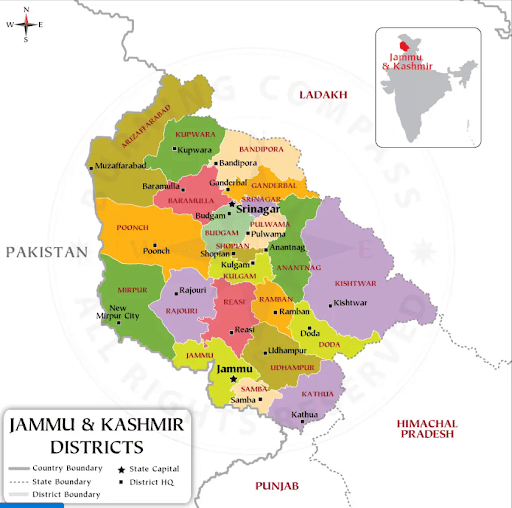
- This group includes Hindus, Muslims, and Sikhs, and consists of people of Kashmiri origin who settled in the Rajouri and Poonch districts over a period of time.
- Among the Paharis, there are upper caste Hindus and also people who were displaced from Pakistan Occupied Kashmir.
- In 2012-13 J&K government commissioned a study by Prof Amin Peerzada of Kashmir University, which supported the ST status of Paharis but the centre rejected the demand at that time.
- The Paharis finally got 4% reservation in jobs and educational institutions in 2019.
- In 2019, Justice (retd) G.D. Sharma commission was appointed to identify groups that were socially, educationally and economically backward. The Commission recommended ST status for Gadda Brahmins, Kolis, Paddari Tribe, and Pahari Ethnic Group.
Paddari Tribe
- They reside in the remote Paddar area of the Kishtwar district, sharing borders with Zanskar (Ladakh) in the north and the east, Pangi in Himachal Pradesh in the south, and the rest of J&K in the west.
- As per 2011 census, Paddari population is 21548 comprising 83.6% Hindus, 9.5% Buddhists, and 6.8% Muslims.
- The people of this area speak the Paddari language.
Dominant ST communities in J&K
- The primary Scheduled Tribe (ST) communities in Jammu and Kashmir are the Gujjars and Bakerwals.
- These communities are predominantly nomadic, migrating with their livestock to higher reaches in the summer and returning before winter.
- With a population of around 18 lakh, the Gujjar-Bakerwal communities constitute the third-largest group in J&K after Kashmiris and Dogras.
- They were granted ST status in 1991, providing them with various benefits, including reservations in government jobs and educational institutions.
Why is Gujjar-Bakerwal Community opposing the ST status for these communities?
- Gujjar-Bakerwal leaders stated that the Gadda Brahmins and Kolis, although being relatively small communities, are already designated as ST.
- It emphasizes that the Gadda Brahmins are a sub-caste of the Gaddis, while the Kolis are categorized as a sub-caste of Sippis signifying that both these communities are already in the ST list.
- Along with granting of ST status to the Paharis, the potential inclusion of the Paddari Tribe in the ST list is rooted in the argument that this group doesn't constitute a unified ethnic entity.
- Instead, they perceive the Paddari Tribe as a diverse amalgamation of individuals from various castes and religious backgrounds who share a particular language.
What is the process of inclusion in the ST list?
- The procedure for adding tribes to the ST (Scheduled Tribe) list commences with recommendations put forth by the relevant State governments.
- These suggestions are subsequently forwarded to the Ministry of Tribal Affairs for thorough evaluation. Upon review, the recommendations are then sent to the Registrar General of India for further evaluation.
- This is followed by the National Commission for Scheduled Tribes (NCST) approval before the list is sent to the Cabinet for a final decision.
- Hence, the final decision rests with the President’s office issuing a notification specifying the changes under powers vested in it from Articles 342.
- The inclusion of any community in the Scheduled Tribes come into effect only after the President assents to a Bill that amends the Constitution (Scheduled Tribes) Order, 1950, as is appropriate, after it is passed by both the Lok Sabha and Rajya Sabha.
(*Click this link to read prelims specific weekly current affairs articles)
FAQs
Question: Who are Scheduled Tribes?
Answer:
Article 366(25) refers to scheduled tribes as those communities who are scheduled in accordance with Article 342 of the Constitution. According to Article 342 of the Constitution, the Scheduled Tribes are the tribes or the Tribal communities or part of or groups within these tribes and tribal communities which have been declared as such by the President through a public notification.
Question: Who are the Pahari Ethnic Group ?
Answer:
This group includes Hindus, Muslims, and Sikhs, and consists of people of Kashmiri origin who settled in the Rajouri and Poonch districts over time. Among the Paharis, there are upper caste Hindus and also people who were displaced from Pakistan Occupied Kashmir.
Question: What is the National Commission for Scheduled Tribes (NCST)?
Answer:
The National Commission for Scheduled Tribes is a constitutional body. The National Commission for Scheduled Tribes was established on February 19, 2004, by revising Article 338 and introducing a new article 338A into the Constitution as part of the 89th Constitution Amendment Act, 2003.
MCQ
Question: If a Particular area is brought under the Fifth Schedule of the Constitution of India, which one of the following statements best reflects the consequence of it? (UPSC 2022)
(a) This would prevent the transfer of land of tribal people to non-tribal people.
(b) This would create a local self-governing body in that area.
(c) This would convert that area into a Union Territory.
(d) The state having such areas would be declared as a Special Category State.
Answer: (a) See the Explanation
The Fifth Schedule of the Constitution deals with the administration and control of Scheduled Areas and Scheduled Tribes residing in any state other than Assam, Meghalaya, Tripura, and Mizoram. After consulting with the tribes advisory council, the governor may issue regulations for the peace and good governance of a designated area. Such regulations may prohibit or limit the transfer of land by tribal members to non-tribal members or among scheduled tribe members, as well as regulate the allotment of land to scheduled tribe members.
Therefore, option (a) is the correct answer.
Download the PREPP App and attempt FREE IAS Exam Mock Tests and get complete study material!

Full Test - 04: UPSC CSE Prelims CSAT (Paper-II)
Full Test - 03: UPSC CSE Prelims CSAT (Paper-II)
UPSC CSE Prelims 2026 GS Paper 1 Question Paper (24-May-2026)
UPSC CSE Prelims 2026 CSAT Paper 2 Question Paper (24-May-2026)

17 February 2025 | The Hindu Must Read Articles | Current Affairs

16 February 2026 | The Hindu Must Read Articles | Current Affairs

13 February 2026 | The Hindu Must Read Articles | Current Affairs









Comments