Now A More Efficacious, Inexpensive Malaria Vaccine
Relevance: GS3 - Awareness in the fields of Biotechnology GS2 - Issues relating to development and management of Social Sector/Services relating to Health,
(Source: The Hindu, 10/09/2023)
Click here for Daily Current Affairs
Why in the news?
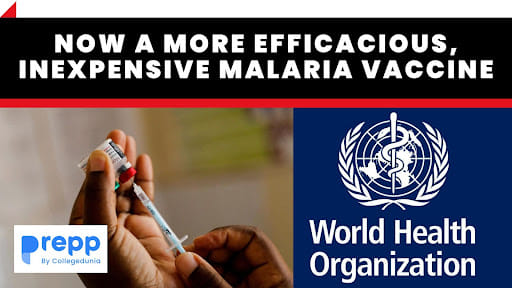
- Recently, the WHO recommended a new malaria vaccine - R21/Matrix M - developed by Oxford University and manufactured by the Serum Institute of India.
- The vaccine which has been found to be 75% effective in reducing episodes over a year is cost-effective and can be manufactured at scale.
Table of Contents
What is the R21/MatrixM vaccine?
- The R21/Matrix M vaccine is a vaccine for malaria that has been developed by the Jenner Institute at the University of Oxford using Novovax’s adjuvant technology.
- The Matrix-M component is a proprietary saponin-based adjuvant from Novavax, which is licensed to the Serum Institute for use in endemic countries, while Novavax retains commercial rights in non-endemic countries.
- Production: The vaccine will be manufactured by the Pune-based Serum Institute of India.
- Its presently established production capacity of 100 million doses per annum, will be doubled over the next two years.
- The vaccine is set to be rolled out in African countries in early 2024 and will be available in mid-2024 in other countries
Phase-III Trial
- A phase-3 trial of the vaccine was conducted at five sites in four African countries — Mali, Burkina Faso, Kenya, and Tanzania - with different malaria transmission intensities and seasonalities.
- In the double-blind trial, 4,800 children were randomly assigned to receive either the malaria vaccine or a control (approved rabies vaccine)
- Dosage: Three doses four weeks apart with a booster shot 12 months after the last dose.
- Results:
- Children between 5-36 months: Vaccine efficacy at the end of one year was 75% where malaria is seasonal and 68% where malaria is perennial.
- Children between 5-17 months: Vaccine efficacy was 79% where malaria is seasonal and 75% where malaria is perennial.
- Children aged 18-36 months: Vaccine efficacy was 73% where malaria is seasonal and 63% where malaria is perennial.
- A Phase II-b trial conducted at Nanoro (Burkino Faso) showed vaccine efficacy of 76% and 77% over one and two years of follow-up using a four-dose vaccine regime in 5-17-month-old infants.
WHO recommendation
- WHO recommended the vaccine on the advice of two expert groups:
- Strategic Advisory Group of Experts on Immunization (SAGE)
- Malaria Policy Advisory Group.
- As a result, GAVI and UNICEF can buy the vaccine from manufacturers.
- R21 is now being reviewed by WHO for prequalification
What are the advantages of the new vaccine?
Effectiveness
- The vaccine efficacy of R21/MatrixM is much higher than RTS,S/AS01 (the first malaria vaccine, recommended by the WHO in 2021).
- In children aged 5-17 months, RTS,S/AS01 had a vaccine efficacy of 56% at the end of one year and only 58% over five years after four booster doses.
Reduced parasite load
- A significantly reduced” parasite load was observed in children who received the vaccine.
- There was a clear reduction in the number of clinical malaria cases, at 12 and 18 months.
- It indicates that the vaccine helped reduce malaria transmission, especially when used in combination with other strategies such as mosquito nets.
Inexpensive
- According to the WHO, the vaccine will be produced by the SII at a cost between $2 and $4 per dose, making it a viable option for less developed countries where malaria is a major concern.
Availability
- The WHO’s recommendation of the vaccine will help treat more patients particularly as the RTS,S vaccine is in short supply.
Is the efficacy of the vaccine waning?
- According to Oxford University, there was some waning of efficacy over the first year of follow-up at both seasonal and perennial sites.
- Vaccine efficacy is highest 14 days after the third dose and begins to slowly wane after that.
- However, efficacy was restored over 18 months by using a booster dose.
- Seasonal vs. Perennial: The vaccine was found to be more efficacious in places with seasonal occurrence of malaria rather than perennial sites.
- In the first six months of follow-up, 82% of malaria episodes were recorded at seasonal sites while only 26% were recorded at perennial sites.
- Since vaccination is done prior to the malaria season, the protection is higher in seasonal sites than in perennial sites.
Malaria
|
(*Click this link to read prelims specific weekly current affairs articles)
FAQs
Question: What is the RTS,S vaccine?
Answer:
RTS, S/AS01, or Mosquirix, is an injectable malaria vaccine that targets P. falciparum, the most common strain of malaria in Africa. It was developed by Glaxo SmithKline in 1987 and is provided in four doses.
Question: What is SAGE?
Answer:
The Strategic Advisory Group of Experts on Immunization (SAGE) was established by the WHO in 1999. It is the principal advisory group to the WHO for vaccination and immunization. It advises the WHO on overall policies and strategies related to vaccination. It is concerned with all vaccine-treatable diseases and meets at least twice a year.
MCQs
Question: Widespread resistance of malarial parasites to drugs like chloroquine has prompted attempts to develop a malarial vaccine to combat malaria. Why is it difficult to develop an effective malaria vaccine? (UPSC CSE 2010)
(a) Malaria is caused by several species of Plasmodium
(b) Man does not develop immunity to malaria during natural infection
(c) Vaccines can be developed only against bacteria
(d) Man is only an intermediate host and not the definitive host
Answer: (b) See the Explanation
- Malaria is a potentially fatal disease caused by Plasmodium parasites that are transmitted to humans by infected female Anopheles mosquitos.
- It has an extraordinary ability to evade the immune system, which made it difficult to develop an effective malaria vaccine.
- However, two anti-malarial vaccines the RTS, S/AS01, and R21/MatrixM are now available.
Therefore, option (b) is the correct answer.
Question: ‘Mission Indradhanush’ launched by the Government of India pertains to (UPSC CSE 2016)
(a) immunization of children and pregnant women
(b) construction of smart cities across the country
(c) India’s own search for Earth-like planets in outer space
(d) New Educational Policy
Answer: (a) See the Explanation
- The Government of India launched Mission Indradhanush in December 2014 with the goal of ensuring that all children under the age of two years and pregnant women are fully immunized with all available vaccines.
- It targeted 100% vaccination of children and pregnant women by 2020.
Therefore, option (a) is the correct answer.
Download the PREPP App and attempt FREE IAS Exam Mock Tests and get complete study material!

Full Test - 04: UPSC CSE Prelims CSAT (Paper-II)
Full Test - 03: UPSC CSE Prelims CSAT (Paper-II)
UPSC CSE Prelims 2026 GS Paper 1 Question Paper (24-May-2026)
UPSC CSE Prelims 2026 CSAT Paper 2 Question Paper (24-May-2026)

17 February 2025 | The Hindu Must Read Articles | Current Affairs

16 February 2026 | The Hindu Must Read Articles | Current Affairs

13 February 2026 | The Hindu Must Read Articles | Current Affairs









Comments