Ganga-Ghagra Basin Canals Pose A Threat To Dolphins: Study
Relevance: GS3 - Conservation, Biodiversity
(Source: The Hindu, 10/09/2023)
Click here for Daily Current Affairs
Why in the news?
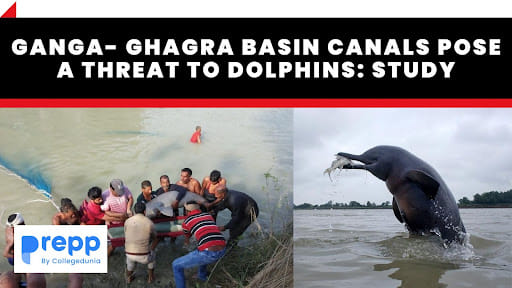
- Recently, a publication, titled “Rescuing Ganges river dolphins (Platanista gangetica) from irrigation canals in Uttar Pradesh, North India, 2013-2020”, has revealed that 19 Gangetic river dolphins had been rescued from the irrigation canals of the Ganga-Ghagra basin in Uttar Pradesh between 2013 and 2020.
Table of Contents
- Rescue Operations Conducted in the Ganga-Ghagra Basin
- How Ganga-Ghagra Basin poses threats to Gangetic River Dolphins?
- About Gangetic River Dolphins
- Initiatives of the Government to Protect Dolphins in India
- Global Efforts to Protect Dolphins
- About Ghagra River Basin
- Initiatives of the Government to Protect Dolphins in India
- Global Efforts to Protect Dolphins
- FAQs
- MCQs
Rescue Operations Conducted in the Ganga-Ghagra Basin
- Between 2013 and 2020, 24 rescue operations were conducted in the Ganga-Ghagra basin in Uttar Pradesh to rescue Gangetic river dolphins from irrigation canals.
- Out of these operations, 19 were successful in rescuing dolphins, while five dolphins unfortunately died during the rescue efforts.
- Demographics: The rescued dolphins included 14 females and 10 males. The total body length (TBL) of the dolphins ranged from 128 cm to 275 cm, with variations between male and female dolphins.
How Ganga-Ghagra Basin poses threats to Gangetic River Dolphins?
- Habitat Fragmentation: Dams, barrages, and irrigation canals fragment the natural habitat of the Gangetic river dolphins. These structures disrupt the continuity of river systems and can isolate dolphin populations. As a result, dolphins may find themselves confined to the canals, limiting their access to their natural river habitats.
- Risk of Entrapment: The canals create artificial waterways that may lead dolphins away from their natural river channels. These dolphins can become trapped in the canals, as the structures may not provide easy exit points for them. The confined spaces of the canals increase the risk of dolphins getting stuck, unable to return to the main river.
- For example: In the recent operation the entrapment of dolphins over 70% was reported primarily post-monsoon or during peak winter, indicating a connection between straying incidents and water release into canals after the monsoon. The other 30% of dolphins were rescued during peak summer when water levels fall and the minimum water flow is maintained.
- Rapidly Receding Waters: Irrigation canals are designed to transport water for agricultural purposes, and water levels can fluctuate rapidly. Dolphins may enter canals following prey or other factors and may not anticipate sudden changes in water levels. When water levels drop rapidly, dolphins can become stranded or injured.
- Heat Stroke: Canals in the Ganga-Ghagra Basin can be exposed to intense sunlight, leading to elevated water temperatures. Dolphins are sensitive to temperature changes, and exposure to hot water can cause heat stroke and distress, potentially leading to injuries or fatalities.
- Human Interference: The presence of humans in and around canals can pose threats to dolphins. Activities such as fishing, boat traffic, and watercraft collisions can harm dolphins directly or disrupt their behavior.
- Limited Prey Base: The canals may not provide an ideal environment for the dolphins' natural prey, which includes fish. Limited food availability in the canals can lead to malnutrition and decreased reproductive success among dolphin populations.
- Seasonal Water Flow: Seasonal changes in water flow, such as during the monsoon or dry seasons, can influence the movement of dolphins. Water releases into canals during the monsoon may attract dolphins, but subsequent decreases in water flow can result in entrapment.
About Gangetic River Dolphins
- It is a freshwater species and one of the few river dolphins found in the world.
- Distribution: It inhabits the Ganges-Brahmaputra-Meghna and Karnaphuli-Sangu river systems of Nepal, India, and Bangladesh.
- It is considered as the national aquatic animal.
- Conservation Status:
- IUCN Red List: Endangered
- Wildlife (Protection) Act 1972: Schedule 1
- Convention on International Trade in Endangered Species (CITES): Appendix 1
- Convention on Migratory Species (CMS): Appendix 1
Initiatives of the Government to Protect Dolphins in India
- National Dolphin Research Centre (NDRC): It is on the 4,400 square metre plot of land on the premises of Patna University for the conservation of the endangered Gangetic river dolphin.
- Dolphin Sanctuary: The Vikramshila Ganges Dolphin Sanctuary has been established in Bihar.
- National Ganga River Dolphin Day: On October 5, the National Mission for Clean Ganga observes National Ganga River Dolphin Day.
- Conservation Action Plan for the Ganges River Dolphin 2010-2020, which "identified threats to Gangetic Dolphins and the impact of river traffic, irrigation canals, and prey depletion on Dolphin populations."
- Project Dolphin: Project Dolphin is a conservation effort for Ganges river dolphins and the riverine ecosystem, by the Ministry of Environment, Forests and Climate Change. It entails conducting systematic status assessments of target species and potential threats in order to develop and implement a conservation action plan.
Global Efforts to Protect Dolphins
- In 2016, the International Whaling Commission’s (IWC) scientific committee recognised that both Ganges and Indus river dolphins require prompt and coordinated action to protect them from imminent threats.
- In 2017, the IWC created the Asian River Dolphin Task Team (AR‐TT) to identify information gaps and research priorities and develop concerted action for the protection of the Ganges and Indus river species in their range.
About Ghagra River Basin
|
(*Click this link to read prelims specific weekly current affairs articles)
FAQs
Question: What are Gangetic River Dolphins?
Answer:
It is a freshwater species and one of the few river dolphins found in the world.It inhabits the Ganges-Brahmaputra-Meghna and Karnaphuli-Sangu river systems of Nepal, India, and Bangladesh. It is considered as the national aquatic animal.
Question: What is the International Whaling Commission’s (IWC)?
Answer:
It is a specialized regional fishery management organization, founded in accordance with the 1946 International Convention for the Regulation of Whaling (ICRW). Its primary mission is to ensure the responsible conservation of whale populations, thereby facilitating the sustainable development of the whaling industry.
Question: Where is Ghagra River?
Answer:
Ghaghara River is a major left-bank tributary of the Ganges River. It rises as the Karnali River in the high Himalayas of southern Tibet Autonomous Region, China, and flows southeast through Nepal.
MCQs
Question: Other than poaching, what are the possible reasons for the decline in the population of Ganges River Dolphins? (UPSC 2014)
- Construction of dams and barrages on rivers
- Increase in the population of crocodiles in rivers
- Getting trapped in fishing nets accidentally
- Use of synthetic fertilisers and other agricultural chemicals in crop fields in the vicinity of rivers
Select the correct answer using the code provided below:
(a) 1 and 2 only
(b) 2 and 3 only
(c) 1, 3 and 4 only
(d) 1, 2, 3 and 4
Answer: (c) See the Explanation
The Ganges River Dolphin is found in the Ganges-Brahmaputra-Meghna and Karnaphuli-Sangu rivers of India and Bangladesh. The population of the Ganges river dolphin has declined to less than 1,800 from 6,000 in 1982 due to the construction of dams and water pollution caused by pesticides, fertilizers and industrial effluents. Crocodile population has nothing to do with the decline in the population of dolphins.
Therefore, option (c) is the correct answer.
Question: Which of the following is the national aquatic animal of India? (UPSC 2015)
(a) Saltwater crocodile
(b) Olive ridley turtle
(c) Gangetic dolphin
(d) Gharial
Answer: (c) See the Explanation
The Ganges River Dolphin has been designated as the National Aquatic Animal by the Ministry of Environment and Forests. The Ganges-Brahmaputra-Meghna and Karnaphuli-Sangu river systems of Nepal, India, and Bangladesh are home to the River Dolphin.
Therefore, option (c) is the correct answer.
Download the PREPP App and attempt FREE IAS Exam Mock Tests and get complete study material!

Full Test - 04: UPSC CSE Prelims CSAT (Paper-II)
Full Test - 03: UPSC CSE Prelims CSAT (Paper-II)
UPSC CSE Prelims 2026 GS Paper 1 Question Paper (24-May-2026)
UPSC CSE Prelims 2026 CSAT Paper 2 Question Paper (24-May-2026)

17 February 2025 | The Hindu Must Read Articles | Current Affairs

16 February 2026 | The Hindu Must Read Articles | Current Affairs

13 February 2026 | The Hindu Must Read Articles | Current Affairs









Comments