Israel At War
Relevance: GS2- Effect of policies and politics of developed and developing countries on India’s interests, Indian diaspora.
(Source: The Hindu, 10/03/2023)
Click here for Daily Current Affairs
Why in the news?
- Recently, Hamas, launched an attack on Israel, following which Israel declared war on the Palestinian extremist group.
- The attacks launched by both sides have resulted in a death toll of over 1000 people and concerns that the war could spread across the West Asian region.
Table of Contents
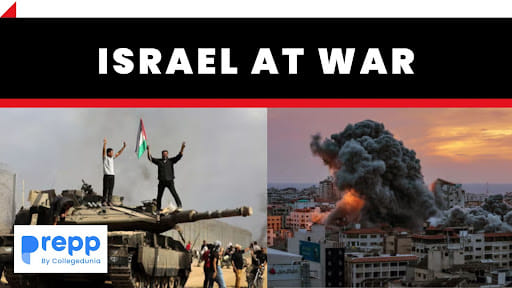
Hamas Attack on Israel
- The attack by Hamas, Operation Toofan Al-Aqsa, was the biggest and deadliest incursion into Israel since Egypt and Syria launched a sudden assault in an effort to reclaim lost territory in the Yom Kippur War 50 years ago.
- It fired rockets from the Gaza Strip and breached Israeli security barriers.
- Hamas also appealed to “resistance fighters in the West Bank" and other allies to join the war against Israel, which it has accused of "illegally occupying" Palestinian land.
- Hamas also claimed that Israel’s increased attacks on Palestinians in the West Bank, Jerusalem, and Israeli jails had incited the attack.
- The violence is also related to the dispute between Israel and Palestine over the sacred Al-Aqsa Mosque compound in Jerusalem.
Israel's retaliation
- According to Israel, this was a declaration of war by the Iran-backed extremist outfit.
- It stated that it would respond appropriately and that Israeli Defense forces were fighting armed militants across land, sea, and air theatres.
Hamas
|
International response
- U.S.A.: Israel’s longtime ally, the U.S.A., denounced the attack and demanded harsh sanctions on Hamas by the UN Security Council.
- It also warned hostile nations like Iran against exploiting these attacks.
- UN: Numerous members of the UN Security Council denounced Hamas and its massive assault on Israel.
- India: Indian Prime Minister Narendra Modi conveyed his solidarity with Israel and expressed shock at what he called “terrorist attacks”.
- Turkey: It said that it is working to de-escalate the crisis in Gaza and Israel, to ensure the conflict can be de-escalated.
- It also reiterated the importance of the “two-state” solution.
India’s evolving ties with Israel
Early Post-Independence Stance
- Jawaharlal Nehru and Mahatma Gandhi vowed to support the Palestinian cause as they rejected the idea of two nations on the basis of religion.
- They believed that states based on religious exclusivity could not be sustained on moral and political grounds which reflected their opposition to the partition of India.
- India’s position on Palestine was also guided by the general consensus in the Arab world, the Non-Aligned Movement, and the United Nations.
- India voted against the Palestine partition plan and Israel’s application for admission to the UN.
- Recognition of Israel: India recognized Israel on September 17, 1950, and allowed it to open a consulate in Mumbai.
India's Strong Support for Palestine
- In 1975, India became the first non-Arab state to recognize the PLO as the sole and legitimate representative of the Palestinian people.
- It permitted the PLO an independent office in New Delhi.
- In the 1980’s, India upgraded the PLO office to that of an embassy endowed with all diplomatic immunities and privileges.
- In 1983, the NAM summit in India released a strong statement of solidarity for Palestine.
- India also maintained its support to Palestine even during the Palestinian intifada (uprising) in 1987 in Gaza and West Bank.
Shifting Alliances
- During the 1962 India-China war and the 1965 and 1971 wars with Pakistan, the Arab states did not display support for India while Israel aided India with arms and ammunition.
- Israel also contributed weapons significantly to India during the Kargil War.
- The dissolution of the Soviet Union, the end of the Cold War, the invasion of Kuwait by Iraq, and the weakening of the NAM led to a change in India’s approach to West Asia.
- Subsequently, India established full relations with Israel in 1992.
- In 2017, Prime Minister Narendra Modi became the first Indian Prime Minister to visit Israel.
- However, he skipped the customary visit to Palestine but visited Saudi Arabia, Iran, Qatar, and UAE, who are all regional rivals of Israel — between 2014 and 2017.
Past decade
- In the last decade or so, India’s ties with West Asian countries such as Israel, Saudi Arabia, UAE, Iran, etc have deepened across sectors such as security, defense, and connectivity.
- India has adopted a geostrategic approach of engaging with all sides in the complex situation in the West Asian region due to three crucial factors:
- 90 lakh-strong Indian community in the region
- West Asia’s role in Indo-Europe connectivity including the IMEC
- Source of more than 50% of India’s energy requirements.
Conclusion
- The rise in violence and declaration of war in the region could impact the Abraham Accords and the efforts for an agreement between Saudi Arabia and Israel.
- India's diplomatic journey from being a staunch supporter of the Palestinian cause to establishing robust relations with Israel reflects the complexities of India's foreign policy in the Middle East and South Asia.
Al-Aqsa Mosque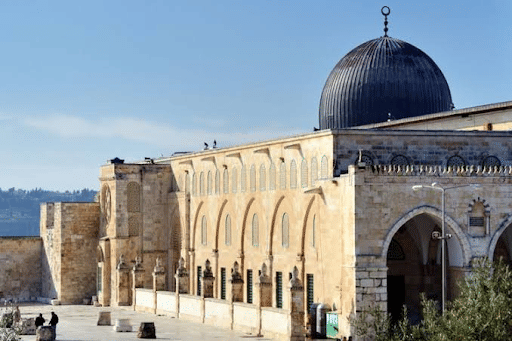
|
(*Click this link to read prelims specific weekly current affairs articles)
FAQs
Question: What is the two-state solution?
Answer:
The two-state solution refers to a solution of the Israeli–Palestinian conflict which calls for two states for two groups of people. It envisions an independent State of Palestine alongside the State of Israel, west of the Jordan River.
Question: What is the Gaza Strip?
Answer:
The Gaza Strip is a Palestinian enclave on the eastern coast of the Mediterranean Sea. It borders Egypt on the southwest, and Israel on the east and north.
It has been claimed by the de jure sovereign State of Palestine along with the West Bank. It has been controlled by Hamas since the Battle of Gaza in 2006 which led to an international political and economic boycott of the region.
UPSC Mains Practice Question:
|
MCQs
Question: The term "two-state solution" is sometimes mentioned in the news in the context of the affairs of (UPSC CSE 2018)
(a) China
(b) Israel
(c) Iraq
(d) Yemen
Answer: (b) See the Explanation
The two-state solution demands the creation of the Palestine state in the Gaza Strip and West Bank, alongside the state of Israel as a solution to the conflict in the region.
Therefore, option (b) is the correct answer.
Question: The Yom Kippur War was fought between which sides countries? (UPSC CSE 2008)
(a) Turkey and Greece
(b) Serbs and Croats
(c) Israel, and Arab countries led by Egypt and Syria
(d) Iran and Iraq
Answer: (c) See the Explanation
The Yom Kippur War, also known as the 1973 Arab-Israeli War, was a war fought by the coalition of Arab states led by Egypt and Syria against Israel from October 6 to 25, 1973.
Therefore, option (c) is the correct answer.
Question: Consider the following statements: (UPSC CSE 2004)
- P.V. Narasimha Rao’s government established diplomatic relations between India and Israel.
- Ariel Sharon is the second Prime Minister of Isreal to have visited India
Which of the statements given above is/are correct?
(a) 1 only
(b) 2 only
(c) Both 1 and 2
(d) Neither I nor 2
Answer: (a) See the Explanation
- Diplomatic relations between India and Israel were established in 1992 under the Narasimha Rao regime.
- Ariel Sharon was the first Prime Minister of Israel to visit India in 2003.
Therefore, option (a) is the correct answer.
Question: Which one of the following pairs is not correctly matched? (UPSC CSE 2005)
(a) Arjun: Indigenously produced Main Battle Tank (MBT)
(b) Phalcon: Cruise missile supplied by Russia to India.
(c) Saras: Indigenously developed civilian passenger aircraft.
(d) Operation Seabird: New Indian naval base at Karwar
Answer: (b) See the Explanation
- Phalcon AWACS is a radar system provided by Israel to India. Hence statement 2 is incorrect.
- It was meant to replace the Flycatcher radar systems used by the Indian Air Defence Corps.
- AWACS are more advanced than ground-based radars in terms of tracking incoming fighters, cruise missiles, and drones
Download the PREPP App and attempt FREE IAS Exam Mock Tests and get complete study material!

Full Test - 04: UPSC CSE Prelims CSAT (Paper-II)
Full Test - 03: UPSC CSE Prelims CSAT (Paper-II)
UPSC CSE Prelims 2026 GS Paper 1 Question Paper (24-May-2026)
UPSC CSE Prelims 2026 CSAT Paper 2 Question Paper (24-May-2026)

17 February 2025 | The Hindu Must Read Articles | Current Affairs

16 February 2026 | The Hindu Must Read Articles | Current Affairs

13 February 2026 | The Hindu Must Read Articles | Current Affairs









Comments