Ken-Betwa River Linking
Relevance: GS2- Functions and responsibilities of the Union and the States, issues and challenges pertaining to the federal structure
(Source: Indian Express, 10/09/2023)
Click here for Daily Current Affairs
Why in the news?
Recently, the Ken-Betwa Link Project (KBLP) secured the final forest clearance necessary nearly six years after it got provisional approval.
Table of Contents
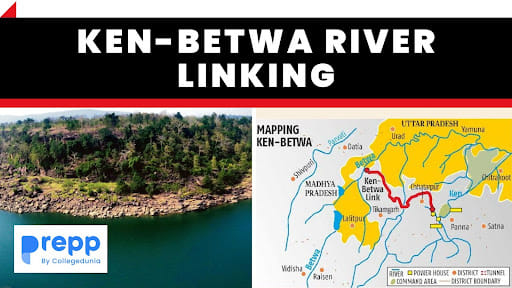
What is the Ken-Betwa River linking project?
- The Ken-Betwa River linking project is the first project for river interlinking under the National Perspective Plan.
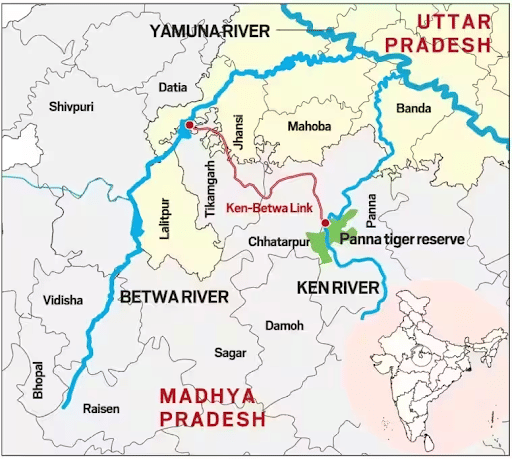
- It will link the Ken and Betwa Rivers in Madhya Pradesh and Uttar Pradesh respectively.
- The project will enable the transfer of surplus water from the Ken River to the Betwa to irrigate the drought-prone Bundelkhand region.
- As part of the project, a 77-metre tall and 2-km wide Dhaudhan dam will be built within the Panna Tiger Reserve along with a 230-km canal.
History
- In August 2005, the Union government and the governments of Uttar Pradesh and Madhya Pradesh signed a tripartite memorandum of understanding for the preparation of the Detailed Project Report (DPR).
- It was marked as a National Project in 2008 and was later included in the Prime Minister's package for the development of the drought-prone Bundelkhand region.
- In 2011, the KBLP had been rejected by the Union government due to its high environmental cost but it was revived and granted wildlife, environmental, and in-principle forest clearances in 2016-2017.
- In 2021, the Union Ministry of Jal Shakti and the two states signed a memorandum of agreement to implement this project, with an eight-year deadline.
- In October 2023, the final clearance was granted to the project by the Union Ministry of Environment, Forests, and Climate Change.
KBLP commitments to get clearance
- The Forest clearance had conditions such as
- The closure of dam gates and the impounding of water is barred until all the revenue villages are relocated.
- The KBLP has undertaken that the state government and the user agency would ensure that the canal would be realigned to minimize the use of forest land for construction.
- The KBLP has committed that the powerhouses shall not be constructed in the forest area to be diverted, which will help avoid constant disturbance in PTR.
What is the significance of the project?
- The completion of the project will accelerate water conservation and produce 103 MW of hydropower and 27 MW of solar electricity.
- It would encourage more river-interlinking projects which help reduce water scarcity in the country.
- It will provide annual irrigation of 10.62 lakh hectares and supply drinking water to around 62 lakh people in Bundelkhand.
What are the concerns associated with the project?
- Scientific basis: Hydrological and ecological experts have expressed concern that the government’s ‘surplus and deficit’ model has little basis in science.
- This may also endanger the water security of the protected Panna region.
- Threat to protected areas: The total loss of 105 sq km of wildlife habitat as a result of submergence and fragmentation will impact endangered species such as vultures, gharials, and tigers.
- Panna is an exceptional tiger habitat with deep gorges, that are at risk of being drowned when the new dam is constructed.
- Similarly, the Ken Gharial Sanctuary, which is home to the critically endangered Gangetic gharial, is located downstream of the national park and could also be affected by the dam.
- It should be evident right away how devastating the planned dam would be for the water flow into and out of this sanctuary, as well as how it would be in violation of the Act's requirements for a sanctuary.
- It is forbidden to divert, stop, or enhance the flow of water into or outside of a sanctuary or a national park except if it is deemed necessary to enhance and better manage the species within.
- Insufficiency of Ken: Some experts have claimed that the Ken, which is a non-perennial river, may not have sufficient water reserves to satisfy the projected needs of the Betwa, let alone that of the drought-hit Bundelkhand region.
- Economic cost: The large estimated economic costs attached to the implementation and maintenance of the project have risen due to the delays in project implementation.
- Clearances: The KBLP requires a total of 60.17 sq km of forest land, including 41.41 sq km of PTR.
- The KBLP has regularly reiterated a request for partial exemption from compensating for the diversion of 60.17 sq km of forest land, by adding an equal extent of revenue or private land to the Panna Tiger Reserve (PTR).
- In 2018, Madhya Pradesh could identify only 42.06 sq km of revenue land and claimed that it would consider 36.22 sq km, of degraded forest land to meet the 60.17 sq km commitment.
- Other challenges: Experts have also claimed that the proposed changes have altered the nature of the project which means that new environmental clearances must be obtained
- The Supreme Court has not yet ruled on the Central Empowered Committee’s 2019 report that sought studies on the impact of KBLP.
- The Madhya Pradesh government has also not completed its recount of the trees to be felled for the KBLP.
To know more, click the link.
What are the benefits of river interlinking?
- Water redistribution: It helps redistribute water resources from regions experiencing excessive rainfall to those facing chronic drought conditions.
- This will help in mitigating floods and alleviating droughts.
- Hydropower: As part of river interlinking initiatives, numerous dams and reservoirs will be established.
- This will increase hydropower generation, by around 34,000 MW if fully realized.
- Water flow: It will also contribute to dry weather flow augmentation with surplus water in reservoirs released during the dry season to maintain consistent minimum flow in rivers
- This will benefit areas such as pollution control, navigation, forest preservation, fisheries, and wildlife protection.
- Agriculture and irrigation: India's agriculture is heavily monsoon-reliant which leads to agricultural vulnerabilities due to the erratic nature of the monsoon.
- River interlinking will improve irrigation facilities and provide relief to water-deficient regions, thereby enhancing agricultural productivity and stability.
- Transportation: River interlinking will help improve the inland waterways transport network in the country.
- This will help generate revenue in the form of transportation, tourism, and other activities like pisciculture.
- Security: It will also help strengthen the country’s national defense and security by expanding the country's waterline defense capabilities.
(*Click this link to read prelims specific weekly current affairs articles)
FAQs
Question: What is the National River Linking Project?
Answer:
The NRLP aims to transfer water from water-excess basins to water-deficient basins by interlinking 37 rivers of India through a network of almost 3000 storage dams.
It has a Himalayan Component which consists of 14 projects and a Peninsular Component consisting of 16 projects.
Question: What is the status of gharials in India?
Answer:
Gharials, or gavials, are a type of Asian crocodilian distinguished by their long, thin snouts. They are generally found in the fresh waters of North India. It has been classified as Critically endangered on the IUCN Red List, Appendix I of CITES and Schedule I of the WPA, 1972.
UPSC Mains Practice Question:
|
MCQs
Question: Recently Uttar Pradesh and Madhya Pradesh govern-ments signed a Memorandum of Understanding for the linking of two rivers as a link project. Which are these two rivers? (UPSC CSE 2006)
(a) Betwa and Chambal
(b) Betwa and Ken
(c) Chambal and Son
(d) Ken and Narmada
Answer: (b) See the Explanation
- In 2005, the Uttar Pradesh and Madhya Pradesh governments signed a memorandum of understanding for the linking of river Betwa and Ken.
- Ken and Betwa are triburaties of Yamuna.
Therefore, option (b) is the correct answer.
Question: Recently, linking of which of the following rivers was undertaken? (UPSC CSE 2016)
(a) Cauvery and Tungabhadra
(b) Godavari and Krishna
(c) Mahanadi and Sone
(d) Narmada and Tapti
Answer: (b) See the Explanation
- The Andhra Pradesh Government is interlinking KrishnaGodavari rivers through the Pattiseema lift irrigation scheme.
- The Pattiseema project lifts flood water from the river Godavari and pumps it into the Polavaram right canal that empties into the river Krishna in Vijayawada.
Therefore, option (b) is the correct answer.
Download the PREPP App and attempt FREE IAS Exam Mock Tests and get complete study material!

Full Test - 04: UPSC CSE Prelims CSAT (Paper-II)
Full Test - 03: UPSC CSE Prelims CSAT (Paper-II)
UPSC CSE Prelims 2026 GS Paper 1 Question Paper (24-May-2026)
UPSC CSE Prelims 2026 CSAT Paper 2 Question Paper (24-May-2026)

17 February 2025 | The Hindu Must Read Articles | Current Affairs

16 February 2026 | The Hindu Must Read Articles | Current Affairs

13 February 2026 | The Hindu Must Read Articles | Current Affairs









Comments