ISRO Plans Ganganyaan Unmanned Flight Tests, Gears For Abort Mission
Relevance: GS3 - Science and Technology, Space Technology
(Source: The Hindu, 10/09/2023)
Click here for Daily Current Affairs
Why in the news?
- The Indian Space Research Organisation (ISRO), in its pursuit of the Gaganyaan mission, is gearing up for the initial uncrewed flight tests, with the commencement of preparations for the Flight Test Vehicle Abort Mission-1 (TV-D1).
- TV-D1, it is expected to take place by the end of October 2023 from the Satish Dhawan Space Centre in Sriharikota (SDSC-SHAR).
Table of Contents
What is TV-D1?
- The Test Vehicle is a single-stage liquid rocket developed for this abort mission.
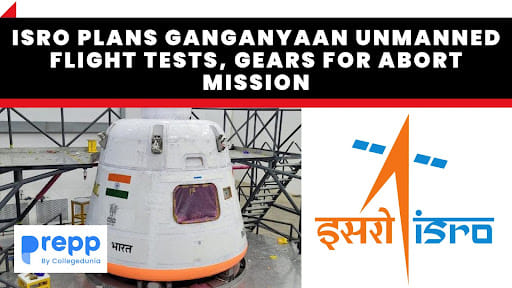
- The payloads consist of the Crew Module (CM) and Crew Escape Systems (CES) with their fast-acting solid motors, along with CM fairing (CMF) and Interface Adapters.
- This flight will simulate the abort condition during the ascent trajectory corresponding to a Mach number of 1.2 encountered in the Gaganyaan mission.
- During the TV-D1 mission, the CES with CM will be separated at an altitude of about 17 km. The abort sequence will include the deployment of parachutes, culminating in the safe landing of the CM in the sea, approximately 10 km from the Sriharikota coast.
- It will have no crew on board, and is meant to evaluate rescue procedures and ensure the safety of astronauts in case of possible emergencies during the main Gaganyaan mission that will carry three Indians into space to a 400-km-altitude low earth orbit for three days.
Importance of TV-D1
- The test vehicle demonstration is an essential step in the Gaganyaan mission’s progress.
- The TV-D1 aims to test the safety and reliability of the spacecraft and its systems, including the escape mechanism, at a much higher altitude than before.
- The TV-D1’s success will pave the way for further testing and the eventual crewed mission.
Why Abort Mission before Gaganyaan?
- The Abort Mission before Gaganyaan, known as Flight Test Vehicle Abort Mission-1 (TV-D1), is essential for crew safety testing and system validation.
- It simulates an emergency abort during launch, ensuring the safety of astronauts, validating critical systems, and collecting data for improvements.
- Its success marks a milestone in the Gaganyaan program, preparing for the first crewed mission with Indian astronauts.
- Therefore, conducting an Abort Mission before the Gaganyaan mission is a crucial step in ensuring the safety and reliability of the spacecraft and systems that will carry astronauts into space.
About Gaganyaan Mission
- Gaganyaan is India's first Human space flight mission aiming for safe transportation of astronauts to space and back.
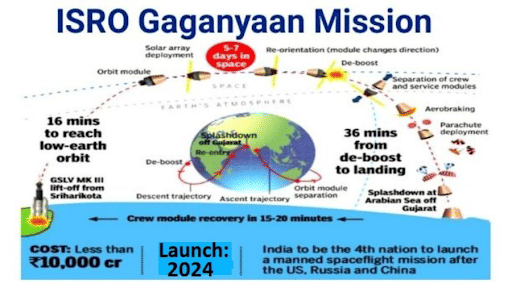
- It envisages demonstration of human spaceflight capability by launching a crew of 3 members to an orbit of 400 km for a three-day mission and bring them back safely to earth, by landing in Indian sea waters (either the Bay of Bengal or the Arabian Sea).
- It necessitates the development of critical technologies, including a human-rated launch vehicle for crew transportation, a Life Support System to create Earth-like conditions for the crew in space, emergency escape provisions for the crew, and the ongoing refinement of crew management aspects encompassing training, recovery, and rehabilitation.
- The LVM3 rocket, the heavy lift launcher of Isro, has been identified as the launch vehicle for the Gaganyaan mission. It consists of the solid stage, liquid stage and cryogenic stage.
- Various precursor missions are planned for demonstrating the Technology Preparedness Levels before carrying out the actual Human Space Flight mission. These demonstrator missions include:
- Integrated Air Drop Test (IADT),
- Pad Abort Test (PAT) and
- Test Vehicle (TV) flights.
Significance of Gaganyaan Mission for India
- Technological Advancement and Scientific Exploration: It showcases advanced capabilities and elevates India's global stature in space technology. This mission paves the way for India to join the league of nations with the capability to send humans to space, enhancing its global standing in the field of space technology.
- Inspiring Youth: It has a unique opportunity to inspire and excite Indian youth and steer many students toward careers in science and technology towards challenging jobs that encourage knowledge, innovation and creativity.
- Economic Boost: The mission provides significant opportunities for Indian industries, with around 60% of equipment being sourced from the private sector. This boosts economic activities and industrial capabilities.
- Employment Generation: Gaganyaan is expected to create new job opportunities, and additional manpower for the space organization. It contributes to human resource development and advanced technology training.
- Academic Collaboration: The program encourages collaboration between ISRO, academia, industry, national agencies, and scientific organizations, fostering research and development.
- Research Opportunities: Gaganyaan supports research in various areas like materials processing, astro-biology, planetary chemistry, and more, involving a large number of researchers and advanced equipment.
- National Prestige: After the successful completion of Ganagyaan, India will become the fourth country to launch a human space mission, after the US, Russia and China. India gains prestige on the global stage and establishes itself as a key player in the space industry.
(*Click this link to read prelims specific weekly current affairs articles)
FAQs
Question: What is Gaganyaan?
Answer:
Gaganyaan is India's first Human space flight mission aiming for safe transportation of astronauts to space and back. The spacecraft is being developed by the Indian Space Research Organisation (ISRO).
Question: What is the purpose of uncrewed missions before crewed missions?
Answer:
The uncrewed missions are for technology demonstration, safety and reliability verification and will be heavily instrumented to study the performance of systems before crewed flight.
Question: What is ISRO?
Answer:
The Indian Space Research Organisation is the national space agency of India. It operates as the primary research and development arm of the Department of Space, which is directly overseen by the Prime Minister of India.
Question: What is TV-D1?
Answer:
The Test Vehicle is a single-stage liquid rocket developed for this abort mission. The payloads consist of the Crew Module (CM) and Crew Escape Systems (CES) with their fast-acting solid motors, along with CM fairing (CMF) and Interface Adapters.
UPSC Mains Practice Question:
|
MCQ
Question: What is the purpose of the Flight Test Vehicle Abort Mission-1 (TV-D1) in the Gaganyaan program?
(a) To test the spacecraft's reentry capabilities
(b) To demonstrate the performance of the Crew Escape System
(c) To perform scientific experiments in space
(d) To test communication systems
Answer: (b) See the Explanation
The Abort Mission before Gaganyaan, known as Flight Test Vehicle Abort Mission-1 (TV-D1), is essential for crew safety testing and system validation.
It simulates an emergency abort during launch, ensuring the safety of astronauts, validating critical systems, and collecting data for improvements.
Therefore, option (b) is the correct answer.
Download the PREPP App and attempt FREE IAS Exam Mock Tests and get complete study material!

Full Test - 04: UPSC CSE Prelims CSAT (Paper-II)
Full Test - 03: UPSC CSE Prelims CSAT (Paper-II)
UPSC CSE Prelims 2026 GS Paper 1 Question Paper (24-May-2026)
UPSC CSE Prelims 2026 CSAT Paper 2 Question Paper (24-May-2026)

17 February 2025 | The Hindu Must Read Articles | Current Affairs

16 February 2026 | The Hindu Must Read Articles | Current Affairs

13 February 2026 | The Hindu Must Read Articles | Current Affairs









Comments