Not The Joint Statement But Ukraine Will Be EU’s Priority At G-20 Summit: EU Official
(Source: The Hindu, 09/07/2023)
Click here for Daily Current Affairs
Why in the news?
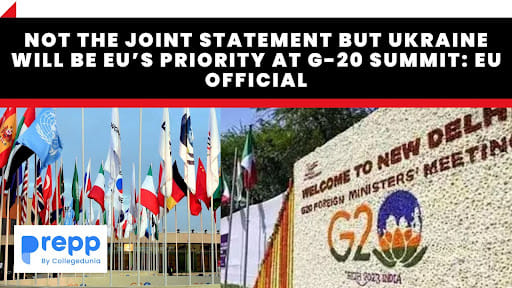
- Recently, a senior EU official stated that the European Union’s priority at the G-20 Summit in New Delhi will be Ukraine.
- In February 2022, Russia launched an invasion of Ukraine which is still continuing despite the huge losses to life and property.
Table of Contents
What is the crisis in Ukraine?
- The Ukrainian crisis is based on the historical, political, and economic dimensions of post-Cold War territorial disputes in Central Europe and Russia's attempts at reviving itself to its superpower status.
- Ukraine and Russia share deep-rooted cultural, linguistic, and familial bonds that span centuries which have been exploited for political gains, both in elections and military endeavors.
Causes of the Ongoing Conflict
- Balance of Power: Russia seeking to assert its influence in the region which affects Ukraine’s national interests, thereby affecting the balance of power in the region.
- Buffer Between Russia and the West: Ukraine's geographical location makes it a buffer zone between Russia and the NATO-influenced region.
- This has contributed to geopolitical struggles for control and influence between the two flanks.
- Ukraine's Bid for NATO Membership: Ukraine's application for NATO membership was seen as a direct threat to Russia’s security interests.
- Russian Interests in the Black Sea: The Black Sea is strategically important for both Russia and Ukraine due to its proximity to the region.
- This is particularly important as the Black Sea is a critical component of the trade, economic, and food supplies of both nations.
- Protests in Ukraine and Russia: Ongoing protests within the two countries reflect the complex political landscape and the aspirations of the people.
- Governments have presented a strong front in order to build public support for their regimes.
Repercussions
- As a result of the invasion of Ukraine, there has been an enormous destruction of infrastructure and subsequently a massive economic loss.
- The war has led to the creation of a massive humanitarian and refugee crisis in Europe.
- The sanctions imposed on Russia by the Western nations led to a deterioration in the socio-economic conditions of Russia and its isolation from the international world.
- Europe suffered from an energy crisis as these countries were heavily dependent on Russian oil and gas.
- Various commodities such as food and energy experienced inflation, leading to a decrease in demand.
What was the stance of other countries?
EU
- The European Union has strongly criticized Russia’s actions in Ukraine which it claims are a breach of Humanitarian Law.
- The EU has also criticized the systematic use of missiles and drones by Russia to attack civilians, civilian objects, and infrastructure across Ukraine.
- In response, the EU has imposed a wide range of sanctions on Russia with the aim of crippling its ability to finance the war, diminish Russia’s economic base, and punish the strategic minds behind the war.
West
- Western countries, led by the U.S.A., have expressed support for Ukraine and provided it with economic, and arms support to defend itself.
- Support provided by Western nations has been framed as a part of the struggle between democracy and authoritarianism, and the defense of democracy.
What have officials said about the G-20 summit?
EU
- Officials of the EU have claimed that the G-20 Summit should prioritize the Ukraine issue and defend the sovereignty and integrity of Ukraine.
- The Western bloc stated that it had wished to include Ukrainian President Volodymyr Zelenskyy at the G-20 summit in New Delhi.
- India, as host of the G-20 had decided not to invite Ukraine to the Summit.
- The G-20 was described as the apt avenue to discuss the Ukraine issue and claimed that the G-20 is a political organization.
- The EU, U.S.A., Russia, France, and India also expressed support for the inclusion of the African Union in the G-20.
- The EU officials also expected friction on the issues of climate change, multilateral development banks, and debt management.
Joint Communique
- The EU official claimed that a joint communique might not be issued as the text prepared by India was not satisfactory for the EU and G-7.
- Traditionally, a consensus is reached by members at the G-20 Summit and a joint declaration is issued.
- A failure to do so in India’s Presidency could impact India’s reputation and also raise questions about the sustainability of the current form of the G-20.
- Although there were strong disagreements among members at previous summits such as Brisbane (2014) and Bali (2022), a final document was achieved.
- No joint communique from any ministerial or official meetings of the grouping that were held in India.
Russia
- The Russian Ambassador to India rejected the EU suggestion to prioritize Ukraine at the G-20 by stating that the G-20 should not be politicized and that non-consensual items should be removed from the agenda.
- According to the Russian ambassador, the G-20 had been hijacked by certain countries to discuss the Ukraine issue.
G-20
Functioning
|
(*Click this link to read prelims specific weekly current affairs articles)
FAQs
Question: What is NATO?
Answer:
North Atlantic Treaty Organisation (NATO), is a political and military alliance of 30 countries established by the U.S.A. under the Washington Treaty in 1949. It is headquartered in Brussels, Belgium, and aims to safeguard the freedom and security of all its members by political and military means.
Question: What are sanctions?
Answer:
Sanctions are coercive measures that can be applied to diplomatic, economic, and cultural relations between states. They are generally non-military in nature and can be unilateral or collective depending on who they are imposed by. They can also be targeted at particular individuals and groups. Economic sanctions are multidimensional and include financial sanctions, business restrictions, travel bans, etc.
UPSC Mains Practice Question:
|
MCQs
Question: With reference to the "G20 Common Framework", consider the following statements:
- It is an initiative endorsed by the G20 together with the Paris Club.
- It is an initiative to support low-income countries with unsustainable debt.
Which of the statements given above is/are correct?
(a) 1 only
(b) 2 only
(c) Both 1 and 2
(d) Neither 1 nor 2
Answer: (c) See the Explanation
- The G20 Common Framework is an initiative endorsed by the G20 and the Paris Club to provide structural support to Low-Income Countries with unsustainable debt. Hence statement 1 is correct.
- The G20 Common Framework is an initiative to support Low-Income Countries with unsustainable debt and ensure that they were able to continue to access financing during the COVID-19 pandemic. Hence statement 2 is correct.
- It includes a package of debt treatments such as relief on debt service, extended maturities, and a reduction in the stock of debt.
Therefore, option (c) is the correct answer.
Question: The term ‘Digital Single Market Strategy’ seen in the news refers to
(a) ASEAN
(b) BRICS
(c) EU
(d) G20
Answer: (c) See the Explanation
- The Digital Single Market Strategy is related to the EU and consists of a single strategy to cover telecommunication, digital marketing, and e-commerce.
- It was recommended by the Juncker Commission in 2015.
- It has three pillars - Growth of digital networks and services, Growth of Europe’s digital economy, and access to online products and services.
Therefore, option (c) is the correct answer.
Download the PREPP App and attempt FREE IAS Exam Mock Tests and get complete study material!

Full Test - 04: UPSC CSE Prelims CSAT (Paper-II)
Full Test - 03: UPSC CSE Prelims CSAT (Paper-II)
UPSC CSE Prelims 2026 GS Paper 1 Question Paper (24-May-2026)
UPSC CSE Prelims 2026 CSAT Paper 2 Question Paper (24-May-2026)

17 February 2025 | The Hindu Must Read Articles | Current Affairs

16 February 2026 | The Hindu Must Read Articles | Current Affairs

13 February 2026 | The Hindu Must Read Articles | Current Affairs









Comments