'India' And 'Bharat' Retained To Align Varied Views In Constituent Assembly
Relevance: GS2 - Polity and Governance; Indian Constitution—historical underpinnings, evolution, features, amendments, significant provisions and basic structure
(Source: The Hindu; 09/07/2023)
Click here for Daily Current Affairs
Why in the news?
- Recently, the Government has replaced the name ‘India’ with a Sanskrit word in dinner invitations sent to guests attending this week’s Group of 20 (G20) summit, triggering speculation that the name of the country will be officially changed.
- Droupadi Murmu is referred to as “President of Bharat” instead of “President of India” in the invitation sent to G20 attendees.
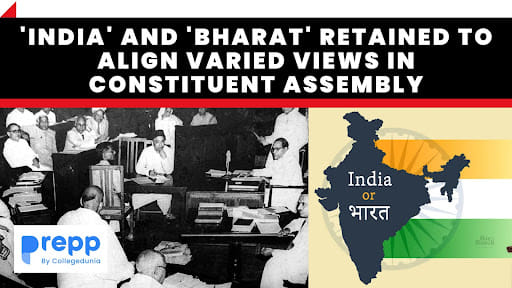
- The Constituent Assembly debates reveal that the inclusion of both 'India' and 'Bharat' in the Constitution was a deliberate choice made in 1948 to accommodate diverse perspectives expressed by its framers.
Table of Contents
Why is there a controversy regarding the name change?
- Conversations regarding the name change have started because of reports claiming that the Narendra Modi-led government is expected to bring a resolution for changing India's official name to 'Bharat' during the special session of Parliament, scheduled from September 18-22.
- A row over the name of the country had erupted with a G-20 dinner invitation going out in the name of the ‘President of Bharat’.
- Critics have raised concerns about the Indian government's use of the term "Bharat" in official invitations, especially in light of Hindu-nationalist ideology and the administration's efforts to promote Hindi.
- Some have interpreted this choice of terminology as an indication of the government's intention to potentially change the official name of the country.
- Under Prime Minister Modi's leadership and the Bharatiya Janata Party (BJP) government, there has been a significant focus on renaming towns and cities with names rooted in the colonial era.
Various Constituent Assembly Debate on ‘Bharat’ or ‘India’
- Jawaharlal Nehru in his monumental ‘Discovery of India’, referred to “India”, “Bharata” and “Hindustan.” But when the question of naming India in the Constitution arose, ‘Hindustan’ was dropped, and both ‘Bharat’ and ‘India’ were retained.
- The debate on Article 1 of the Indian Constitution, which deals with the name of the country, began in 1948. Initially, it was scheduled to start on November 17, 1948, but was postponed at the suggestion of Govind Ballabh Pant.
- The discussion revolved around whether to use 'Bharat' or 'India' as the official name of the country.
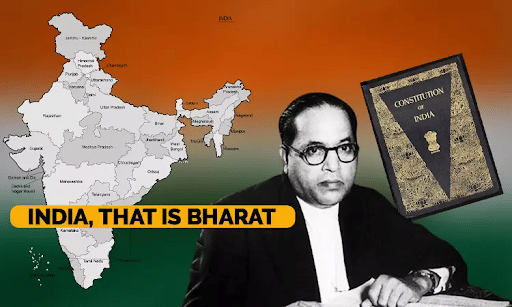
- On September 17, 1949, Dr. B.R. Ambedkar presented the final version of the provision, which included both 'Bharat' and 'India'. However, there were differing opinions among the members of the Constituent Assembly.
- Seth Govind Das from Jabalpur advocated for placing "Bharat" above "India," emphasizing that the latter was merely a translation of the former in English.
- Hari Vishnu Kamath cited the example of the Irish Constitution to argue that 'India' was just a translation of 'Bharat.' He pointed out that the Irish Free State had changed its name upon gaining freedom, and its constitution referred to this change in both Irish (Eire) and English (Ireland).
- Hargovind Pant, representing the hill districts of the United Provinces, strongly advocated for 'Bharatvarsha'. He argued that 'India' was a name imposed by foreign rulers who had colonized India for its wealth, and clinging to it would be an acknowledgment of that insulting history.
- Some Constituent Assembly Members earlier had proposed replacing 'States' in Article 1 with 'Pradesh,' but Pandit Nehru objected, highlighting the ambiguity of the term and advocating for the precision of 'State.'
Ancient Reference of the term
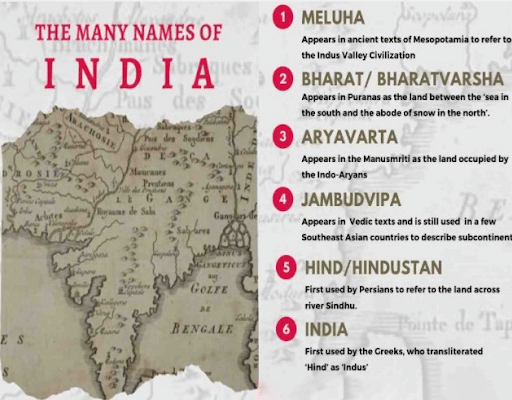
- The term “India” finds its roots in the ancient name of the Sindhu (or Indus) River. It was the Greeks who, in the 5th century BCE, began using this nomenclature to refer to the land beyond the river. By the 9th century, Old English literature mentioned “India”, and by the 17th century, the term had comfortably nestled into Modern English.
- The roots of “Bharat”, “Bharata”, or “Bharatvarsha” are traced back to Puranic literature, and to the epic Mahabharata. The Puranas describe Bharata as the land between the “sea in the south and the abode of snow in the north”. Contrarily, “Bharat” harks back to India’s mythological past. King Bharat, a legendary monarch, is said to have been the forebearer of all Indians. Thus, the name “Bharat” symbolizes a nation of King Bharat’s descendants.
- The name Hindustan is thought to have derived from ‘Hindu’, the Persian cognate form of the Sanskrit ‘Sindhu’ (Indus), which came into currency with the Achaemenid Persian conquest of the Indus valley (northwestern parts of the subcontinent) that begin in the 6th century BC (which was the time of The Buddha in the Gangetic basin).
Supreme Court’s Remark
- In March 2016, Chief Justice of India T.S. Thakur stated that citizens have the freedom to call their country either 'Bharat' or 'India,' and no authority, State, or court could dictate their choice. This clarification came in response to a query about the phraseology of Article 1 of the Constitution, which mentions "India, that is Bharat, shall be a Union of States."
- In June 2020, during the pandemic, a petition seeking to remove 'India' from Article 1 of the Constitution was presented to Chief Justice S.A. Bobde in a virtual hearing. Chief Justice Bobde noted that 'Bharat' and 'India' were both constitutional names for the country and did not entertain the petition. However, he suggested transforming it into a representation for Central Ministries, especially the Union Ministry of Home Affairs.
Retaining and Advocating for the name
- Retaining ‘India’:
- Some members, including B.R. Ambedkar, argued for retaining the name 'India' due to its historical continuity and recognition among foreign nations.
- Ambedkar highlighted that 'India' was the name under which the country had signed international agreements and was a member of the United Nations.
- Advocating for ‘Bharat’:
- Members like Seth Govind Das supported 'Bharat,' emphasizing that it reflected the country's rich history and culture without hindering progress.
- The example of the Chinese traveler Hiuen-Tsang referring to the country as 'Bharat' was cited to support this perspective.
What does the Constitution of India say?
- The Constitution of India under Article 1 states that,
- India, that is Bharat shall be a Union of States
- The States and Union Territories thereof shall be specified in the 1st Schedule
- The territory of India shall comprise Territory of States, Union Territories specified in the First Schedule, Other territories may be acquired.
- Article 1 of the Constitution of India is an essential statement specifying what our country will be called and what will comprise the sovereign territory of our nation.
- It acknowledges that India is a ‘Union of States’ and not a Federation of States where states and central government will work together to ensure the common good of the nation.
- Article 1 of the Constitution which sets the tone for the entire constitutional framework starts with both 'India' and 'Bharat.' If the name of the country is changed, it would require an amendment to Article 1.
(*Click this link to read prelims specific weekly current affairs articles)
FAQs
Question: What is Article 1 of the Constitution?
Answer:
Article 1 of the constitution says that India, that is Bharat, shall be a union of states and the territory of India consists of that of the states, union territories specified in the First Schedule and other acquired territories.
Question: Why was there a debate around the “President of Bharat” in 2023?
Answer:
A G20 invitation in 2023 referred to the Indian President as the “President of Bharat”, sparking discussions on the official naming of the country.
MCQ
Question: Which of the following is not mentioned in Article 1 of the Indian constitution.
(a) State territories
(b) Union territories
(c) Territories that may be acquired by India at any time
(d) India as a " Federation of States"
Answer: (d) See the Explanation
Article 1 of the Indian Constitution states that India shall be a Union of States, and its territory shall be divided into states and union territories. It provides a description of the territorial extent of the country.
Therefore, option (d) is the correct answer.
Download the PREPP App and attempt FREE IAS Exam Mock Tests and get complete study material!

Full Test - 04: UPSC CSE Prelims CSAT (Paper-II)
Full Test - 03: UPSC CSE Prelims CSAT (Paper-II)
UPSC CSE Prelims 2026 GS Paper 1 Question Paper (24-May-2026)
UPSC CSE Prelims 2026 CSAT Paper 2 Question Paper (24-May-2026)

17 February 2025 | The Hindu Must Read Articles | Current Affairs

16 February 2026 | The Hindu Must Read Articles | Current Affairs

13 February 2026 | The Hindu Must Read Articles | Current Affairs









Comments