‘ASEAN Central Pillar Of India’s Act East Policy’
Relevance: GS2 - India and its neighborhood- relations, Bilateral, regional, and global groupings and agreements involving India and/or affecting India’s interest
(Source: The Hindu, 09/07/2023)
Click here for Daily Current Affairs
Why in the news?
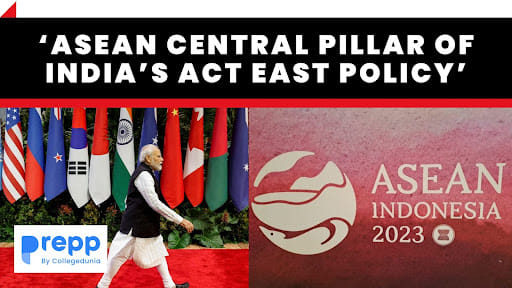
- Recently, Prime Minister Narendra Modi attended the ASEAN Summit in Jakarta and described the summit as the central pillar of India’s Act East policy.
- The Prime Minister is also scheduled to attend the ASEAN-India Summit and the East Asia Summit.
Table of Contents
What has the Prime Minister said about ASEAN?
- Prime Minister Modi has stated that ASEAN is the epicenter of growth and that it plays a crucial role in global development.
- He reiterated India’s support for the ASEAN outlook on the Indo-Pacific.
- There has been consistent progress in the mutual cooperation between India and ASEAN despite the atmosphere of global uncertainty.
- India and ASEAN will engage on important regional and global issues to help create a better planet.
- The India-ASEAN relationship has evolved dynamically as a result of the comprehensive strategic partnership between India and ASEAN.
East Asia Summit
The Prime Minister recognized the forum as an opportunity to deliberate on regional and global concerns such as food and energy security, environment, health, and digital transformation.
What is India’s Act East Policy?
- The Act East Policy was launched in 2014 at the East Asia Summit as an upgrade of the previous Look East Policy.
- It focuses on economic and security integration and widens its scope to East Asia and South-East Asia.
- The Look East Policy aimed at economic integration and was restricted to South East Asia alone.
Objectives
- Develop closer cultural ties, strategic relationships, and economic integration with the countries in the Asia-Pacific region through continuous engagement at bilateral, regional, and multilateral levels and improved connectivity with the North East region of India.
- Increase interaction between states of North-East India and neighboring countries.
- Develop alternatives to traditional business partners like the South East Asian and Pacific countries.
- Curb China’s increasing influence in the region.
- 4C’s:
- Culture
- Commerce
- Connectivity
- Capacity building
Institutional mechanisms
- Annual Summit Level Meetings
- Active participation in the East Asia Summit and the ASEAN Regional Forum
- 30 Sectoral Dialogue Mechanisms
- Involvement in regional forums such as BIMSTEC, IORA, Asia Cooperation Dialogue, and the Mekong Ganga Cooperation.
ASEAN
- ASEAN or the Association of South East Asian Nations is a regional association of countries that was established to promote social and political stability in the Asia-Pacific region.
- Formation: It was established in 1967 under the Bangkok Declaration which was signed by Malaysia, Indonesia, the Philippines, Thailand, and Singapore.
- Members: Brunei Darussalam, Burma, Cambodia, Indonesia, Laos, Malaysia, Philippines, Singapore, Thailand, and Vietnam
- Secretariat: Jakarta, Indonesia
- Fundamental principles:
- Mutual respect for the independence, sovereignty, equality, territorial integrity, and national identity of all nations.
- The right of a state to be free from external interference, subversion, or coercion.
- Non-interference in the internal affairs of other members.
- Peaceful settlement of disputes
- Renounce the threat or use of force.
- Cooperation among members.
Objectives
- Develop a peaceful and prosperous community of Southeast Asian nations through economic growth, social progress, and cultural development.
- Abide by the rule of law, justice, and principles of the UN charter to ensure regional peace and stability
- Collaborate and assist in shared interests in economic, social, cultural, technical, scientific, and administrative fields.
- Collaborate in agriculture, industries, trade expansion, transportation and communications, and improving living standards of people.
- Promote Southeast Asian studies.
- Cooperation with existing international and regional organizations.
ASEAN Forums
- ASEAN Regional Forum (ARF): It was launched in 1993 to facilitate cooperation on political and security issues to contribute to regional confidence-building and preventive diplomacy.
- ASEAN Plus Three: It is a consultative group of the ten ASEAN states, China, Japan, and South Korea that was launched in 1997.
- East Asia Summit (EAS): It is a summit for heads of state from ASEAN, Australia, China, India, Japan, New Zealand, Russia, South Korea, and the United States that discusses security and prosperity in the region with ASEAN playing a central role.
- ASEAN Defence Ministers Meeting (ADMM)-Plus Meeting: The ADMM-Plus is a platform for ASEAN and its eight Dialogue Partners to strengthen security and defense cooperation for peace, stability, and development in the region.
- Dialogue partners: Australia, China, India, Japan, New Zealand, ROK, Russian Federation, and the United States.
To know more, click the link
India-ASEAN relationship
- The India-ASEAN relationship is a critical component of India’s foreign policy and the basis of its Act East Policy.
- India and ASEAN have been partners last 30 years as India became a Sectoral Dialogue partner of ASEAN in 1992 and a Dialogue Partner in 1995.
- India began participating in ASEAN Summits in 2002 and became a Strategic Partner in 2012.
- In 2015, India formally established a Mission to ASEAN.
Strategic
- The ASEAN is at the center of India’s Indo-Pacific vision of Security and Growth for All in the Region (SAGAR).
- The ASEAN-India Centre (AIC) has been established to undertake policy research, advocacy, and networking activities with organizations and think tanks in India and ASEAN.
Economic Cooperation
- ASEAN is India's fourth largest trading partner with total trade amounting to $110.4 billion in 2021-22.
- India's exports to ASEAN account for 11.28% of the country’s total exports.
- The ASEAN India-Business Council (AIBC) was launched in 2003 to integrate key private sector players from India and the ASEAN countries on a single platform.
- India has established the following funds to provide economic assistance to ASEAN nations.
- ASEAN-India Cooperation Fund
- ASEAN-India Science & Technology Development Fund for joint R&D projects
- ASEAN-India Green Fund to support environment- and climate change-related activities.
Socio-Cultural Cooperation
- India’s cultural and trade ties with Southeast Asia can be traced to 2,000 years ago.
- India and ASEAN have been hosting programmes to promote people-to-people interactions in the form of student exchanges, exchange of Parliamentarians, and training of diplomats, etc.
Infrastructure
- India is looking to develop regional connectivity with ASEAN countries through initiatives such as the India-Myanmar-Thailand (IMT) Trilateral Highway, the Kaladan Multimodal Transit Transport Project, etc.
Defense and Security
- India-ASEAN defense cooperation has been strengthened through joint military exercises like the ASEAN-India Maritime Exercise.
Other initiatives
- Delhi Declaration: The India-ASEAN strategic partnership has identified the maritime domain, terrorism, economy, and tourism as a key area of cooperation.
- It was released following the India-ASEAN Commemorative Summit in 2018.
How is ASEAN significant for India?
- A close diplomatic relationship with India and the ASEAN nations is crucial for India’s economic and security interests.
- ASEAN’s global influence can help build consensus for multilateral reforms backed by India.
- India will benefit from the introduction of ASEAN’s agricultural and industrial products, while ASEAN relies on India’s demographic dividend.
- Enhanced connectivity between India and the ASEAN nations will help India build its influence in the region and cement its position as a regional power.
- Such connectivity projects which are Northeast India-centred contribute to the enhanced economic growth of the northeastern states, which are comparatively less developed.
- Strengthened trade ties between India and ASEAN would help act as a counterweight to China’s presence and influence in the region.
- This would also contribute to increased economic growth and development in India and its neighbors.ASEAN is a major destination for India’s service sectors and a vital source of foreign investments.
- ASEAN is a central part of the rules-based security architecture that India and like-minded nations have advocated for the Indo-Pacific region.
- The Free and open Indo-Pacific region based on a rules-based order is essential for India’s maritime security and trade interests
- The India-ASEAN collaboration can contribute significantly to tackling the insurgency problem faced in the Northeast, including illegal trafficking, tax evasion, etc.
- The ASEAN countries are also home to a significant Indian diaspora leading to strong cultural ties and people-to-people relations.
Challenges in the India-ASEAN relationship
- Trade Deficit: India-ASEAN relations have been affected by trade imbalances and the lack of a Free Trade Agreement (FTA).
- The trade deficit rose from around $5 billion in FY11 to $21.8 billion in FY19.
- China: India has expressed concerns over the closeness of ASEAN countries to China and the military engagement which poses a threat to India’s national interests.
- Delays in Connectivity Projects: Connectivity projects between India and the ASEAN countries have been hindered by long delays which have complicated relations.
- Inter-ASEAN issues: The different political systems and governance models in ASEAN countries and various human rights issues have inhibited strong cooperation amongst them.
East Asia Summit
|
(*Click this link to read prelims specific weekly current affairs articles)
FAQs
Question: What is the Indo-Pacific region?
Answer:
The Indo-Pacific region is a geographical concept that refers to the region across the Indian and Pacific oceans including Southeast Asia. It is differently interpreted by major powers and is an indicator of the rising prominence of the region in global geopolitics.
Question: What is the Look East Policy?
Answer:
Look East Policy of India was launched by the Government of India in 1991 to develop political, economic, and security cooperation with Southeast Asian countries. It was a part of India’s post-Cold War strategy of acting as a counterweight to China in the region.
UPSC Mains Practice Question:
|
MCQs
Question: India is a member of which among the following?
- Asia-Pacific Economic Cooperation (APEC)
- Association of South-East Asian Nations
- East Asia Summit
Which of the above is/are correct? (UPSC CSE 2015)
(a) 1 and 2 only
(b) 3 only
(c) 1, 2 and 3
(d) India is a member of none of them
Answer: (b) See the Explanation
- The Asia-Pacific Economic Cooperation (APEC) is an inter-governmental forum of countries in the Pacific rim region.
- India is not a member of APEC.
- Members of APEC: Australia; Brunei Darussalam; Canada; Chile; People's Republic of China; Hong Kong, China; Indonesia; Japan; Republic of Korea; Malaysia; Mexico; New Zealand; Papua New Guinea; Peru; The Philippines; The Russian Federation; Singapore; Chinese Taipei; Thailand; United States of America; Viet Nam..Hence statement 1 is incorrect.
- ASEAN is a regional association of Southeast Asian countries including Brunei Darussalam, Burma, Cambodia, Indonesia, Laos, Malaysia, Philippines, Singapore, Thailand, and Vietnam.
- India is not a member of ASEAN. Hence statement 2 is incorrect.
- The East Asia Summit is an ASEAN-led initiative for security, economic, and political cooperation among member countries. ‘
- Its members include the ten ASEAN countries and 8 partners i.e. Australia, China, India, Japan, New Zealand, Republic of Korea, Russia and the United States. Hence statement 3 is correct.
Therefore, option (b) is the correct answer.
Download the PREPP App and attempt FREE IAS Exam Mock Tests and get complete study material!

Full Test - 04: UPSC CSE Prelims CSAT (Paper-II)
Full Test - 03: UPSC CSE Prelims CSAT (Paper-II)
UPSC CSE Prelims 2026 GS Paper 1 Question Paper (24-May-2026)
UPSC CSE Prelims 2026 CSAT Paper 2 Question Paper (24-May-2026)

17 February 2025 | The Hindu Must Read Articles | Current Affairs

16 February 2026 | The Hindu Must Read Articles | Current Affairs

13 February 2026 | The Hindu Must Read Articles | Current Affairs









Comments