The Implications Of The Expansion Of BRICS
Relevance: GS2 - Bilateral, regional and global groupings and agreements involving India and/or affecting India’s interests India and its neighborhood- relations.
(Source: The Hindu, 09/06/2023)
Click here for Daily Current Affairs
Why in the news?
- Recently, BRICS members announced that 6 new countries - Iran, Saudi Arabia, UAE, Ethiopia, Egypt, and Argentina - would be joining the grouping.
- BRICS is a multilateral grouping of emerging countries that meets annually with the XVth Summit being held in Johannesburg in 2023.
- This article discusses the expansion of BRICS and the opportunities and challenges presented by it to the existing members and prospective members.
Table of Contents
- Expansion of BRICS
- New members
- How does BRICS challenge the Western-Dominated World Order?
- What is the significance of the expansion of BRICS?
- Outlook for regional and global affairs
- Criticism of BRICS
- BRICS Institutional Framework
- New Development Bank (NDB)
- Contingent Reserve Arrangement (CRA)
- FAQs
- MCQs
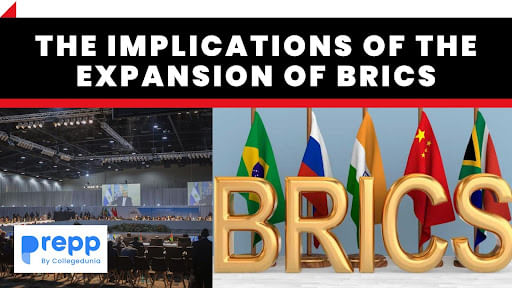
Expansion of BRICS
- BRICS is an acronym for Brazil, Russia, India, China, and South Africa that exists as an annual summit between the leaders of the member countries.
- 40 countries had expressed interest in gaining BRICS membership of which 22 submitted formal applications.
- At the XVth summit at Johannesburg in August 2023, six countries were invited to join the group.
New members
- West Asia: Iran, Saudi Arabia, and the United Arab Emirates (UAE)
- Africa: Egypt and Ethiopia
- Latin America: Argentina
- The expansion of BRICS' is part of the group’s commitment to diversifying its membership and strengthening its global presence.
How does BRICS challenge the Western-Dominated World Order?
- BRICS members have expressed a shared dissatisfaction with the Western-dominated international institutions such as the World Bank, IMF, UN, and its bodies, which were established in the aftermath of World War II.
- BRICS seeks to challenge this order through:
- Intra-BRICS Cooperation: BRICS has aimed to foster economic and political cooperation among BRICS members.
- Building Alternative Institutions: BRICS has suggested the creation of multilateral institutions that are not dominated by the West.
- Multilateral Reforms: BRICS members have been advocating for comprehensive reforms in existing global institutions to ensure that they best represent the interests of emerging economies.
- The BRICS members reject the Western short-sighted view of an emerging global binary divide and the “new cold war”.
- At the Johannesburg summit, the UN Secretary-General described the Western-dominated institutions as reflecting yesterday’s world.
- They have insisted on asserting their strategic autonomy in a multipolar world order to ensure their interests are protected.
What is the significance of the expansion of BRICS?
Economic
- As a result of the addition of the six new members, the economic influence enjoyed by BRICS has increased significantly.
- GDP: BRICS now accounts for 37% of global GDP (in PPP terms), more than the G-7’s share of 30.7%.
- Global Trade: The five core members of BRICS account for 23% of global exports and 19% of global imports which is projected to increase by 3.7% and 3% respectively.
- Energy: The share of BRICS in global output of oil production is expected to increase from 20% to 42% as a result of the inclusion of West Asian nations.
Geo-Strategic
- The addition of new members will increase the grouping’s influence in global politics.
- Saudi Arabia, UAE, and Iran already have strong ties with BRICS members in energy and trade.
- Despite U.S. sanctions, Iran has increased oil production, with much of it going to China.
- Russia which is a major supplier of oil to China and Russia is looking to expand to Brazil.
- Egypt and Ethiopia are strategically important countries which are located in the Horn of Africa and the Red Sea respectively.
- They can thus play a significant role in the trade activities of BRICS nations.
- Argentina is the second-largest economy in Latin America.
Outlook for regional and global affairs
- The new BRICS members are a natural fit into the political and economic framework of BRICS.
- The new members from West Asia have displayed an alignment with the BRICS goals of independent foreign policy making by reducing their dependence on the U.S.A.
- Saudi Arabia ended the Qatar blockade in January 2021 through de-escalation and dialogue and is engaging with Turkey and Iran.
- In March 2023, Saudi Arabia and Iran signed an accord.
- The UAE has also normalized ties with Iran and is focusing on expanding its maritime footprint across the Gulf, the Gulf of Aden, the Red Sea, and the Horn of Africa
- Iran’s entry into BRICS opens up opportunities for accelerated regional economic cooperation in the country.
- This will include the revival of connectivity projects through the Chabahar port in which India holds a significant interest.
Criticism of BRICS
- Divergent National Interests: BRICS members have diverse economic and political priorities, which leads to a conflict of interests among members
- E.g.: The trade-deficit-related disputes between India and China have led to economic tensions within the group.
- Economic Inequalities: The benefits of cooperation are not equitably distributed due to the economic disparities among members.
- E.g. South Africa struggles to compete with larger economies like India and China for investment and trade opportunities.
- Geopolitical Competition: Cooperation among members is impacted by the geopolitical rivalries and regional conflicts among members such as China's territorial disputes in the South China Sea and India’s concerns over freedom of navigation.
- Political Diversity: The governance and diplomatic policies of BRICS countries differ due to the various political systems and freedoms followed.
- E.g.: India, Brazil, and South Africa are democratic systems while Russia and China are less democratic.
- Inadequate Infrastructure: Trade and cooperation between the members has been adversely impacted by the lack of adequate infrastructure and connectivity which hinders the movement of goods and services.
- Institutional Limitations: BRICS institutions such as the NDB are limited in terms of resources, decision-making capacities, and lending ability in comparison to more established institutions like the World Bank.
- Rotation of leadership: The BRICS presidency is rotated annually among the members which impacts the continuity of the group's priorities.
BRICS Institutional Framework
- BRICS has hosted annual summits, and ministerial and expert conclaves since its inception in 2009.
- BRICS has established two major institutions as part of its institutional framework that empowers member nations to collaborate outside Western-dominated institutions.
New Development Bank (NDB)
- The NDB was established as a multilateral development bank to provide development assistance for infrastructure and sustainable development projects in emerging markets and developing countries (EMDCs).
- It was established as part of the BRICS Summit held in Fortaleza in 2014.
- It is headquartered in Shanghai, China, and has regional offices in South Africa and Brazil.
- Members: Brazil, Russia, India, China, South Africa, Bangladesh, UAE, Egypt, and Uruguay.
- Membership is open to members of the United Nations.
- Although the voting power of each member is equal to its subscribed shares in the capital, the share of the BRICS nations can never be less than 55%.
- The NDB has already financed 96 projects valued at $33 billion.
Contingent Reserve Arrangement (CRA)
- The CRA mechanism was established in 2015 to support member countries that are facing short-term balance-of-payments crises and protect against global liquidity pressures.
- The legal basis for the CRA was signed in Fortaleza, Brazil, in 2014.
- It has a total lending capacity of $100 billion.
To know more about the BRICS summit meeting at Johannesburg, click the link.
(*Click this link to read prelims specific weekly current affairs articles)
FAQs
Question: What is BRICS?
Answer:
BRICS is an acronym that refers to a grouping of the world’s leading emerging economies i.e. Brazil, Russia, India, China, and South Africa. It was first called BRIC and was renamed following the addition of South Africa in 2009. It does not exist as an organization but is an annual summit.
Question: What is the Horn of Africa?
Answer:
The Horn of Africa is a peninsula in Northeast Africa and the fourth largest peninsula in the world. It lies along the southern boundary of the Red Sea and extends into the Guardafui Channel, Gulf of Aden, and Indian Ocean. It spreads across countries such as Djibouti, Eritrean Ethiopia, and Somalia and geographies such as the Ethiopian Plateau, the Ogaden desert, and the Eritrean and Somalian coasts.
UPSC Mains Practice Question:
|
MCQs
Question: With reference to a grouping of countries known as BRICS, consider the following statements.
- The First Summit of BRICS was held in Rio de Janeiro in 2009.
- South Africa was the last to join the BRICS grouping.
Which of the statements given above is/are correct? (UPSC CSE 2014)
(a) 1 only
(b) 2 only
(c) Both 1 and 2
(d) Neither 1 nor 2
Answer: (b) See the Explanation
- The first meeting of BRICS members was a meeting between Brazil, Russia, India, and China in Yekaterinburg in 2009. Hence statement 1 is incorrect.
- South Africa became the last member of the BRICS grouping in 2010 and the name of the group was changed from BRIC to BRICS. Hence statement 2 is correct.
Therefore, option (b) is the correct answer.
Question: Consider the following statements:
- New Development Bank has been set up by APEC.
- The headquarters of the New Development Bank is in Shanghai.
Which of the statements given above is/are correct? (UPSC CSE 2016)
(a) 1 only
(b) 2 only
(c) Both 1 and 2
(d) Neither 1 nor 2
Answer: (b) See the Explanation
- The New Development Bank (NDB) is a multilateral development bank established by Brazil, Russia, India, China and South Africa (BRICS) with the purpose of mobilizing resources for infrastructure and sustainable development projects in emerging markets and developing countries (EMDCs). Hence, statement 1 is incorrect.
- The bank is headquartered in Shanghai, China. Hence, statement 2 is correct.
Therefore, option (b) is the correct answer.
Download the PREPP App and attempt FREE IAS Exam Mock Tests and get complete study material!

Full Test - 04: UPSC CSE Prelims CSAT (Paper-II)
Full Test - 03: UPSC CSE Prelims CSAT (Paper-II)
UPSC CSE Prelims 2026 GS Paper 1 Question Paper (24-May-2026)
UPSC CSE Prelims 2026 CSAT Paper 2 Question Paper (24-May-2026)

17 February 2025 | The Hindu Must Read Articles | Current Affairs

16 February 2026 | The Hindu Must Read Articles | Current Affairs

13 February 2026 | The Hindu Must Read Articles | Current Affairs









Comments