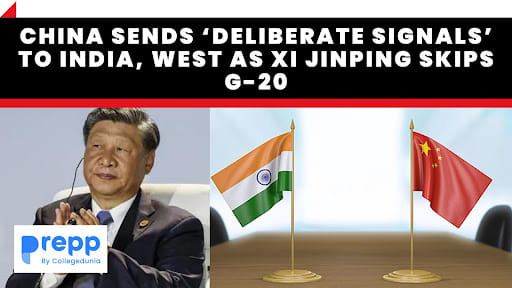
China Sends ‘Deliberate Signals’ To India, West As Xi Jinping Skips G-20
(Source: The Hindu, 09/06/2023)
Click here for Daily Current Affairs
Why in the news?
- Recently, China announced that President Xi Jinping would not be attending the G-20 Summit scheduled to be held in New Delhi on 9th and 10th September, 2023.
- The Prime Minister of China, Li Qiang, will attend the Delhi G-20 summit.
- Experts have described this as China’s way of expressing its displeasure with the status of the Sino-Indian bilateral relationship and what it calls the “politicization” of the grouping.
Table of Contents
What are the factors behind President Xi Jinping’s decision to miss the G-20 Summit?
China's Displeasure with India
- The decision of the Chinese President to not attend the G-20 summit is a reflection of China’s dissatisfaction with the state of its bilateral relations with India.
- It has continuously rejected India’s position that the restoration of peace on the Line of Actual Control (LAC) is essential for normalizing broader bilateral ties.
- Indo-US ties: China is also unhappy with India's growing strategic ties with the U.S.A., which is China's main rival.
- However, the Chinese ministry has rejected the argument that the decision indicates dissatisfaction with India but did not provide any specific reasons behind the decision.
- Beijing expressed its support for India’s presidency and claimed that it attaches great importance to and actively participates in bilateral and multilateral ties.
- According to the Chinese spokesperson, China-India relations have been stable, and dialogue and communication have been maintained at various levels.
Politicization of the G-20
- China has expressed concern at the politicization of the G-20 which should focus on economic issues.
- China has criticized the G-20’s position on the Ukraine crisis.
- The G-20 members have been exerting greater pressure on China, and Russia and criticized their policies.
- Russian President Vladimir Putin’s absence has meant that China will be subjected to greater pressure.
- China prefers the SCO and the BRICS where it is in a better position to influence the agenda and the decisions.
Deliberate signals
- The decision has been interpreted as a deliberate signal to the G-20 and India that China is unwilling to take the first steps to revive the worsening ties between them.
- It is also a signal that China is unwilling to contribute to India’s growing influence as its economy is slowing down in comparison to India’s which is one of the fastest-growing major economies in the world.
East is rising and the West is falling
- The decision could be part of China’s efforts to spread the narrative that the countries of the Eastern Hemisphere are gaining prominence while the West is losing its sheen.
- China’s move could be part of its intent to display solidarity with Russia, whose President Vladimir Putin is also not attending.
Focus on domestic issues
- The immediate focus of the Chinese government and the President is domestic issues such as the economic slowdown and national security.
- Experts have suggested that China is attempting to make foreign leaders visit the country to solidify public perception that it is focussing on domestic concerns.
Why was the decision surprising?
- No previous instance: President Xi Jinping’s decision to miss the summit was surprising as he had attended all the previous summits of the G-20.
- No health issues: He had recently attended a meeting with the President of Benin and a session on key services in trade, indicating that there are no health concerns.
- Chinese protocol: The Chinese system maintains a clear division of responsibility regarding international meetings with the President (Head of State) attending the G-20 and APEC Summits and the Prime Minister (Head of Government) attending the East Asia Summit.
- Normally both attend the SCO where there are separate Head of State and Head of Government meetings.
What are the major complications in India-China ties?
- Border issues: India and China have not been able to resolve their border dispute.
- There have been reported reports of Chinese military incursions and the establishment of military infrastructure along border areas.
- India has repeatedly asserted that peace at the border is essential for the normalization of ties.
- Maps: China recently issued a new “standard map” for 2023 in August that shows the entire State of Arunachal Pradesh and the Aksai Chin region as Chinese territory.
- China had also opposed India holding G-20-related events in Arunachal Pradesh.
- In 2019, Chin had objected to India’s map showing the newly created union territory of Ladakh, despite New Delhi claiming that the map had not changed India’s external borders
- Belt and Road Initiative: India has objected to China’s BRI by claiming that the China-Pakistan Economic Corridor, which passes through PoK, violates its sovereignty.
- Geopolitics: China has opposed India’s permanent membership in the UN Security Council and the NSG.
- India has expressed concern about Chinese expansionism and aggression in the neighborhood and the Indian Ocean Region.
- China’s strategic bilateral relations with Pakistan are another major concern for India.
- Trade: The India-China trade relationship is heavily imbalanced in favor of China.
- India’s trade deficit with China is expected to rise from $73.3 billion in 2021-22 to around $100 billion in FY23 and accounts for 38-40% of India's total merchandise trade deficit.
- The government has also banned Chinese apps on the basis of the emergent nature of threats to the country.
G-20
|
(*Click this link to read prelims specific weekly current affairs articles)
FAQs
Question: What is geopolitics?
Answer:
Geopolitics refers to the study of the effects of Earth's geography, including its physical and human aspects, on politics and international relations. It is focused on the links between political power and geographic space such as territorial waters and territory in relation to diplomatic relations.
Question: What is the Belt and Road Initiative?
Answer:
The Belt and Road Initiative (BRI) is an investment program for infrastructure development and economic integration of countries along the historic Silk Road. It is a transcontinental approach that was announced by China in 2013 by China and was previously known as the One Belt One Road initiative.
UPSC Mains Practice Question:
|
MCQs
Question: In which one of the following groups are all four countries members of G20? (UPSC CSE 2020)
(a) Argentina, Mexico, South Africa and Turkey
(b) Australia, Canada, Malaysia and New Zealand
(c) Brazil, Iran, Saudi Arabia and Vietnam
(d) Indonesia, Japan, Singapore, and South Korea
Answer: (a) See the Explanation
The G-20 is an informal group of 19 countries and the European Union, with representatives of the International Monetary Fund and the World Bank.
- Its members include Argentina, Australia, Brazil, Canada, China, France, Germany, India, Indonesia, Italy, Japan, Mexico, Republic of Korea , Russia, Saudi Arabia, South Africa, Turkey, the United Kingdom, the United States and the European Union (EU).
- Singapore, Vietnam, and Malaysia are not members of the G-20.
Therefore, option (a) is the correct answer.
Download the PREPP App and attempt FREE IAS Exam Mock Tests and get complete study material!

Full Test - 04: UPSC CSE Prelims CSAT (Paper-II)
Full Test - 03: UPSC CSE Prelims CSAT (Paper-II)
UPSC CSE Prelims 2026 GS Paper 1 Question Paper (24-May-2026)
UPSC CSE Prelims 2026 CSAT Paper 2 Question Paper (24-May-2026)

17 February 2025 | The Hindu Must Read Articles | Current Affairs

16 February 2026 | The Hindu Must Read Articles | Current Affairs

13 February 2026 | The Hindu Must Read Articles | Current Affairs









Comments