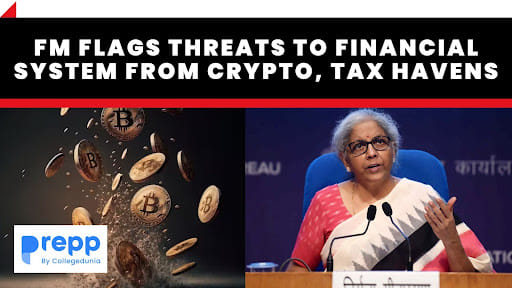
FM Flags Threats To Financial System From Crypto, Tax Havens
Relevance: GS3 - Indian Economy and issues relating to planning, mobilisation of resources, growth, development and employment; Internal Security – Challenges to internal security through communication networks
(Source: The Hindu, 09/06/2023)
Click here for Daily Current Affairs
Why in the news?
Recently, Union Finance & Corporate Affairs Minister Nirmala Sitharaman addressed delegates at the Global Fintech Fest 2023 in Mumbai, emphasizing the importance of recognizing and countering global threats to the financial ecosystem.
Table of Contents
What is Fintech?
- Fintech refers to the innovative use of technology to enhance and automate the delivery of financial services.
- This encompasses various areas within the financial sector, such as retail banking, investment, and even emerging technologies like cryptocurrencies and decentralized finance (DeFi).
- Fintech aims to improve financial services, increase accessibility, and promote financial literacy and education.
- Fintech in India: India’s fintech ecosystem is based on the four pillars of income, investment, insurance, and institutional credit. Over the past few years, there has been a massive adoption of digital transactions in India.
Global Fintech Fest (GFF) 2023
- GFF is the largest fintech conference, jointly organized by the National Payments Corporation of India (NPCI), the Payments Council of India (PCI), and the Fintech Convergence Council (FCC).
- With GFF, the aim is to provide a singular platform for fintech leaders to foster collaborations and develop a blueprint for the future of the industry.
- GFF 2023, the fourth edition of the conference, is taking place from September 5 to 7, 2023 at the Jio World Centre in Mumbai.
Major threats Recognized by the Finance Minister to the Global Financial Ecosystem
- Cyber Threats: The significance of cybersecurity was emphasized and urged fintech companies to invest heavily in advanced encryption and security measures to protect user data and financial transactions.
- Cryptocurrencies: It was pointed out that cryptocurrencies present both opportunities and threats, underscoring the importance of regulating and handling crypto assets. It was mentioned that consultative papers on crypto are being discussed, and the International Monetary Fund (IMF) and Financial Stability Board (FSB) have released synthesis papers on the topic.
- Drug Mafias: The minister highlighted the threat posed by drug wars and drug mafias to the financial ecosystem, suggesting that addressing this issue is essential.
- Tax Havens and Evasion: Concerns were raised about tax havens, resource round-tripping, and tax evasion as challenges that need to be tackled on a global scale.
Key Points on India's Wealth Creation and Financial Ecosystem
- Demat Accounts: It was highlighted that the growth in demat accounts, noting that the number increased by 2.5 times, from 4.1 crore in 2019-20 to 10 crore in 2022-23. This expansion signifies increased participation in financial markets.
- Mutual Funds and SIPs: Sitharaman mentioned the record number of mutual funds and Systematic Investment Plans (SIPs) being registered, emphasizing their role in wealth generation. The trend of smaller cities contributing significantly to India's mutual fund assets, indicating financial inclusion beyond metropolitan areas was also mentioned.
- Cryptocurrencies: The Finance Minister reiterated India's stance on cryptocurrencies, emphasizing the need for global cooperation and a regulatory framework to address the challenges posed by cryptocurrencies. She stressed the importance of responsible regulation in the absence of existing regulations for crypto assets in India.
- Nomination of Heirs: It was urged that the banks and financial institutions encourage customers to nominate heirs, which can help reduce unclaimed money in the financial system. This initiative promotes financial planning and ensures the smooth transfer of assets to beneficiaries.
- Income Tax Returns (ITR): The Finance Minister highlighted the significance of the recently released Income Tax Return (ITR) data for August. It was noted that a substantial increase in tax filing across all income brackets, with some brackets experiencing a fourfold surge. This reflects enhanced tax compliance and broader participation in the tax system.
India's Role and Priorities
- India's role in promoting a responsible, inclusive, resilient, and sustainable financial ecosystem was emphasized.
- The Finance Minister highlighted India's priority to enhance cross-border payment arrangements due to the significant volume of remittances to the country.
- Under India's G20 Presidency, the focus is on seeking global cooperation and collaboration, particularly in areas like crypto asset regulation and framework development.
Significance of Fintech Industry
- In India, the fintech industry plays a pivotal role in shaping a responsible financial ecosystem, driving greater financial inclusion, and exerting influence on the country's financial landscape.
- According to a 2022 BCG Matrix Report, fintech companies have gained a significant presence in lending, a traditional banking domain, capturing a 36% share of new-to-credit customers compared to the 22% share held by traditional brick-and-mortar banks.
- This illustrates the fintech sector's ability to extend its reach even in areas historically dominated by conventional banking institutions.
(*Click this link to read prelims specific weekly current affairs articles)
FAQs
Question: What is Fintech?
Answer:
Fintech refers to the innovative use of technology to enhance and automate the delivery of financial services. Fintech aims to improve financial services, increase accessibility, and promote financial literacy and education.
Question: What is Global Fintech Fest (GFF)?
Answer:
It is the largest fintech conference, jointly organized by the National Payments Corporation of India (NPCI), the Payments Council of India (PCI), and the Fintech Convergence Council (FCC).
Question: What is Cryptocurrency?
Answer:
Cryptocurrency or crypto-currency or crypto means online money created using digits or digital encryptions. A cryptocurrency is an internet-based medium of exchange that is distributed across many computers. A cryptocurrency conducts financial transactions using cryptographic functions.
UPSC Mains Practice Question:
|
MCQ
Question: Which of the following is a most likely consequence of implementing the Unified Payments Interface (UPI)? (UPSC 2017)
(a) Mobile wallets will not be necessary for online payments.
(b) Digital currency will totally replace physical currency in about two decades.
(c) FDI inflows will drastically increase.
(d) Direct transfer of subsidies to poor people will become very effective.
Answer: (a) See the Explanation
Mobile wallets will not be necessary for online payments. UPI allows you to pay directly from your bank account to different merchants without the hassle of typing your card details, or net banking/wallet password.
Therefore, option (a) is the correct answer.
Download the PREPP App and attempt FREE IAS Exam Mock Tests and get complete study material!

Full Test - 04: UPSC CSE Prelims CSAT (Paper-II)
Full Test - 03: UPSC CSE Prelims CSAT (Paper-II)
UPSC CSE Prelims 2026 GS Paper 1 Question Paper (24-May-2026)
UPSC CSE Prelims 2026 CSAT Paper 2 Question Paper (24-May-2026)

17 February 2025 | The Hindu Must Read Articles | Current Affairs

16 February 2026 | The Hindu Must Read Articles | Current Affairs

13 February 2026 | The Hindu Must Read Articles | Current Affairs









Comments