In Second Action By ISTRAC, Aditya-L1 Enters New Orbit
Relevance: GS3 - Awareness in the fields of IT & Space
(Source: The Hindu, 09/06/2023)
Click here for Daily Current Affairs
Why in the news?
- Recently, Aditya L1, India's pioneering space mission dedicated to studying the Sun, has successfully completed its second earth-bound manoeuvre, marking a crucial step in the mission's progress.
- The manoeuvre, known as the "second Earth-bound manoeuvre," was executed by ISRO's Telemetry, Tracking, and Command Network (ISTRAC) located in Bengaluru.
Table of Contents
About the Mission
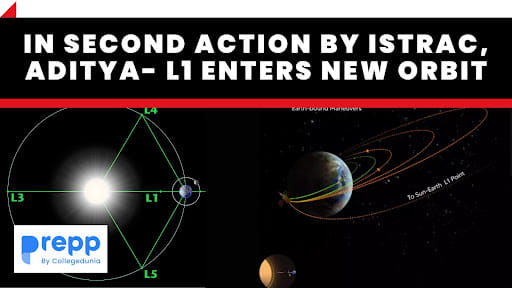
- Aditya-L1, India's space observatory, is specifically designed for solar studies. It orbits the Sun-Earth Lagrangian point L1, situated about 1.5 million kilometers from Earth.
- Launched on September 2, 2023, via ISRO's Polar Satellite Launch Vehicle (PSLV-C57) from Sriharikota's Satish Dhawan Space Centre (SDSC), Aditya-L1 marks a significant achievement in India's space exploration efforts.
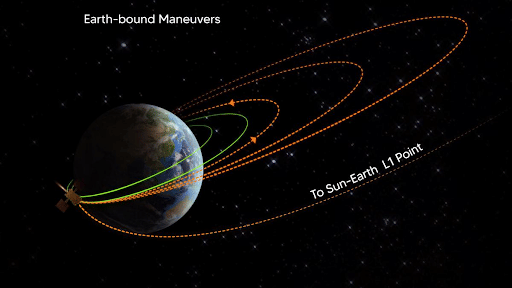
- Its journey began successfully with the first Earth-bound maneuver, and two more such maneuvers are planned before it reaches its final destination, L1, in approximately 127 days.
Objective
- The primary objective of the Aditya L1 mission is to study the Sun's upper atmospheric layers, specifically the chromosphere and corona.
- The mission will also examine coronal mass ejections (CMEs), large expulsions of plasma and magnetic fields from the Sun’s corona, and analyse the corona’s magnetic field, the driver of space weather.
Payloads
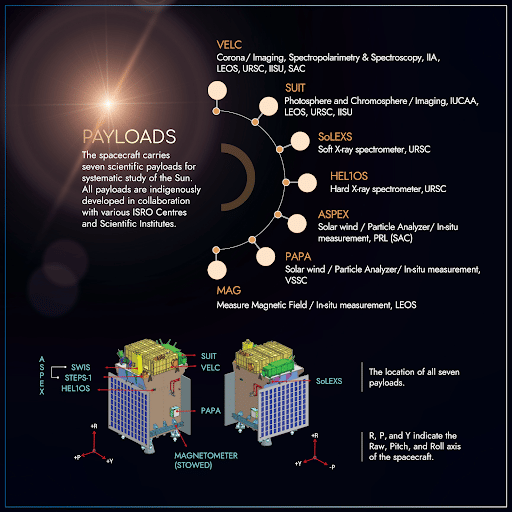
- Visible Emission Line Coronagraph (VELC), Solar Ultraviolet Imaging Telescope (SUIT), Solar Low Energy X-ray Spectrometer (SoLEXS), High Energy L1 Orbiting x-ray Spectrometer (HEL1OS), Aditya Solar wind Particle Experiment (ASPEX), Plasma Analyser Package for Aditya (PAPA), and Advanced Tri-axial High Resolution Digital Magnetometers.
What does Aditya L1's orbit raising maneouver mean?
- Aditya-L1's orbit-raising maneuver is a crucial step in its mission to study the Sun. It involves using propulsion systems to increase the satellite's orbit gradually. This process includes firing rockets and adjusting angles.
- Once Aditya-L1 gains enough velocity, it will follow its intended path towards the L1 point near the Sun.
- The satellite will remain in Earth orbit for 16 days, during which five orbit-raising maneuvers will be conducted to achieve the required velocity.
- After these maneuvers, Aditya-L1 will start its 110-day journey to the L1 point near the Sun.
- To reach the L1 point, Aditya-L1 will undergo a trans-Lagrangian1 insertion maneuver, which will inject it into a stable halo orbit around Lagrangian Point 1.
- This point is where the gravitational forces of the Earth and Sun balance each other, providing stability to the satellite.
- Aditya-L1 will be positioned 1.5 million km away from Earth, directed toward the Sun, allowing it to study the Sun's outer atmosphere.
- This mission is expected to take approximately four months to cover the distance.
What is L1?
- The Lagrange point L1 resides roughly 1.5 million km from Earth and enables continuous solar observation through unobstructed halo orbit movement.
- There are five Lagrangian points between Earth and the Sun, where objects can maintain stable positions with minimal fuel consumption.
- They were first described by Joseph-Louis Lagrange in his influential 1772 paper, "Essai sur le Probleme des Trois Corps."
- These Lagrange points provide spacecraft with a valuable advantage, enabling them to conserve fuel while staying in a stable position where the gravitational forces of the Sun and Earth are precisely balanced by the necessary centripetal force.
- Aditya L1's mission aims to capitalize on this unique vantage point, offering unprecedented insights into the Sun and its activities.
Lagrange Points in the Sun-Earth System
- L1: Ideal for solar observations; offers continuous Sun viewing. It is currently home to the Solar and Heliospheric Observatory Satellite (SOHO).
- L2: It is positioned directly 'behind' Earth as viewed from the Sun and is excellent for observing the larger Universe without Earth's shadow interference. The James Webb Space Telescope orbits the Sun near L2.
- L3: It is positioned opposite Earth behind the Sun; potential for observing the far side of the Sun.
- L4 and L5: Stable positions forming an equilateral triangle with Earth and Sun. Used for space observatories, especially for asteroid studies.
(*Click this link to read prelims specific weekly current affairs articles)
FAQs
Question: What is Aditya L-1 mission?
Answer:
Aditya-L1, India's space observatory, is specifically designed for solar studies. It orbits the Sun-Earth Lagrangian point L1, situated about 1.5 million kilometers from Earth.
Question: What is the objective of the mission?
Answer:
The primary objective of the Aditya L1 mission is to study the Sun's upper atmospheric layers, specifically the chromosphere and corona. The mission will also examine coronal mass ejections (CMEs), large expulsions of plasma and magnetic fields from the Sun’s corona, and analyse the corona’s magnetic field, the driver of space weather.
Question: What is ISRO?
Answer:
Indian Space Research Organization (ISRO) was established on 15 August 1969. It is the national space agency of India. It launched its space rocket from the Satish Dhawan Space Center in Sriharikota, Andhra Pradesh.
UPSC Mains Practice Question:
|
Download the PREPP App and attempt FREE IAS Exam Mock Tests and get complete study material!

Full Test - 04: UPSC CSE Prelims CSAT (Paper-II)
Full Test - 03: UPSC CSE Prelims CSAT (Paper-II)
UPSC CSE Prelims 2026 GS Paper 1 Question Paper (24-May-2026)
UPSC CSE Prelims 2026 CSAT Paper 2 Question Paper (24-May-2026)

17 February 2025 | The Hindu Must Read Articles | Current Affairs

16 February 2026 | The Hindu Must Read Articles | Current Affairs

13 February 2026 | The Hindu Must Read Articles | Current Affairs









Comments