BRICS Summit
Relevance: GS2 - Bilateral, regional and global groupings and agreements involving India and/or affecting India’s interests.
(Source: Indian Express, The Hindu, 08/24/23)
Click here for Daily Current Affairs
Why in the news?
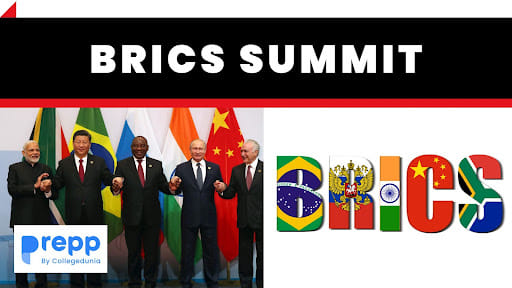
Recently, The BRICS group of major emerging economies - Brazil, Russia, India, China, and South Africa conducted a government summit in Johannesburg between Aug. 22 and Aug. 24.
Table of Contents
Why BRICS isn't NAM?
- It is inaccurate to claim that BRICS is similar to NAM on the basis that the presence of several friends of BRICS, and special invitees from Africa makes the Johannesburg summit similar to the Bandung Conference.
- The first large-scale Asian–African or Afro–Asian Conference also known as the Bandung Conference was a meeting of Asian and African states, most of which were newly independent, which took place on 18–24 April 1955 in Bandung, West Java, Indonesia.
- The conference aimed to promote Afro-Asian economic and cultural cooperation and to oppose colonialism or neocolonialism by any nation.
- While the NAM aimed to distance itself from both the U.S.-dominated Western and USSR-dominated Eastern blocs BRICS is led by the Sino-Russian alliance.
- Challenging Western dominance: China and Russia's motives are evident in their push to transform BRICS from a platform for multipolarity and opposition to unipolarity into a platform challenging Western dominance.
- China’s ascent: With China's rise as the world's second-largest economy and increased influence in the Global South, the notion of Chinese capital as altruistic and benign comes under scrutiny. Critics argue that China's economic forays might be akin to neocolonialism and worse than Western imperialism, causing apprehensions in developing countries.
- Against the objective of equitable development: The Non-Aligned Movement (NAM) and the Global South aimed to address disparities between developing and developed nations, not engage in East-West rivalry. This transformation contradicts the original spirit of the Global South and its quest for equitable development.
Which nations want to join BRICS and why?
- More than 40 countries, including Iran, Saudi Arabia, United Arab Emirates, Argentina, Algeria, Bolivia, Indonesia, Egypt, Ethiopia, Cuba, Democratic Republic of Congo, Comoros, Gabon, and Kazakhstan expressed interest in joining the forum.
- Argentina, Egypt, Iran, Saudi Arabia, Ethiopia, and UAE have been welcomed into the BRICS grouping and will become members from 2024.
- The addition of the new members is expected to bring new dynamism and energy to BRICS and build confidence in the idea of a multipolar world order.
- The addition of Iran, Saudi Arabia, and the UAE is significant as the three countries represent the major factions of the energy-rich Gulf.
- Although India was initially not in favor of such rapid expansion, it took the lead in determining the membership criteria and expressed hope that it would bolster the push for UN reform i.e. expansion of the UNSC and improved representation for the Global South.
Reasons for joining
- As an Alternative: They view BRICS as an alternative to global bodies viewed as dominated by the traditional Western powers and hope membership will unlock benefits including development finance, and increased trade and investment.
- Many countries aim to bolster their bargaining power by aligning themselves with the BRICS group.
- Dissatisfaction with global order: Dissatisfaction with the global order among developing nations was exacerbated by the COVID-19 pandemic when life-saving vaccines were hoarded by rich countries.
- Diversification and de-dollarisation: Bolivia wants to reduce dependence on the U.S. dollar for foreign trade, instead turning to the Chinese yuan and Algeria seeks to diversify its economy and strengthen partnership with China and other countries.
Concerns
- Political intentions of China: The expansion of BRICS membership is driven by China's political intentions to mobilize non-Western nations in rivalry with the US. China aims to leverage BRICS for bilateral compacts with the US, thereby enhancing its bargaining power.
- China played a major role in the Saudi-UAE and Iran peace deal which facilitated their addition to the BRICS group.
- Although this has raised concerns about India having to lobby harder to make its vote count India could benefit from most of the new members being its strategic partners.
- Absence of common values: Unlike some other alliances, BRICS lacks a clear set of common political values. Its primary motivation is to counterbalance the West's dominance, but beyond that, the member countries have varying interests and priorities.
- Developmental Focus without Clear Alternatives: The BRICS positioned itself as a development-oriented group without offering concrete alternatives to the existing global system. The developmental vision of the BRICS is underdeveloped.
- Research and innovation: Research spending is decreasing as a percentage of GDP in most BRICS countries, except China. This reduction threatens the effectiveness of rebalancing efforts without research innovation.
- BRICS Expansion: The push to expand the BRICS group might impact its effectiveness. It can undermine group coherence. Larger membership often reduces shared goals and can lead to managing numerous bilateral differences, as seen in SAARC and SCO.
Other outcomes of the Summit
- Johannesburg Declaration: It reiterated the BRICS commitment to inclusive multilateralism and upholding international law, including the purposes and principles enshrined in the United Nations Charter.
- It cited Ukraine and stressed the need for the peaceful resolution of differences and disputes through dialogue and inclusive consultation.
- Stronger multilateralism and global multipolarity require strong and effective multilateral institutions.
- Aside from the main BRICS events, Prime Minister Narendra Modi conducted bilateral meetings with delegations from Senegal, Mozambique, Ethiopia, and Iran.
- He invited the participants of the BRICS-Africa Outreach and BRICS Plus dialogue session to join the International Solar Alliance, One Sun, One World, One Grid, Coalition for Disaster Resilient Infrastructure, One Earth, One Health; Big Cat Alliance and Global Centre for Traditional Medicine.
- The BRICS member countries also expressed their full support to Russia which is scheduled to chair and host the 2024 edition of the BRICS summit in Kazan.
What Is BRICS?
BRICS' major accomplishments
To know more, click the link. |
(*Click this link to read prelims specific weekly current affairs articles)
FAQs
Question: What is NAM?
Answer:
The Non-Aligned Movement, or NAM, is a major international organization in which India has played a key role since its founding. The NAM was established at the Belgrade Conference in 1961 under the Presidency of Josip Broz Tito of Yugoslavia. It's been 60 years since the formation of NAM.
Question: What is a New Development Bank?
Answer:
The New Development Bank (NDB) is a multilateral development bank established by Brazil, Russia, India, China, and South Africa (BRICS) with the purpose of mobilising resources for infrastructure and sustainable development projects in emerging markets and developing countries (EMDCs). The bank is headquartered in Shanghai, China.
Question: Who are the founding members of BRICS?
Answer:
Brazil, Russia, India and China are the founding members.
UPSC Mains Practice Question:
|
MCQ
Question: Consider the following statements: (UPSC-2016)
- New Development Bank has been set up by APEC.
- The headquarters of New Development Bank is in Shanghai.
Which of the statements given above is/are correct?
(a) 1 only
(b) 2 only
(c) Both 1 and 2
(d) Neither 1 nor 2
Answer: (b) See the Explanation
- The New Development Bank (NDB) is a multilateral development bank established by Brazil, Russia, India, China and South Africa (BRICS) with the purpose of mobilising resources for infrastructure and sustainable development projects in emerging markets and developing countries (EMDCs). Hence, statement 1 is incorrect.
- The bank is headquartered in Shanghai, China. Hence, statement 2 is correct.
Therefore, option (b) is the correct answer.
Download the PREPP App and attempt FREE IAS Exam Mock Tests and get complete study material!

Full Test - 04: UPSC CSE Prelims CSAT (Paper-II)
Full Test - 03: UPSC CSE Prelims CSAT (Paper-II)
UPSC CSE Prelims 2026 GS Paper 1 Question Paper (24-May-2026)
UPSC CSE Prelims 2026 CSAT Paper 2 Question Paper (24-May-2026)

17 February 2025 | The Hindu Must Read Articles | Current Affairs

16 February 2026 | The Hindu Must Read Articles | Current Affairs

13 February 2026 | The Hindu Must Read Articles | Current Affairs









Comments